
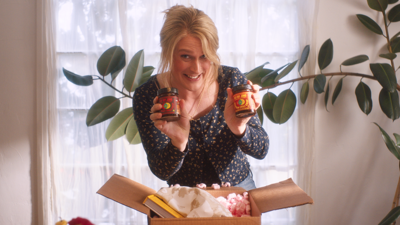

There’s a moment in Maddie’s Secret, the directorial debut from comedian and Nashville native John Early, when a group of eating disorder patients watches a mukbang — a type of online eating video popularized in the 2010s. They giggle between flashes of saucy fingers disappearing into an on-screen mouth, yelling “ew!” like they’re watching something filthy. It’s sweet and strange, and a little sad — and it’s very camp.
Maddie’s Secret is a dark dark comedy, following chef Maddie Ralph as her career at a food content company skyrockets while she battles bulimia. As a satire, it makes its targets rich and precise: TV movies, culinary influencers, our psychosexual relationships with social media and food. It’s part of it that Early plays Maddie — but it’s never the punchline.
Early caught up with the Scene about the film ahead of its opening at the Belcourt. Our conversation has been edited for length and clarity.
The visual language of this movie is so specific. What was on your Maddie’s Secret mood board?
We were looking at TV movies from the ’70s, ’80s and ’90s. What I really admire about those is that the priority is hooking people immediately, so that they don’t change the channel. There’s a directness in the visual language, and a kind of emotional clarity.
Perhaps a little more pretentiously, we were also looking at lush ’50s melodramas. We were looking at Adrian Lyne. ... Brian De Palma, Hitchcock. The camera movement of Paul Verhoeven and Showgirls was a huge influence. Muriel’s Wedding is always my North Star.
You’ve previously mentioned the TV movie Kate’s Secret, which is also about a woman with bulimia. The bingeing shots there are very clinical. But they’re so close-up and gross in Maddie’s Secret, and you really watch the eating in a carnal way.
“Carnal” is the word that I would always give the designers. This movie is deliberately trying to make a connection between food and sex. I think that that was part of why we wanted to get up-close.
I have noticed a very sexual quality to homemade food Instagram and TikTok videos. There’s just something brazen about the sound effects and the angles. It’s like everything’s becoming porn or something.
Who are some of your favorite food influencers — or the ones you’re most fascinated by?
Everyone who was and is in the Bon Appetit test kitchen. That’s where it started for me and many other people, I think — this certain kind of food obsession, and a parasocial relationship with the chefs making the food.
There’s one [other] woman I’m obsessed with. I genuinely love her recipes. She also formerly was, like, a weapons manufacturer, and there’s something very tragicomic [about it]. Whenever she does an “Ask Me Anything,” people confront her about her past. There’s this very cozy relationship that I feel that I have with her, and then suddenly she’ll be in these arguments with random people on Instagram. The theater of that has been fun to watch.
Walk me through the decision to play Maddie.
I just was really chomping at the bit to play a kind of angelic person, who everyone around them is going, “God, you’re perfect, you’re beautiful.” It felt like a character who almost [doesn’t] exist anymore: this optimistic, openhearted ingénue.
It required a level of commitment on everyone’s part. I think that endows it with a magical quality, because there’s this illusion at the center of the movie that’s kind of glowing, and it made us all care more about successfully achieving the illusion. And then I also think, because I’m a man playing a woman, there is this potential for it to feel mocking. We’re not making that choice — it’s a razor’s edge, but we’re always choosing to be sincere and tender about it.
This movie has a very strange personal quality that I can’t even really explain. This is not my life. I am not a woman. I’ve never had an eating disorder. My mom is an angel, and let’s definitely put that on record in the Nashville Scene. The movie could not be further removed from my life, and yet it has a strange personal quality, and I think that just comes from this meeting between me and this archetype.
It’s unlike the characters you’ve played in the past. What’s drawing you to ingénues right now?
It’s exactly what you’re saying. I approach all my characters with sincerity, but a lot of the time I’m playing characters who have a certain contemporary, internet-bred irony. I have to embody these guards that they have up.
In both life and in art, I feel hunger for a certain kind of directness. For as long as I’ve been on social media, I’ve felt this vague pressure to be the smartest person in the room, and I’m tired of that. I wanted to make something where I could be dumb and openhearted. I don’t think Maddie is dumb, but the movie itself has a blunt, careening sincerity, which is how I feel. I feel like a bull in the china shop, the china shop of the internet, you know?
There’s a hospital in the film called Presbyterian, and you grew up going to Second Presbyterian Church in Nashville. Is there a connection there?
It’s kind of my subtle way of acknowledging that I am Maddie. Maddie actually earned her good-girl persona. She rose from the ashes of her childhood to become a beautiful angel. But I grew up among the beautiful angels of Second Presbyterian. And I think [it’s] maybe a way of reassuring Maddie: “Just go. Go to the program, they’ll take care of you.”
The last time you spoke with the Scene, you said you felt “allergic to the pressure of queer representation” in your work. What’s your relationship with that pressure now?
I guess I’m less cranky. I mean, this movie is a reflection of that. This movie is me yielding to my schmaltzy core. When I started writing it, it actually was a little bit edgier and more angry, and there was more cultural commentary, but the movie just kept wanting to be tender.
There is a real algorithmic chokehold on the idea of representation. ... And there is no one queer experience. That is, I think, part of the source of my anger, when people [have] asked me to speak to how my work is addressing the queer experience. I’m like, “What is the queer experience? I don’t even know what my experience is.”
This goes back to the social media conversation in the film. There’s that moment where the dishwasher [says] to Maddie: “It’s so great to see an actually healthy person making [culinary] content.”
I put that moment in there because I was trying to address, very quickly, the prison of representation. The tone of body positivity, it’s right in the name: It’s positive. It’s a necessary correction for some of our cultural ills, but it’s tonally so limiting. What do you do with your irrational feelings of disgust towards yourself?
That’s part of what was so cathartic for me about this movie: I don’t feel like it’s socially acceptable to feel bad about myself. It is very cathartic for me to tap into these older, more archaic modes of expressiveness — to go, “Mother, I’m hideous!”



Post a comment as anonymous
Report
Watch this discussion.
(0) comments
Welcome to the discussion.
Log In
Welcome to the discussion.
Keep it clean. Please avoid obscene, vulgar, lewd, racist or otherwise abusive language. Comments featuring hate speech or threatening or violent content will not be tolerated.
PLEASE TURN OFF YOUR CAPS LOCK.
Be truthful. Don't knowingly lie or mislead.
Be proactive. Use the “report” link on any comment that violates our comment policy.
Share with us. We'd love to hear your feedback.