
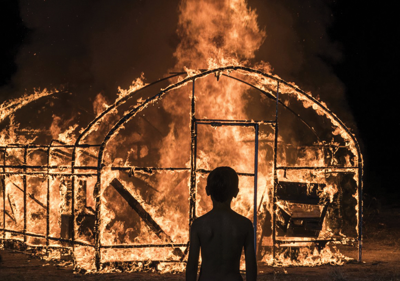

Even before its release, Burning garnered a lofty reputation, having earned a higher critics’ jury score at this year’s Cannes Film Festival than any film in years. From South Korean director Lee Chang-dong, one of the masters of contemporary world cinema, the film is a thriller of deconstructed suspense. It features three spiritually off-the-rails characters who wander, disconnected, into the most ambiguous of moral landscapes.
Burning is also the rare film that successfully adapts a work by Japanese author Haruki Murakami — in this case, the short story “Barn Burning” from his 1993 collection The Elephant Vanishes. Seeing as how the film is inspired by a Murakami work, that means there will be a mystery, there may be a lot of cigarette smoking at night, and there most definitely will be a cat that may or may not actually exist — and then there will be yet another cat who does exist, but is lost and then found (and in very magical and cute fashion, I might add). Lee is a skilled adaptor, and Burning marks his triumphant return as director eight years after the excellent Poetry.
Yoo Ah-in plays the young and spaced-out Jong-soo, who’s opposite Ben (The Walking Dead’s Steven Yeun) in a love triangle with Shin Hae-mi (breakout newcomer Jeon Jong-seo), an old friend of Jong-soo. To elaborate on who these characters are or how they meet would reveal too much of Lee’s method and mystery. In one of the scenes she steals, Shin pantomimes peeling an invisible tangerine — that’s just one of many instances in which characters offer up a binary, the real juxtaposed with the imagined. There’s a trip to Africa that perhaps never happened; a greenhouse that was never burned; the aforementioned cat. What actually happened, and what do we make up in our minds?
Burning should be experienced on the big screen, where everyday sights and sounds seem to be summoned from some dreamlike underworld. One scene in particular — perhaps the most transcendent scene of the year — seemingly aims to top every virtuosic long take that auteurs like Alfonso Cuarón and Carlos Reygadas have filmed. But it’s not just for show: Putting us in the real-time lived experience of these three protagonists at an apocalyptic magic-hour smoke-up — a scene that took three weeks to shoot — Lee needle-drops one of the most recognizable (at least to arthouse audiences) soundtracks from movies past. He envelops us in an utterly sublime sunset, and then leaves us there in anticlimactic silence, stranded. There’s no moment of clarity, connection or redemption, but that seems to be the entire point. Like Luca Guadagnino’s recent bold reimagining of Suspiria, Lee’s narrative of aimless youth doubles down on the existential nihilism that comes with being alive in 2018.
Burning ultimately morphs into the tragic thriller you just know it’s going to become. It’s called Burning, after all, and the burn is a slow one. It clocks in at two-and-a-half hours, but there is no fat to be trimmed, and you’ll have a hard time finding a spot for a bathroom break — at any moment, a new piece of the puzzle could be revealed, or all that tension might finally reach a breaking point. Lee’s patient narrative is akin to that of a long, languid detective novel you just can’t put down, where you know something terrible is going to happen. What happens, and how it slowly comes to happen, is a mystery to savor piece by piece.



