

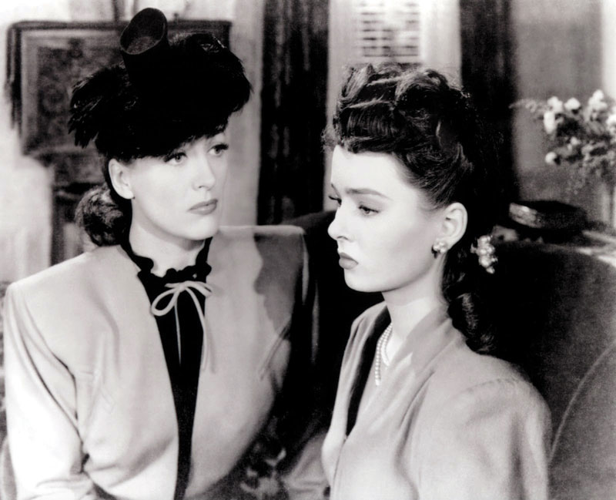
The Belcourt, seizing an opportunity for a little comparison shopping in film history, has the good sense to offer a gift-wrapped box of poison for Mother's Day: Michael Curtiz's 1945 film adaptation of James M. Cain's "hard-boiled melodrama" Mildred Pierce. The booking comes hot on the heels of HBO's five-part miniseries starring Kate Winslet as the titular heroine, a self-sufficient single mom struggling to make ends meet at the height of the Great Depression.
The Curtiz version was a midcareer triumph for Joan Crawford, whose eyebrows semaphore distress as she plays a self-sacrificing mother who becomes a successful businesswoman, taken for granted at every step by her spoiled daughter. The remake — by director Todd Haynes, who provided a similar dissection of the "woman's picture" in his Douglas Sirk pastiche Far from Heaven — rereads Cain's novel through the lens not only of current history but of film history (the earlier film, as well as the analytical melodramas of Sirk and R.W. Fassbinder).
Together, they make a fascinating matched set — a classic black-and-white slice of high-contrast Hollywood noir, and its languid, more coolly appraising mirror image in burnished color. It's fun to compare Crawford's harder interpretation with Winslet's more open vulnerability: Crawford's sexuality is much more subsumed within Mildred's overall struggle to define her steely independence, while Winslet's Mildred seems much more susceptible to the ways the dominant conventions of the time assail her soul.
To see Mildred 1.0 today, however, is no mere exercise in media excavation or social studies. Maybe it's not a semiotic analysis of social conditions, in the manner of Haynes. But it is a singular film — a masterpiece that examines, with brutal frankness, the limits of maternal love and sacrifice. It'll put you through the wringer, all right.
The films, of course, have different historical circumstances and agendas. (Haynes' miniseries deserves to be called a "film," since its style, pacing, and pedigree place it more in the tradition of extended cinematic works customarily made for European television, such as Olivier Assayas' Carlos or Raúl Ruíz's upcoming Mysteries of Lisbon.) Part of what attracted Haynes to the material, clearly, was its engagement with the Depression and how it might resonate with the ongoing effects of the 2008 economic crisis. How do once-stable class and gender identities come unmoored? How can we think critically about an individual's need to improvise solutions, on the one hand, when she's running up hard against unyielding class and social strictures on the other?
Winslet's Mildred, as a "grass widow" (i.e., a married woman facing divorce), is implicitly blamed by her daughter Veda (played as an adult by Evan Rachel Wood) for turning out her cheating husband Bert (Brían F. O'Byrne). This leads, at least in Veda's eyes, to an intolerable demotion in class. In this sphere, actually working for a living is revolting — the stuff of inferiors. But Haynes is able to step back and demonstrate the frameworks which neither Veda nor Mildred can see — namely, that the world around them is stuck in a modernist dichotomy of art against craft. Veda's musical talent appears virtually God-given, for example, where Mildred's astonishing gifts as a baker are crass, demeaning labor.
A deconstructionist who aspires to the direct appeal of a four-hankie weeper, Haynes highlights social action in broad strokes, even as he plunges into the heartbreak of a woman convinced by the vipers around her she will never be good enough. But Curtiz, who also directed Casablanca, is more of a button-pusher than an intellectual. His greatest gift as a helmer is getting out of the way of his cast and script (co-written by an uncredited William Faulkner). Needless to say, the shorter, faster 1945 version is haunted by the living memory of Hoovervilles and soup kitches, and as such it packs a more potent emotional punch.
His Mildred begins with the shooting death of her second husband, playboy Monte Beragon (Zachary Scott), then moves into the police interrogation that serves as the frame story. We see Mildred and Bert's split, Mildred selling pies for cash, her attempt to conceal her waitressing job from the judgmental Veda, and the eventual opening of her own restaurant, which leads to vastly improved financial circumstances. As Veda never fails to point out, however, Mildred's work ethic and class background always undermine her efforts to improve. (This image of Woman as the Rise of the Middle Class makes Mildred an older sister to Fassbinder's Maria Braun, the goddess of West Germany's Economic Miracle.)
Shot through with noirish shadows, spaces of decadent wealth, and a general sense of decency bobbing hopelessly within a sea of vile desperation, Curtiz's Pierce is a true hybrid work. Feminist scholars have rightly embraced it as a study in maternal dysfunction and the melodramatic double-bind, even as its organization and bad-seed characterization of Veda place it squarely in the noir canon. (Unlike in Haynes' film, this Veda [Ann Blyth] is not even redeemed by art.) Crawford's performance anchors the film with a hard-edged tenderness, a bootstraps mentality very much keeping with the times (pretty much debunked in Haynes's world) undermined time and again with basic motherly love.
In the end, her Mildred is not "liberated" as such, but she does find her place in the world. And, as she and Bert exit the courthouse in the final shot, we see an African-American cleaning woman on her knees, scrubbing the floors of the halls of justice. It's an innocent enough image for its time — but seen through the Haynes-colored lens, it offers another message: "We got next."
Email arts@nashvillescene.com.



Post a comment as anonymous
Report
Watch this discussion.
(0) comments
Welcome to the discussion.
Log In
Welcome to the discussion.
Keep it clean. Please avoid obscene, vulgar, lewd, racist or otherwise abusive language. Comments featuring hate speech or threatening or violent content will not be tolerated.
PLEASE TURN OFF YOUR CAPS LOCK.
Be truthful. Don't knowingly lie or mislead.
Be proactive. Use the “report” link on any comment that violates our comment policy.
Share with us. We'd love to hear your feedback.