
On June 20, the film world lost a giant — former Village Voice and New York Observer critic Andrew Sarris. That barely begins to articulate Sarris' importance to serious film study in the U.S. and around the world, and numerous articles, obituaries and tributes from recent weeks provide a fuller picture of his lasting contributions. But Sarris' writing helped shape my thinking about cinema in various ways, and I cite him here for one of them.
As the primary and most "systematic" (he might have bristled) exponent of auteur theory in North American film criticism, Sarris maintained that a director's career should be understood as a total body of work, with newer films shifting our original impressions of the older ones. That is, a good oeuvre is an argument of sorts, and it's never really finished until the great bell chimes.
This means we have to see and re-see films we care about (or perhaps thought we didn't), and above all, you can never write off a "bad" director, no matter how much you think you've got their number. It's not just that he or she may grow, of course; there may well have been a blind spot that you, the viewer, didn't recognize, and some subsequent film could be the one that results in the aha! moment. In short, Sarris' theory of viewing was one of patience and generosity — one that grappled with "interesting failures" and demanded that we never give up on an artist.
This brings us to the latest feature by Todd Solondz, Dark Horse. Solondz is still best known for two of his earliest films, Welcome to the Dollhouse and Happiness. I detested them, finding their worldview cynical and repugnant. The former struck me as an exercise in kick-the-dog cruelty disguised as black humor. Happiness, meanwhile, still hailed by some as an indie-cinema masterwork, seemed little more than a calculated shock tactic neatly tied with a glittering bow of smug middle-class moralism. Later films, like Storytelling and Palindromes, only cemented my opinion. I was done with Solondz.
Then I was assigned to review his film before Dark Horse, Life During Wartime. In it, I discovered that the director's formal style — hard, flat and artificial, with a hint of distance between the performer and the character — seemed to invite a new degree of empathy and sorrow. Had this been there all along? Instead of moralism, I saw exhaustion and fear. And much to my surprise/relief, Solondz's latest is even better. In fact, it may be his very best film to date.
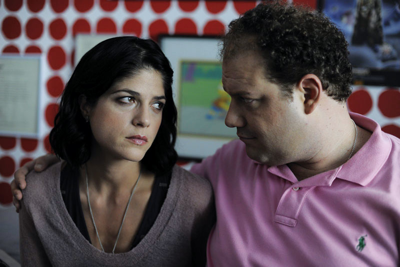
Interestingly enough, Dark Horse is about second chances, the fleeting nature of success, and its chimerical definition, the ever-present but elusive carrot dangling from the American stick. Abe (Jordan Gelber) is getting older, but losing sight of who he's supposed to be. He lives at home, shuffles papers at his parents' company, and gets into arguments with his dad (Christopher Walken) while his mom (Mia Farrow) tries to smooth things out. Unlike his brother Richard (Justin Bartha), whom Dad always called his "frontrunner," Abe was labeled the "dark horse," an ostensible compliment.
Solondz is exploring the psychology of the late bloomer, and the story is in part about the last gasp of Abe's hopes for happiness. At a wedding, he meets Miranda (Selma Blair), an attractive but deeply depressive younger woman. Miranda starts dating Abe mostly because he blindsides her with his combination of persistence and utter delusion. Her lack of interest rolls right off Abe's Teflon coating of Tony Robbins-style positivity and loudmouthed winner-talk.
The writer-director could make sport of Abe quite easily, but Dark Horse is really about the complex and deeply ideological notion of success in America, in particular what it means to be a fully realized man. Solondz depicts Abe as someone stunted by a lifetime of low expectations, while at the same time constantly biting every helping hand due to a fierce sense of entitlement. Dark Horse could be Solondz's statement on Gen-X, Gen-Y and the Millennials all rolled into one.
But above all, much like Life During Wartime, Dark Horse is a film about redemption, after a fashion. Abe is the sort of character we would cross the street or even change jobs to avoid in real life. But Solondz asks us not to give up on him, faults and all. It's a film that shows me I was too hasty to recoil from Todd Solondz's cinema, and it makes me want to go back and give those earlier films another look. Solondz asks us to summon up that patience and generosity so vital to Andrew Sarris' intellectual project, even if (and especially when) it's the most difficult thing to do. In this respect, both men, Sarris and Solondz, have done something rather striking. They've used cinema to propose an ethics.
This week at the movies
Friday marks the running of the annual 48 Hour Film Project, in which competing teams have exactly 48 hours to write, shoot, edit and hand in a finished short film. Some 700 filmmakers representing 48 teams are expected to participate. Entry fee is $170; the event launch will be 6 p.m. Friday, July 13 at Numynd Studios, 915 Twin Elms Court. See for more information.
• Free 2 p.m. Saturday, July 14, at the downtown Nashville Public Library: Ridley Scott's gorgeous 1977 debut The Duellists, with Harvey Keitel and David Carradine. Continuing noon Saturday and Sunday at The Belcourt: some of the best sections of Mark Cousins' epic documentary The Story of Film, concentrating on postwar cinema from film noir to Italian neo-realism and the Nouvelle Vague.
Email arts@nashvillescene.com.



