
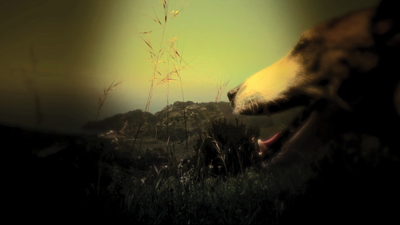
Heart of a Dog, the new essay film by avant-garde musician and performance artist Laurie Anderson, is a work of quiet power, perhaps surprising in its equanimity. Thematically organized around the death of her rat terrier Lolabelle, Heart of a Dog is an expansive film that eventually encompasses Anderson's wise, often bemused observations on the brute fact of death — how it may be the decisive punctuation mark that gives daily existence its ultimate meaning, but one that hardly makes it seem like any less of a puzzle for those left in its wake.
Anderson's relationship with Lolabelle, as seen in her home movie footage, was a deep and joyous one. Our pets are often the secret loves in our lives, since the place they occupy in our hearts can seem shameful, even narcissistic. But for Anderson, the light that Lolabelle brought to her life is unproblematic, and it illuminates other, much more complicated relationships and human affairs. The first half of Heart finds Anderson considering life before and after 9/11; the second explores the Buddhist conception of the afterlife, Anderson's difficult childhood and the artist's painful reckoning with her late mother.
There is a soft, wafting ambiance to Heart of a Dog, not so different from Anderson's recent albums but very different from the large-scale performance work that made her reputation in the 1980s. Those works, particularly her career-defining four-part performance cycle United States, have been characterized as, among other things, "cinematic," and rightfully so. Anderson became an art star during the era when cinema's dominance made artists "go big." Faced with Heart of a Dog's introspective tone and delicate hand-drawn animations, some might be surprised by just how soft-spoken Anderson's new film is.
But Anderson's work and persona have always been steeped in a basic ambivalence and detachment. It is in some sense about ridiculous disparities of scale, how American hubris often outstripped an equally indigenous pull toward plainspoken Midwestern common sense. United States wasn't just some postmodern version of the Wagnerian Gesamtkunstwerk, but a self-indicting artifact of that outsized ambition. Even in the go-go '80s, Anderson was essentially an observational comedian, magnifying her musings on airplane food until you could see the typewriter script disintegrate into Rorschach blots.
This tone of reflection and beatitude defines Heart of a Dog, a film that points to the palpability of loss by speaking slowly, showing the spaces where things used to be, and reminding us that every silly scene of a dog playing the piano is a moment out of time: a snapshot of a ghost the world will soon forget, but who will haunt the low, small corners of someone's peripheral vision. At one point Anderson quotes Wittgenstein, noting that if we cannot speak of something, we simply pass over it in silence. In this regard, we should consider the absence of Anderson's late husband, Lou Reed, until the final scene.
Email arts@nashvillescene.com



Post a comment as anonymous
Report
Watch this discussion.
(0) comments
Welcome to the discussion.
Log In
Welcome to the discussion.
Keep it clean. Please avoid obscene, vulgar, lewd, racist or otherwise abusive language. Comments featuring hate speech or threatening or violent content will not be tolerated.
PLEASE TURN OFF YOUR CAPS LOCK.
Be truthful. Don't knowingly lie or mislead.
Be proactive. Use the “report” link on any comment that violates our comment policy.
Share with us. We'd love to hear your feedback.