
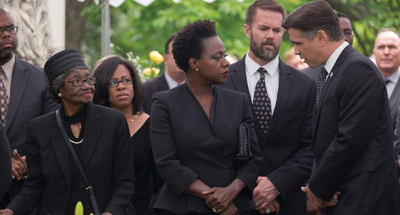

The opening sequence of director Steve McQueen’s heist thriller Widows is one of 2018’s most viscerally exciting few minutes of film. A crew of Chicago thieves — led by the grizzled Harry Rawlins, played by Liam Neeson — sees a job go disastrously awry, leading to a high-speed chase, much of which McQueen shoots from the perspective of the criminals, huddled in the back of a van with an open rear door. That action, so pulse-pounding, is contrasted with flashback scenes of the men enjoying some quiet moments of domesticity with their wives and girlfriends, who have no idea they’re about to say goodbye to these guys for the last time.
All of this is much more invigorating, moving and, yes, entertaining than one might expect from a film that’s ultimately about the systemic marginalization of women and minorities, in a city ruled by political corruption and mob violence.
The easiest way to sell Widows — beyond just calling it one of this year’s best films — is to note that the screenplay was written by McQueen and bestselling Gone Girl/Sharp Objects novelist Gillian Flynn, based on a British TV series created early in the career of Prime Suspect writer Lynda La Plante. In other words: Widows has plenty of popular crime-fiction bona fides. La Plante’s source material provides Flynn and McQueen with a lot of good, grabby plot — plus one lollapalooza of a twist about two-thirds of the way through. Even so, the movie sometimes feels like it has too many characters to give them all their due.
Despite some sag in the middle, the script keeps coming back to one key storyline: Rawlins’ wife Veronica (Viola Davis) rallies the other women who are left financially struggling after their men’s botched crime; she leads them on a caper of their own. The bulk of the film — all the way up to a crackerjack climactic robbery sequence — considers the specific ways these ladies take advantage of being underestimated for their gender to out-hustle Chicago’s professional hustlers.
But Widows is driven by more than just gender politics. Next to that white-knuckle opening, the most visually arresting scene follows Chicago legislator Jack Mulligan (Colin Farrell) as his car drives from a rally in the poor, predominately black section of his district to his own lavish home in an upscale neighborhood, just a few blocks away. Mulligan is defending his seat against a challenge from Jamal Manning (Atlanta’s Brian Tyree Henry), a ruthless crime boss whose platform has less to do with uplifting his people than wresting control of the Chicago rackets from the Irish. Neither candidate has any intention of getting guns off the streets, or constituents into well-paying jobs.
The performances in Widows are uniformly excellent, led by Davis playing an aging woman used to a life of privilege — a woman who becomes aware of how precarious her status is once she’s in danger of losing all her money. Elizabeth Debicki is excellent as a widow whose dependence on her abusive husband leaves her with few options after his death; and Daniel Kaluuya is scary-good as Jamal’s brother Jatemme, who does the dirty work. (A scene in which Jatemme punishes one of his incompetent lackeys by forcing him to freestyle rap is at once hilarious and terrifying.)
But like McQueen’s Oscar-winning 12 Years a Slave, what stands out most about Widows is how the director takes a story that’s often violent and despairing — and focused on social inequities — and makes it downright exhilarating. McQueen has never shied away from sensuality in his movies: whether it’s the soft entanglement of lovers, or the raw threat of a villain’s hand on a vulnerable throat.


Post a comment as anonymous
Report
Watch this discussion.
(0) comments
Welcome to the discussion.
Log In
Welcome to the discussion.
Keep it clean. Please avoid obscene, vulgar, lewd, racist or otherwise abusive language. Comments featuring hate speech or threatening or violent content will not be tolerated.
PLEASE TURN OFF YOUR CAPS LOCK.
Be truthful. Don't knowingly lie or mislead.
Be proactive. Use the “report” link on any comment that violates our comment policy.
Share with us. We'd love to hear your feedback.