
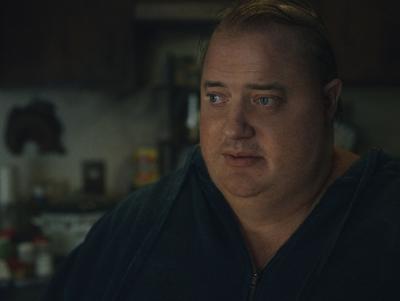

Every so often, a film comes along that is such a debilitating gut-punch of despair that it splits audiences entirely. Adapted by Samuel D. Hunter from his play of the same name, The Whale is just such a film, as likely to break your heart as it is to downright piss you off.
Directed by the eternally divisive Darren Aronofsky, The Whale features ’90s heartthrob Brendan Fraser — poised for a career renaissance — as Charlie, a severely obese recluse who teaches writing courses remotely from his two-bedroom apartment someplace in Idaho. Estranged from his ex-wife and daughter and still not recovered from the death of the boyfriend he left them for, Charlie is shut off from the outside world and dying from congestive heart failure. He interacts with others only through food delivery, visits from door-to-door religious zealots, the college courses he instructs virtually (though he intentionally disables his laptop’s camera for those) and his friend and nurse Liz.
Liz is portrayed by Hong Chau, and as remarkable and rightfully acclaimed as Fraser’s performance is, for my money, it’s Chau who surprises and devastates here the most, expressing Liz’s deep frustration, rage and anguish at her friend’s unwillingness to save his own life. Fraser donned a fat suit and prosthetics to take on the role, and in a number of scenes he’s shown obsessively binge-eating or painstakingly moving around his apartment with the help of a walker. Some critics, though united in their praise of Fraser’s commitment, have called the film fatphobic. Writing for The New York Times, noted author and critic Roxane Gay calls the film “a carnival sideshow.” Writes Gay, “Come look at the freak, the movie beckons.” And though Aronofsky does indeed lens Charlie’s labored movements in an exaggerated manner, the depiction is ultimately sympathetic. Heartbreaking, obsessive and sympathetic.
The Whale does feel very much like the adaptation of a stage play in its scope. It’s unavoidably claustrophobic — the entire movie takes place almost exclusively inside Charlie’s cramped and filthy apartment, its cast limited to only half a dozen actors. Even the aspect ratio is tight, boxing us in at 1.33:1. (Another common criticism here is that A24, the hip distribution company behind The Whale, leans too heavily on uncommon aspect ratios; American Honey, The Lighthouse, First Reformed, the list goes on.) But it works. With Aronofsky’s camera trained closely on Fraser’s every moment, as he yearns to connect with his teenage daughter (Stranger Things’ Sadie Sink, bitter and seething), as he obsesses over a particularly special student essay about Moby-Dick, as he gives in to the temptation to binge-eat junk food, we are in this apartment with him.
Like Kenneth Lonergan’s Manchester by the Sea or even Charlie Kaufman’s Synecdoche, New York, The Whale is a film characterized by wall-to-wall woe and the lonesomeness and obsession felt by one doomed man. It is devastating, dark and raw, relentless in its commitment to make the audience feel something. As it happens, for many audiences that something will be rage. For others, sorrow and awe. But without question, it will make you feel something.



