
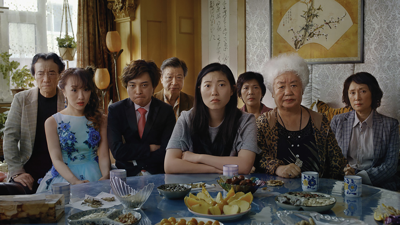


Several years ago, when my father was in the hospital for a prolonged stay after a particularly aggressive heart attack, my family camped out at his bedside night after night. There were a lot of us — my mother, siblings, aunts, uncles, cousins, friends and myself — and the weight of our collective grief made our presence heavier and louder.
That presence was not welcome. Those sharing waiting rooms with us made it a point to let us know we were “too much” and taking up “more space than necessary.” Doctors and nurses would refer to us as “that family” and quickly developed a familiar chorus of sighs that they’d issue at the sight of us. The sound is, to this day, imprinted on my brain. I recognized it when a third family member in the span of one day would ask the same nurse the same questions, and when one too many of us crowded around my father’s bed. But for South Asian families like mine, and East Asian ones like director Lulu Wang’s, you mourn together. It’s just the way it is. In Wang’s second film The Farewell, the Chinese-American filmmaker captures exactly that dynamic — how it feels to witness it as a Westerner, and to be a part of it as a family member.
Wang achieves this feat by borrowing from her own story: Upon discovering her grandmother (“Nai Nai”) was dying of cancer in China, Wang’s family decided not to tell Nai Nai the truth. That way she would be spared the trauma of saying goodbye to them. But so they could say goodbye to her, they organized a wedding for a cousin (who hadn’t actually planned to get married) as an excuse for everyone to reunite in China and see their matriarch for the last time. Wang first shared this story in a 2016 segment of This American Life. Within 24 hours, producers were calling, and just a few years later, The Farewell was being buzzed about at the 2019 Sundance Film Festival, going on to beat Avengers: Endgame’s per-theater box-office average on its opening weekend last month. That’s especially impressive for a film set in China, featuring an entirely Asian cast, with its characters speaking largely in Mandarin.
But as culturally specific as the film is, The Farewell’s meditation on the highs and lows of grief is acutely relatable. There’s a universal sense of sadness as well as a gallows humor that hits in moments like these, right when you really need it. It helps that Nai Nai (Zhao Shuzhen) is an incredibly delightful, sassy presence who, if she’s aware of her condition, doesn’t betray it for a moment.
Much of the film’s accessibility is owed to its star, rapper and actress Awkwafina, who made hilarious splashes in last year’s Crazy Rich Asians and Ocean’s 8, often playing spontaneous “best friend” types. Here she’s Billi, who travels to China and, upon discovering her family’s plan, finds herself in an emotionally debilitating dilemma: Should she tell her grandmother the truth, or go along with her parents’ determination to spare her the anguish?
Here Awkwafina is something new — so emotionally porous, an endearing mix of naivete and heartbreak. As she drives through the streets she knew as a child, there’s a forlorn sadness as she mourns the life she could have had; in perpetuating the lie to her grandmother’s face, there’s a piercing, stricken quality — lying shouldn’t be so easy, but losing someone is hard. It’s a very Western concept, Billi’s family tells her, to want to be honest about this kind of thing. Catharsis doesn’t exist in quite the same way in Asian cultures. One wonders if Wang has achieved a sense of catharsis in making The Farewell, which itself feels like a goodbye to her own grandmother in the most naked way — her extended family might grimace at the thought.
The film’s narrative isn’t built on much else, but that’s a good thing. There are no love interests, no characters outside of the family, no stakes aside from Nai Nai and the lie. Almost every shot, most of them wide, encompasses the entire family and its myriad facial expressions. There’s an emotional choreography to this film. At the wedding, we see the silly games the family members play as the camera pivots around them, gathered in a circle; when they visit their grandfather’s grave, they each leave treats behind; when it’s dinnertime, they cook together, and then eat together, again in a circle.
The narrative is not about Billi, really, or even Nai Nai, but rather family — their shared emotional burden. At the start of the film, we see a bird somehow break into Billi’s New York apartment as she chats on the phone with Nai Nai. Later, when she arrives at her hotel room in China, she sees a bird on the windowsill. At the film’s conclusion, several birds break free from the trees around her as she walks through the busy city streets alone. That imagery is representative of the connective tissue we don’t often notice or value, particularly as children of immigrants and/or those straddling cultures.
It’s a reminder that there’s always a bridge between the old and the new, the familiar and the unfamiliar, the near and the distant. The Farewell serves as a reminder that even if we feel a distance, we are always connected — by shared experiences, but also by our love and our memories.



Post a comment as anonymous
Report
Watch this discussion.
(0) comments
Welcome to the discussion.
Log In
Welcome to the discussion.
Keep it clean. Please avoid obscene, vulgar, lewd, racist or otherwise abusive language. Comments featuring hate speech or threatening or violent content will not be tolerated.
PLEASE TURN OFF YOUR CAPS LOCK.
Be truthful. Don't knowingly lie or mislead.
Be proactive. Use the “report” link on any comment that violates our comment policy.
Share with us. We'd love to hear your feedback.