
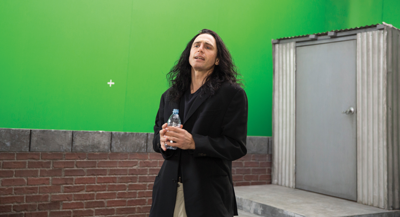


The Room has been called “the Citizen Kane of bad movies” and “the worst film of all time.” The 2003 romantic drama, which fails at being either romantic or dramatic, is as perplexing as its enigmatic director, producer, writer and star, Tommy Wiseau.
Wiseau, a man of indeterminate age, background and means, was the driving creative force behind that project, a film that ultimately proved a disaster from top to bottom. Thanks to its wildly befuddling “plot,” barrage of seemingly unrelated characters, and abysmal execution of filmmaking basics like editing, sound design and, you know, acting, The Room has become a cult classic. It screens in sold-out theaters all over the world with audiences screaming its most egregiously bad lines (i.e., “You are tearing me apart, Lisa!”) and throwing plastic picnic spoons at the screen (a joke not quite worth explaining if you don’t get it already). In fact, The Room will screen Friday and Saturday as the Belcourt’s Midnight Movie. It is beloved for its utter bizarreness. It is the very definition of “So Bad It’s Good.”
When James Franco decided to direct and star in The Disaster Artist, a fictionalized film about the making of The Room, based on The Room co-star Greg Sestero’s book of the same name, a common reaction was, “But why?” Because he could, I suppose.
So how is it? In a word, unnecessary. But in two words? Unnecessary and hilarious.
Reframed as a bizarro buddy comedy centering on the unlikely friendship of Wiseau (played by Franco) and Sestero (played by Franco’s younger brother Dave), The Disaster Artist proves to be a surprisingly delightful exercise. Something of a family affair, the film also features Franco the Younger’s wife Alison Brie (stellar in both Community and GLOW) and others from the Francoverse (Judd Apatow, Seth Rogen and Zac Efron), along with an endless bevy of cameos and supporting performances from the likes of Sharon Stone, Melanie Griffith, Hannibal Buress, Josh Hutcherson and more. Fans of bad-movie podcast How Did This Get Made? will be overjoyed to see that all three HDTGM? hosts have roles in the film — there are even a couple moments that play out like segments from the show. This is a joke that everyone is in on.
James Franco’s dedication is remarkable as the dead-faced, mush-mouthed Wiseau. In fact, his performance transforms Wiseau into a new character, a person who is neither James nor Tommy, but rather some otherworldly being whose ineptitude and misplaced anger are almost charming. And yes, The Room’s remarkably uncomfortable sex scene is reproduced — Franco & Co. remade 25 minutes of the original film shot for shot. As Sestero, Dave Franco does most of the duo’s heavy lifting. After all, he’s the one who must humanize these two, remind us that there are actual people at the heart of this iconically bad film, and play straight man to a richly bonkers character.
Some have asked me if it’s necessary to watch The Room before seeing The Disaster Artist, and the answer is no. Or anyway, I don’t think so. If you’ve watched and enjoyed the experience of watching The Room, there’s no doubt in my mind that you’ll enjoy The Disaster Artist. If you haven’t? Well, my companion at the preview screening has never seen The Room, save a handful of clips I begged her to watch ahead of time. She wasn’t particularly confused by The Disaster Artist’s premise or plot, per se. And although she did find it funny, she was a little perplexed as to why it made sense to make a movie about an asshole (her word, not mine) making a movie.
And it doesn’t really make a lot of sense that this film exists. No more sense than the fact that The Room exists — or the fact that you’re reading this review, for that matter. It feels like a film that was made simply because it could be made, because James Franco is sharp enough to know he can cash in his star power and use it to turn cinema’s dumbest inside joke into a pet project with his buddies, and because he’s talented enough to actually make it work.



