
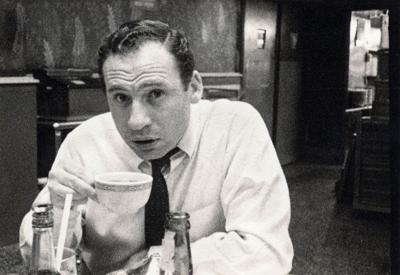

The way Mel Brooks talks about a piece of pie? That alone is worth the price of admission for the new documentary The Automat. It’s not just the fact that Brooks waxes poetically about a dessert, but rather the way he does it — floating back in time on a cloud of a memory to one of the simplest times in his life. It’s a bit like that scene in Ratatouille when austere food critic Anton Ego flashes back to his childhood and that humble plate of ratatouille that made him love food in the first place. The smallest things in our lives can often have the biggest impact.
It isn’t difficult to explain the premise of The Automat, but it’s a little challenging to describe how it makes you feel. On the surface, it’s a case study about an early-20th-century restaurant chain in the Northeast, with a gimmicky window turnstile device (that’s the Automat) via which a few nickels could get you a slice of pie or a ham sandwich. Most folks who watch The Automat have most likely never used an Automat, or even been to the restaurant chain Horn & Hardart. The whole thing might sound like something you’d walk in on your grandma “watching” (i.e., snoozing through in her comfy chair) on PBS.
But that’s right where the documentary wants you — and The Automat takes on an unexpected resonance. Director Lisa Hurwitz’s film explains how Horn & Hardart took over major metropolitan areas like New York and Philadelphia in the early 1900s, and does so with a careful power. It wields its nostalgia in a warm, inviting manner. Imagine this: Art Deco exteriors; seas of windows previewing all the desserts and pastries you could ever want; cheap, delicious cups of coffee dispersed by regal dolphin-shaped spigots; friendly conversations with strangers; and the world’s best mac-and-cheese and baked beans.
For us Southerners, you could call the Automat a midcentury New Yorker’s Waffle House — a place that glows on the darkest night, welcoming passers-by who just need a hot cup of java and a good rest. Hurwitz recruits an illustrious group of A-list Automat devotees, including Brooks, Carl Reiner, Ruth Bader Ginsburg, Colin Powell, Howard Schultz and Elliott Gould, to help add context as to why this now-ancient restaurant chain wove itself so delicately into the fabric of American culture. In doing so, Hurwitz shows how places like the Automat were a great equalizer. They were places where future Supreme Court justices, famous actors, budding businessmen and just plain folks could congregate and enjoy simple pleasures on the plate. Even during segregation, Horn & Hardarts were melting pots of American experience — places that didn’t discriminate based on origin, race and gender. They only hoped to sweep you in with grandiose architecture and unbeatable prices (as long as you remembered to bring your coin purse).
Clocking in at roughly 80 minutes, Hurwitz’s film doesn’t overstay its welcome. While most rearview documentaries like this one are reliably informative, The Automat stands apart with its bittersweet melancholy, with its mourning of the way things used to be — when all you had to worry about was having enough nickels in your pocket for that oh-so-sweet piece of pie. Horn & Hardart restaurants were known for taking care of their people — company executives would attend the funerals of workers who’d passed. The company itself gained a reputation as a business that focused not only on the bottom line, but also empathy for its workers and customers.
Some of the documentary’s participants — namely Ginsburg, Reiner and Powell — have since passed, adding to the profundity of what Hurwitz has crafted. Brooks, the beloved comic mind, becomes so involved in the film’s production that he writes and sings a sweet little ditty about what those cheap cups of coffee still mean to him all these years later.
Even if you’ve never been to an Automat, you might recall the simpler days of hitting up a Luby’s cafeteria at the mall, or rolling up to a Mr. Gatti’s for a slice of Friday-night pizza. Change isn’t always a bad thing — most times, it’s necessary. But The Automat posits that sometimes, society abandons things that are truly valuable for the sake of convenience. We might leave places like the Automat behind, but they never leave us. How wonderful it is to be reminded of their power.



Post a comment as anonymous
Report
Watch this discussion.
(0) comments
Welcome to the discussion.
Log In
Welcome to the discussion.
Keep it clean. Please avoid obscene, vulgar, lewd, racist or otherwise abusive language. Comments featuring hate speech or threatening or violent content will not be tolerated.
PLEASE TURN OFF YOUR CAPS LOCK.
Be truthful. Don't knowingly lie or mislead.
Be proactive. Use the “report” link on any comment that violates our comment policy.
Share with us. We'd love to hear your feedback.