
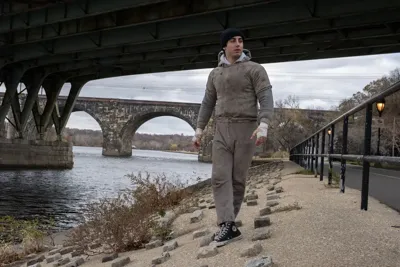

In my family, I was taught early that rooting for the underdog is a moral obligation. It doesn’t matter how lousy their odds are, how outmatched they seem or how spectacularly they’re expected to fail. If everyone else has counted them out, we’re already in their corner. (Blame it on us being lifelong Toronto Blue Jays fans.) This might explain my enduring affection for Rocky, the 1976 boxing classic about a working-class Philadelphia nobody who gets the chance to become somebody. But here’s the kicker: The story of how Rocky got made is arguably an even better underdog tale than the one that unfolds in the ring.
Peter Farrelly’s I Play Rocky revisits the unlikely rise of Sylvester Stallone, a struggling actor who, despite having little money, few prospects and even fewer industry connections, refused to give up on a screenplay he’d written about an equally down-on-his-luck Philadelphia boxer. When Hollywood came knocking, Stallone made a seemingly outrageous demand: He would only sell the script if he got to play the lead.
It’s a terrific story, one also recounted in Thom Zimny’s superb 2023 documentary Sly, which offers a more intimate, psychologically revealing portrait of the actor and the personal demons that fueled his ambition. Farrelly’s version is considerably lighter on introspection, but understands the story’s enduring appeal. In an era when movie stars are an endangered species and risk-averse studios rule the landscape, there’s something positively romantic about watching an unknown actor stubbornly bet on himself — and win.
Anthony Ippolito plays the young Stallone, navigating humiliating auditions, financial desperation and the industry executives who see potential in his script but considerably less in its author. The film’s most entertaining stretches unfold during the negotiations, as producers Irwin Winkler (P.J. Byrne) and Robert Chartoff (Toby Kebbell) attempt to reconcile Stallone’s impossible demands with Hollywood’s insistence on a bankable star. These scenes crackle with wit and frustration, particularly when a gloriously exasperated Tracy Letts enters the picture as a studio executive.
The supporting cast does plenty to keep the proceedings from feeling too rote. Jay Duplass brings a delightfully nervous energy to his portrayal of Rocky director John G. Avildsen, while Stephan James is effortlessly charismatic as Carl Weathers. But a particular pleasure is AnnaSophia Robb as Stallone’s first wife, Sasha Czack. The woefully underrated actress brings tenderness to a role that could easily have been reduced to obligatory supportive girlfriend.
Ippolito’s role, meanwhile, is more complicated. Physically, the resemblance to Stallone is often uncanny, but his garbled delivery occasionally veers dangerously close to caricature. Some viewers will find it distracting, perhaps even unintentionally funny. And while the commitment is admirable, impersonation isn’t necessarily interpretation.
That distinction points to the film’s larger weakness. For all its interest in Stallone’s determination, I Play Rocky seems curiously reluctant to examine the psychology behind it. Stallone’s difficult childhood, complicated relationship with his father and deep-seated insecurities are acknowledged but seldom meaningfully explored. It’s almost as though Farrelly fears deeper emotional excavation might threaten the audience’s good time.
And perhaps that’s the calculation. I Play Rocky is proudly populist entertainment — a warm crowd-pleaser tailor-made for a family outing near the holidays. It knows exactly which emotional buttons to push, and it pushes them with considerable enthusiasm. There’s nothing particularly challenging or revelatory here, but not every movie needs to reinvent the wheel. Sometimes there’s real value in just giving audiences a reason to cheer.
I Play Rocky’s optimism feels especially poignant given how much Hollywood has changed since Stallone’s improbable breakthrough. The film is a reminder of a kind of success story that feels increasingly impossible today: an unknown writer-actor convincing a studio to take a chance on his singular vision. In today’s increasingly merger-happy, franchise-obsessed, nepotism-loving industry, it’s difficult to imagine a studio taking that gamble.
I remember my dad telling me the story of how Stallone got Rocky made when I was very young. He always recounted it with such admiration, marveling at the sheer audacity of a nobody who refused to take no for an answer. I wonder now whether, as an immigrant who worked tirelessly to build a life for himself, my dad saw something of his own experience in Stallone’s determination. Whatever the reason, the story stayed with me. I suspect it’s partly responsible for both my work ethic and my lifelong love affair with movies. And perhaps that’s what I Play Rocky, for all its shortcomings, understands best: The power of a good underdog story doesn’t end when the credits roll. Sometimes it inspires another generation to keep fighting.



Post a comment as anonymous
Report
Watch this discussion.
(0) comments
Welcome to the discussion.
Log In
Welcome to the discussion.
Keep it clean. Please avoid obscene, vulgar, lewd, racist or otherwise abusive language. Comments featuring hate speech or threatening or violent content will not be tolerated.
PLEASE TURN OFF YOUR CAPS LOCK.
Be truthful. Don't knowingly lie or mislead.
Be proactive. Use the “report” link on any comment that violates our comment policy.
Share with us. We'd love to hear your feedback.