
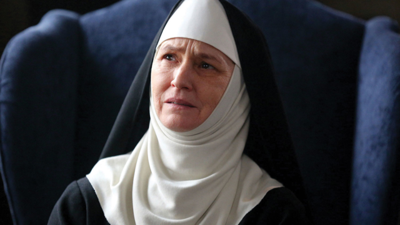


Who is Novitiate made for? It’s somewhat rare to see an American film dealing so directly with Christianity while making no attempt to please the “faith-based” audience, and so this question leapt to my mind. Set in 1964 — although there’s a brief section depicting its heroine’s childhood and adolescence in the 10 years before that — Novitiate portrays becoming a nun as an extreme experience akin to participating in Mao’s Cultural Revolution, complete with incredibly similar self-criticism sessions. The reforms of Vatican II are a deus ex machina, but their effects remain unknown at the end of the film.
The flashbacks explain how Cathleen Harris wound up becoming a nun. Her mother (Julianne Nicholson) doesn’t really care about religion or even believe in it, but she occasionally takes Cathleen to church as a social obligation. As a 12-year-old, Cathleen (played by Sasha Mason in the flashbacks ) gets a scholarship to a Catholic school, where she has a religious experience in the chapel. At 17, Cathleen (now played by Margaret Qualley) has no interest in romance or sex with her male or female peers, but thinks she’s in love with God. She becomes a postulant, which means she will become a nun if she doesn’t anger her Reverend Mother Marie St. Clair (Melissa Leo). The fellow young women who accompany Cathleen on the journey to nunhood don’t all make it, for various reasons, and the Reverend Mother proves quite cruel.
Director Margaret Betts seems to have lifted a lot of her ideas about how to film women’s faces from Chantal Akerman’s Jeanne Dielman. She tends to frame them head-on or in profile, with little in between. Her film is far less austere than Akerman’s work, but there’s a rigor to it that seems to derive from the tradition of European films like Carl Dreyer’s The Passion of Joan of Arc and Ordet and Robert Bresson’s Mouchette. Novitiate comes closer to Bresson’s films about tormented girls than his Diary of a Country Priest: The protagonist in Country Priest has a level of agency and control over his life that Cathleen, under her superior’s thumb, doesn’t. Kat Westergaard’s cinematography uses intensely bright beams of sunlight to suggest a divine presence, or at least the power of female sexuality.
Leo is one of America’s great character actors, but her mother superior is written as a fairly one-dimensional villain. Relatively early on, she kicks two girls out for having a relationship, although she describes this in extremely euphemistic terms. She encourages her charges to confess their sins in front of her and all their peers. If there’s a level of nuance to her character, it’s thanks to Leo, who finds humanity amid sadistic glee (her nun is an analog to J.K. Simmons’ abusive teacher in Whiplash), rather than the script, which is based on real present-day and former nuns’ memoirs. As an image of power, the Reverend Mother is about as unflattering as Nurse Ratched in One Flew Over the Cuckoo’s Nest.
God can’t destroy anybody’s libido, and the postulants still live in a world where lesbian relationships and masturbation exist. No one is going to mistake Novitiate for Ken Russell’s The Devils, or one of the many lesser “nunsploitation” films that came out in the ’70s, but it crosses the line between austerity and titillation a few times. I’m no prude, but I’m not sure it’s necessary to show topless women in this context. At the same time, it may be a good idea to remind right-wing Christians that displays of the body are not shameful and that women were attracted to each other long before Ellen DeGeneres came out in the ’90s.
The film rests on a fine line between trying to cater to lapsed Catholics and speaking to practicing ones in a way that won’t anger them. I don’t think it really has enough nuance to achieve this, especially since the closing credits seem to be celebrating the fact that 90,000 nuns left the church after Vatican II’s reforms were passed. Novitiate is a film obsessed with religion, but it might please atheists most. And Betts’ statements that Vatican II reduced women’s agency seem absurd in this context; the world she portrays may be one of the few run by women, but it’s just as repressive and homophobic as any patriarchal environment.
Email arts@nashvillescene.com



Post a comment as anonymous
Report
Watch this discussion.
(0) comments
Welcome to the discussion.
Log In
Welcome to the discussion.
Keep it clean. Please avoid obscene, vulgar, lewd, racist or otherwise abusive language. Comments featuring hate speech or threatening or violent content will not be tolerated.
PLEASE TURN OFF YOUR CAPS LOCK.
Be truthful. Don't knowingly lie or mislead.
Be proactive. Use the “report” link on any comment that violates our comment policy.
Share with us. We'd love to hear your feedback.