
Everything is dying. It's a truism that all cultural expression is a faint shadow of what it was a mere 20 or 30 years ago, that we're in a perpetual state of decline. As a result, one of the dominant themes of contemporary arts discourse is the Death of This and the Death of That. Some of this is more of the same nostalgia talking — that sense that once upon a time, more people read poetry, attended experimental one-act plays, and debated the relative merits of Sibelius over Rachmaninoff.
But there seems to be a particular virulence to "death of film" discussions. Perhaps it's because, unlike other media such as classical music, literature or painting, there clearly is something out in the world taking film's place. Cinema, we are frequently told — the "serious" kind that true lovers of the artform thrive upon — peaked in the 1960s with Godard, Bergman and Fellini. The greats of our own era, to hear it from certain gray eminences within film criticism, can't hold a candle to that Golden Age of Cinephilia. What we're experiencing instead is a kind of zombie version of the seventh art, hobbled by a commercial need to be as loud and obnoxious as possible to cut through the new media landscape's sensory clutter.
But that's not all. Film, the actual celluloid substance upon which motion photography has chemically impressed itself since 1895, has been steadily replaced with digital technology. Granted, a few weeks ago Eastman Kodak gave film a stay of execution, agreeing to continue manufacturing it for the time being. But as theaters convert to DCP and junk their old 35mm projectors, the end is inevitable. Cheap computer reproducibility and the corporate profit motive have won the day. Actual film will soon be a specialty item for museums, the mass-media equivalent of a Biedermeier chair.
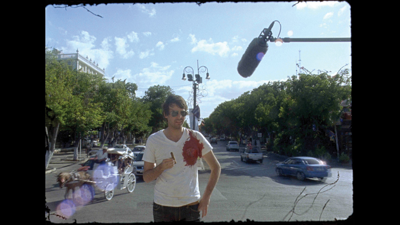
These are some of the issues implicitly addressed by La Última Película, a very funny and quite odd new film playing Thursday in Third Man Records' Light and Sound Machine series. It's a feature-length experimental narrative, the result of a collaboration between Raya Martin, a major figure in contemporary Filipino cinema, and Mark Peranson, a programmer for the Locarno Film Festival and editor-in-chief of the Canadian film magazine Cinema Scope. (Full disclosure: Both men are friends of mine, and I write for Peranson's magazine.) Loosely based on Dennis Hopper's infamous 1971 film The Last Movie, a film that effectively torched the director's industry goodwill left over from Easy Rider, LUP is an attempt to make literal the idea that a medium such as film could actually die. Would its death take anyone else down with it?
The premise: an American director (Alex Ross Perry, maker of The Color Wheel and the upcoming Listen Up Philip) has managed to secure the last remaining celluloid in existence. From a medium-specific standpoint, he is making the last film. So he goes to Mexico, his shoot coinciding with the end of the Mayan calendar and the possibility of apocalypse. Alex has joined with a local friend (Gabino Rodríguez) who tries to help him scout locations, even though he mostly asks Alex why he has chosen to come to Mexico in the first place.
Alex spends a great deal of time explaining his rationale in a kind of deadpan parody of insular critic-speak. His primary fallacy entails speaking of engaging in an open, uncertain work method while simultaneously remaining blinkered and arrogant in the making of the film itself. But for its own part, LUP is a dense, self-reflexive work. Not only did Martin and Peranson shoot the film in nearly every available gauge and medium — from 35mm to smartphone — Perry and Rodríguez break character by a campfire to discuss whether the (actual) film they're in makes sense, a possible nod to William Greaves' now-classic Symbiopsychotaxiplasm: Take One.
But the dominant idea of LUP, which the filmmakers wisely play for mordant laughs, has to do with whether an artform can truly have a terminus. Can "film" die? By hinging together two very different eschatological notions — a material/industrial shift and the end of the world — Peranson and Martin provide a number of jarring images which all aim toward a particular vanishing point down the road. As tourists wander around the ruins of a Mayan temple, we can see that they were wrong about the coming cataclysm. But the death of film, like so many other small losses, is a symptom of a more slow-motion annihilation: that of global capitalism on the rampage. And unlike the popular images of total destruction (by Transformers, sharknadoes, CGI storms or a vengeful god), it gradually replaces everything with a grim substitute: a lumbering avatar of death.
Email arts@nashvillescene.com



Post a comment as anonymous
Report
Watch this discussion.
(0) comments
Welcome to the discussion.
Log In
Welcome to the discussion.
Keep it clean. Please avoid obscene, vulgar, lewd, racist or otherwise abusive language. Comments featuring hate speech or threatening or violent content will not be tolerated.
PLEASE TURN OFF YOUR CAPS LOCK.
Be truthful. Don't knowingly lie or mislead.
Be proactive. Use the “report” link on any comment that violates our comment policy.
Share with us. We'd love to hear your feedback.