
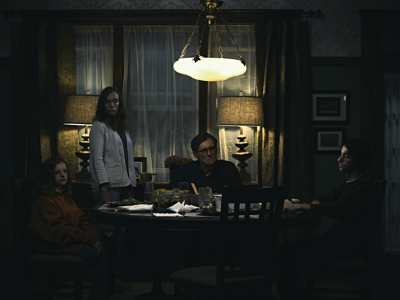


Sadness has lived in the Graham home since long before Grandma Leigh died. But what was it that the bookseller Kazanian said, about how the only true mystery is our lives being governed by dead people? Not always, but it does seem that we discover the things that shake our very lives to the core in times of loss. They were always there, in our stories, and we just didn’t know it at the time. But ignorance is no defense, is it? The Ancient Greeks didn’t think so, and they would have fucking loved Hereditary.
The Grahams are a family of artists. Or rather, the Grahams related by blood to the recently deceased — whose death came after a battle with dissociative identity disorder and dementia — are. Annie (Toni Collette) makes miniatures in exacting detail. Little Charlie (Milly Shapiro, haunting) works in three-dimensional collage and mixed media. Peter (Alex Wolff, who was a tween pop star on Nickelodeon and one of the Tsarnaev brothers in that reprehensible Marky Mark film Patriot’s Day) is a musician. And they all feel things in a way that fascinates and frustrates psychologist and father Steven (Gabriel Byrne).
There’s so much depression and repression going on with the Grahams that even the most grounded of inquisitive minds could get caught up in what’s unfolding. With the ghosts. And the secrets. And the unspeakable horrors that will be spoken, as viscerally upsetting as a bloody disarticulation. We’re all haunted, every day of our life. So much of Hereditary deals with pivoting perspectives — the way different minds process what they see, and accordingly react. Or how when you listen to someone, do you accept what they say as literal or figurative? I’m not trying to reach for a hot take here, but this aspect of the film should resonate deeply with anyone trying to process the nationwide second-guessing and analysis of the latest missives from, you know, that guy in the White House, always being assigned secret motives or hidden insight.
At its best, which is often, Hereditary is the Synecdoche, New York of horror — not specifically because of the miniatures that occupy much of the emotional and physical space of the Graham house, though they do echo the theatrical sets of Synecdoche. Those are just a physical representation of a desperate need to find another way to confront and reconcile with the countless fractures that have made us who we are. There’s a lot to be said for the way Hereditary plays with your sense of certainty, using real-world photography and Annie’s detailed miniatures interchangeably for establishing shots.
Hereditary delights in thwarting some expectations and fulfilling others, and it uses a trope of American Horror Cinema that warms my heart the most: a scene in which a high school English teacher explores a theme that is of utmost relevance and importance to our protagonist. If we’re going to approach things from the side of the scientifically verifiable, then the moment that begins the twist/resolution phase of this film is the shift from depression into mania. The iconography remains the same, but the pace and deployment of information ramp up. Loose strands are drawn together and tighten, hardening into knots that trap the viewer, as well as the characters, in something ancient — but also something quantifiable. Something that can be named can be bound.
So maybe there’s a Wes Craven’s New Nightmare scenario afoot, where taking the abstract and making it concrete is necessary to thwart something more monstrous than what Hereditary depicts. For so much of its run time, it provokes and wounds and hurts the viewer in a way that no traditional creature feature or satanic antics have; it exacts shock and horror from the audience without mercy or relent. And then all of a sudden, with the reveal of a book, everything shifts.
Writer-director Ari Aster is an incredible talent. This film is a psychological minefield that demands a series of incredibly difficult emotional choices from the viewer, and when the viewer’s choices don’t sync with Aster’s, there may be a break. Collette is staggeringly good in this film. She and Wolff are so good and viscerally affecting that I started engaging more with them working through the decades of pain and sorrow with the kind of transgressive sadness of something like Dead Ringers than I did with the taloned hand of fate that was looming over the proceedings to play its final hand of ancient evil since the first title card was on screen.
I have no idea how this film will play in front of a big audience. In a way, it’s like Eraserhead: No matter who all you’re watching it with, you’re feeling it in a vacuum of the personal, the immediate. Hereditary is a horror film on several levels from frame one, and for the vast majority of its run time, it is one of the best.



Post a comment as anonymous
Report
Watch this discussion.
(0) comments
Welcome to the discussion.
Log In
Welcome to the discussion.
Keep it clean. Please avoid obscene, vulgar, lewd, racist or otherwise abusive language. Comments featuring hate speech or threatening or violent content will not be tolerated.
PLEASE TURN OFF YOUR CAPS LOCK.
Be truthful. Don't knowingly lie or mislead.
Be proactive. Use the “report” link on any comment that violates our comment policy.
Share with us. We'd love to hear your feedback.