

Science-fiction gives filmmakers a unique opportunity for metaphor and allegory, helping us better understand our own world by transporting us to another. Russian literary scholar Darko Suvin, who devoted his career to understanding and defining the genre of sci-fi, called this founding principle “cognitive estrangement” — meaning that sci-fi often takes familiar issues and problems from our own world and allows us to see them from a new perspective by placing them in a different context.
The new film After Yang is predicated on the idea of cognitive estrangement, using an image of the future to help the audience find new ways to empathize with struggles in the present day. Adapted from a short story by author Alexander Weinstein, After Yang inevitably recalls Steven Spielberg’s heart-shattering Pinocchio story A.I. Artificial Intelligence, but director Kogonada uses android-human relations to explore a different set of questions. His debut feature Columbus is all about public spaces, following two lonely hearts who connect amid the modernist architecture that Columbus, Ind., is known for. But After Yang is noticeably devoid of public space, set in a tastefully designed future where everyone is trapped in the monotonous solace of self-driving cars shuttling between work, home, repeat.
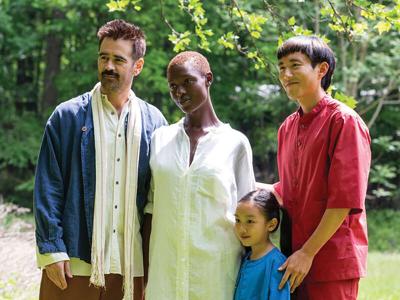
It’s the near future, that same not-so-far-off place we’ve seen in movies like Her and Ex Machina, where everyone wears high-waisted pants and turtlenecks and everything looks like it was bought at a Muji. Parents Jake and Kyra (Colin Farrell and Jodie Turner-Smith) have adopted two children: a young girl named Mika, and an older robot brother named Yang. Mika is Chinese and her parents are not, so they’ve adopted Yang with the hopes that he might be able to give her some greater connection to her heritage and history than they could. While Yang has been programmed to rattle off 1,001 fun facts about Chinese history, he too struggles deeply with his connection to his identity — what does it mean for a robot, designed by humans to look like a human, to have a culture or ethnicity or even a personal identity? Yang may have been designed to “look Chinese.” He may have been programmed with an infinite wealth of knowledge about the nation. But like Mika, he has no direct connection to this part of himself — probably even less so since he is on some level aware that he was “made” to be Chinese.
When Yang’s robotic interior starts to break down and he shuts off, it sends the family into crisis. Mika grieves her brother, while Jake and Kyra worry about their daughter’s emotional health and ability to accept the loss — and they also mourn someone they have come to see as a son. Jake tries his best to put Yang back together again, but he comes up against the staunch corporate forces of his world, who have very precise rules and regulations about opening up robots and what they can and cannot fix — an experience that has obvious echoes for anyone who has ever tried to get something fixed at an Apple Store. His desperation leads him to an underground technician, who opens up Yang and finds a cube inside that contains something like memories, short seconds of time and images that Yang’s processors have recorded and archived throughout his life. Jake descends deeply into Yang’s mind, viewing his literal experiences and eventually discovering that Yang had an interior life all his own, with unknown thoughts and passions, and even something of an emotional entanglement with a clone (Haley Lu Richardson).
It’s a premise with so much nuanced and complex potential, but filmmaker Kogonada poses fascinating questions only to offer the most obvious answers. When Mika and Yang discuss what it means to have “real” parents and to be connected to a family, he takes her to an orchard to show her a tree with a limb that’s been grafted on, and offers an on-the-nose explanation for how this limb is just like her, taken from another tree and sutured to a new one. It’s a potentially powerful metaphor, but when it’s explained so literally, it feels like an easy solution to a complicated emotional issue.
Kogonada, who was formerly based in Nashville, began his career as a video essayist, making short films about the works of other auteurs by pulling out the most striking and stunning images from their movies. Those origins frequently come across in his movies, in which every frame is precise and carefully designed, both beautiful and claustrophobic. It feels like there is often no room to breathe or move, that every image is an immaculate composition that cannot be disturbed by human hands. There are no accidents; everything is planned, to the point that it begins to feel predictable, if still visually beautiful and at times emotionally raw. Though the soundtrack features an original song from Mitski and contributions from legendary composer Ryuichi Sakamoto, it sometimes feels oppressive as well, as lonesome piano keys thunderously remind us that these characters are sad. After Yang feels like a closed circuit — perhaps even like a perfectly designed robot, with no room for accident or mess. Every theme it presents and every problem it poses is perfectly answered, just like a computer executing a set of algorithmic commands. But sometimes the most insightful — and most human — way to answer a question is not to answer it at all.



Post a comment as anonymous
Report
Watch this discussion.
(0) comments
Welcome to the discussion.
Log In
Welcome to the discussion.
Keep it clean. Please avoid obscene, vulgar, lewd, racist or otherwise abusive language. Comments featuring hate speech or threatening or violent content will not be tolerated.
PLEASE TURN OFF YOUR CAPS LOCK.
Be truthful. Don't knowingly lie or mislead.
Be proactive. Use the “report” link on any comment that violates our comment policy.
Share with us. We'd love to hear your feedback.