
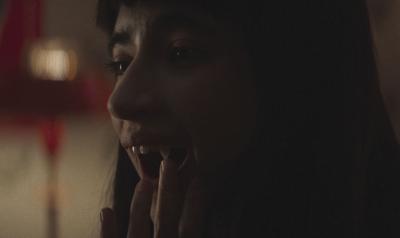
In Humanist Vampire Seeking Consenting Suicidal Person, Canadian director and screenwriter Ariane Louis-Seize introduces us to Sasha, a teenage vampire with too much empathy to kill. Louis-Seize’s debut feature shows us a modern vampire story that’s part horror and part rom-com.
Below is a discussion between Scene digital editor Kim Baldwin and Scene senior film critic Jason Shawhan about Humanist Vampire Seeking Consenting Suicidal Person and its generational themes.
Kim Baldwin: The spark for doing this was to talk to someone about how certain vampire traits evolve over time. I’m Gen X and grew up on Anne Rice. I also read the Twilight series. There’s a difference between Anne Rice’s vampires (stone-cold killers) and the Edward Cullens and now Sashas, who prefer not to kill humans to feed.
Jason Shawhan: I’m of the Gen X/Anne Rice school as well, and I think if there’s any throughline to be found in the portrayal of vampirism from a generational perspective, it’s comparable to the rise of vegetarianism and veganism, or raising queer kids. Consciousness-raising about what one eats has been a factor in family fractures and the need to break free from tradition for a while now, and vampirism is a way of exploring that through the lens of the fantastic. There are a lot of issues that can be explored using vampirism as a distancing factor. Twilight as a series is about the idea of control and temptation and making women feel guilty about anything close to sexual assertiveness. Anne’s vampires are killers, but they can refrain from doing so for love, for curiosity or because that’s their kink, so they’re a major evolution from the Dracula/Varney/Bathory archetype.
KB: The vegetarian thing is interesting. I’m not a vegetarian, so I didn’t clock that. I wrote it off as a softening for the newer generations. Like, “Oh, Gen Z doesn’t want to see vampires chomping down into people’s necks. Let’s just have them drink blood bags, or kill deer.”
JS: One of the things that I love about the subsequent generations is how they are very good at interrogating what was taken as obligatory by those who came before.
KB: Are the vampires created by boomers different from the vampires Gen X or millennials create? These new vampires have human emotions, like empathy and compassion, and in Sasha’s case, PTSD.
JS: Few boomers have accomplished what Anne Rice did, and I think she’s such a singular creator that it’s very difficult to fit her into a generational space. The novel Interview With the Vampire is coming up on its 50th anniversary, and fiction authors who work in the vampire milieu are still reckoning with her work and its aesthetics. In a way, I think Sasha’s family in HVSCSP embodies the shifting perspectives on vampire ethics in that the oldest member of the family, the aunt, is the most bloodthirsty and the one who ascribes the least agency to human beings. The parents are torn between tradition and acknowledging their daughter’s growing social conscience and sense of ethics.
KB: Sasha’s is the first vampire family I’ve seen portrayed like this — with love and understanding for their daughter. I don’t know if What We Do in the Shadows comes into this, but it’s also a very loving dysfunctional family. I loved that Sasha’s family got her a clown for her birthday, and that she was supposed to eat it. And then when she freaked out, they took her to a vampire therapist.
JS: It’s also interesting how vampire cultures are often portrayed as diaspora communities, where they may be a central council or collective of ancient thought, but they are at a remove from the average vampire, so the keeping of these traditions can be seen as a way of maintaining something they were raised in. I love the idea of the sacrificial birthday clown, though, and admire the way that HVSCSP finds its own kétaine spin on the modern reckoning with the vampire that modern media has been having. Also, there are few things that bring me joy like Quebecois swears.
KB: YES!!
JS: In a way, vampires are like cops, in that the needs of the story are going to determine both how they are portrayed and the ethics with which they conduct themselves.
KB: Omg, AVAB. I want to talk about how the scene where she brings Paul back to her cousin’s loft is like a losing-your-virginity scene. When they’re on the bed and she’s preparing to bite him, he asks if he should angle his neck, close his eyes or lie down. I also thought the way she got her fangs was similar to a girl getting her period, or puberty in general. The surprise, horror and shame is familiar.
JS: I would agree with you. Sasha getting her fangs is very relatable to anyone who spent years at the mercy of biochemistry and autonomic nervous responses. And it’s also very funny the way that their relationship evolves, to the point that the bite can’t happen until they’ve done the groundwork and truly gotten to know one another. It’s such an intimate act that neither of them can undertake it casually.
KB: One more point I’m interested in. I’ve recovered from disordered eating and I saw a parallel between Sasha’s refusal to eat and human eating disorders. The way her family had to beg her to eat and then how she stopped eating to prove a point/gain control.
JS: That’s an intriguing perception. It seems a very complex metaphor that I’m not really qualified to speak to. But I have no doubt that the makers of HVSCSP are concerned with the issues that young women face in the world, and I think that makes sense as something that they want to address.





