
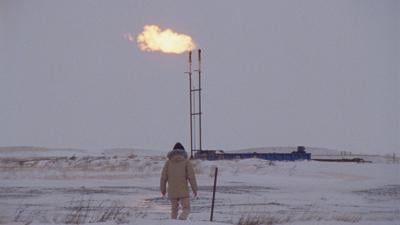

How to Blow Up a Pipeline is a caper drama where the stakes are unusually high — the target isn’t a cache of gems or the contents of a bank vault. The crew behind this job has set their sites on the future of the planet.
The movie is inspired by the nonfiction book of the same name, written by climate activist Andreas Malm — a book that despite its DIY-harkening title doesn’t actually give instructions for blasting the hell out of a petroleum pipe. Rather, Malm looks at the tactics of the climate protest movement and notes: “Thus far, the movement for averting a spiralling climate catastrophe has not only been civil: it has been gentle and mild in the extreme.”
Malm is no Chairman Mao. He concedes the advantage of nonviolence as a strategy. But he and other activists say attempts to persuade the powerful to ditch fossil fuels have proven futile, and it’s time to consider launching attacks on property.
Which brings us to the group of fictionalized young people at the center of Pipeline the film. We watch them gather in a dusty patch of Texas where they plan to sabotage an oil facility. They joke about being terrorists — “Jesus was a terrorist!” one says giddily — but they aren’t mad bombers. Their painstaking plan is to disable the pipeline without hurting humans or creating a massive oil spill. Of course, plans are never certain, and the filmmakers (director Daniel Goldhaber, writing with Jordan Sjol and Ariela Barer, who also stars) have devised tension and twists that propel the film for a taut and satisfying 104 minutes.
Frequent flashbacks flesh out the stories of the crew. A central figure is Xochitl (Barer), who grew up next to a refinery and watches her childhood friend Theo (Sasha Lane) suffer with leukemia — due, a doctor hints, to exposure to refinery toxins.
Theo is on board with the pipeline plot, along with her girlfriend Alisha (Jayme Lawson), whose subtle facial expressions convey a pragmatic reluctance about the mission — a sentiment canceled out by her fierce love for Theo. Logan and Rowan (Lukas Gage and Kristine Froseth) seem like West Coast bubbleheads, but they prove wily and strong when plans go awry. The man with the munitions is Michael (Forrest Goodluck), who has a penchant for rage and sharing his explosive tips on the internet. Shawn (Marcus Scribner) is a bookish filmmaker who is ready to graduate to direct action. Finally there’s Dwayne, a Texan with a young family to feed who has a powerful grievance against the oil industry.
As noted, the movie’s pace is propulsive, thanks to the writing and clever editing by Daniel Garber. Tehillah De Castro’s cinematography invokes ’70s thrillers without being precious. The soundtrack of electronic music helps drive the tension, but to me, it occasionally devolved into a pinging distraction.
The filmmakers do a good job of showing the exhilaration of disparate people coming together for a cause. The script neither glorifies the characters nor looks down on them. And it’s up to the viewer to decide whether the team is taking the right strategy toward a very dire dilemma.
Ultimately, the filmmakers aim to stir a sense of empathy, vital to piercing the apathy that surrounds the climate crisis. And director Goldhaber is clearly the right man for the job.
In an interview before the film screened at the Toronto Film Festival, Goldhaber noted that his parents are climate scientists, and added with a laugh, “I’m grateful to them for raising me with an impending sense of doom.”



