
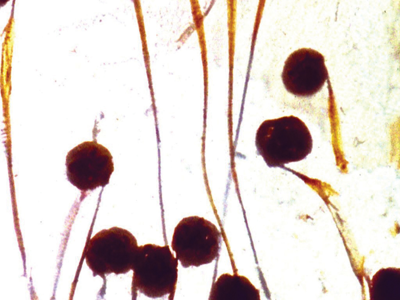
This is an article that may or may not have a purpose. To be more exact, this is an article about the films of Stan Brakhage, some of which will be screened at Third Man Records on Thursday, July 23, as part of the increasingly unmissable "Light and Sound Machine" series. It is not the words on this page, or the ideas contained herein, that represent Brakhage's esoteric thinking. Brakhage's philosophy, as such, is contained within his films. The conundrum is this: Should I "prepare" you for these films with language?
Brakhage was a devout modernist, a firm believer that he was using cinema to express ideas that couldn't be conveyed any other way. That is, he aimed to minimize those aspects that mainstream cinema so often borrowed from other arts, such as theater (acting, character identification), literature (plot, narrative), and in most cases even music (emotional goosing, background accompaniment). What you had left would be a kind of moving, time-based visual art, images edited according to rhythms dictated by the tonal qualities of the material. So while Brakhage's films may bear comparisons to a different set of artforms — painting, photography, poetry — they are based on irreducible elements of cinema: light, time and motion.
What's so mystical about that? Seen in that light, Brakhage's cinema scans easily as a component of the larger 20th century project of modernism across all the arts. In painting, Cézanne, the Cubists, and eventually Pollock and Rothko represented a similar mission: to purge 3D illusionism from the canvas and instead explore thresholds of flatness. What can be done with the bald-faced application of pigment on a 2D surface, with no "cheats" from either photography or historical "narrative"? In literature, novels became less about storytelling and more about crises of internal consciousness (Faulkner, Proust) and eventually the problematics of language itself (Gertrude Stein, late Joyce, all the poets). Even in the most scientifically inflected of the 20th century arts, photography, modernists became concerned with using the mechanical objectivity of the camera to express interior states (Alfred Stieglitz's "Equivalents") or found abstractions (from Man Ray to Minor White).
The trouble is, Brakhage believed that his practice was in direct opposition to language. If one views a Brakhage film (which is now easier than ever, thanks to the two-volume Criterion Collection DVD set), one is immediately struck by his unconventional, even disorienting style. In a film such as his 1963 short "Mothlight" — made without a camera by pasting moths' wings, flowers and other organic ephemera between strips of 16mm splicing tape — deep blacks might give way to sudden flashes to hot white. Scenes of deep red or blue hover on the edge of photographic legibility, like monochromatic etchings. Shots are in variable focus, or the lens will shift mid-shot, providing a suddenly closer view of a person or object.
The handheld camerawork is jarring, jerking about in swish-pans or rapid drops, lending an impressionistic glimpse of things that may or may not rhyme with or reinforce moments witnessed prior. And, in perhaps the most notable feature of mid-period Brakhage films — a body of work that literally spans from birth (1959's "Window Water Baby Moving") to death (1971's "The Act of Seeing with One's Own Eyes") — shots tend to last only a few seconds. Even then, they are just as likely to be "visual noise" (black leader, end flares, color tests, overexposures, scratched emulsion) as photographic content.
All of this intense visual activity, which in all but a few cases is presented in absolute silence — no soundtrack, no accompaniment — speaks to Brakhage's theory of the "untutored eye." He understood visual perception to come before language, something that we humans experience right from the start of our lives. We have an immediate, tactile relationship with the world through this pure, innocent vision, a way of seeing unfettered by need, logic or concept.
Inevitably, though, words and ideas rush in to kill the buzz. With an irony that was in no way lost on the filmmaker himself, Brakhage elaborated his concept of the "untutored eye" in 1963 by writing a book, titled Metaphors on Vision. Here are the opening lines:
"Imagine an eye unruled by manmade laws of perspective, an eye unprejudiced by compositional logic, an eye which does not respond to the name of everything but which must know each object encountered in life through an adventure of perception. How many colors are there in a field of grass to the crawling baby unaware of 'Green?' How many rainbows can light create for the untutored eye? How aware of variations in heat waves can that eye be? Imagine a world alive with incomprehensible objects and shimmering with an endless variety of movement and innumerable gradations of color. Imagine a world before the 'beginning was the word.' "
Although Brakhage's manifesto exhibits the sort of tone that has since been co-opted for salesmanship — "Imagine a digital TV with colors so sharp, you'll never see 'green' again!" — it goes a long way toward explaining how he conceived of his cinematic project. By extension, one can also see why an article such as this one plays directly into the very paradox that Brakhage explores. On the one hand, the ideal viewer for Brakhage's cinema goes in with absolutely no explanations, no verbal cues, no conceptual shortcuts. To look at his technique and think, "Oh, this is about the attempt to break down language's hold on vision," is in some sense to label Brakhage, just as surely as if the films themselves invited us to say, "That's a car, that's a table, that's a bankrobber and a bomb ... "
Follow that thought to its seemingly logical conclusion, and the "ideal viewer" for Brakhage's cinema isn't any of us — certainly not me, or any of you. It's that hypothetical infant whose eyes have only just opened, her head too large to hold up, her senses providing mere passels of phenomenological flux. Projected above a crib, the Brakhage film would flit in and out of the baby's memory like a shadow — a thing among others that happened, but one that left no real impression. Nevertheless, it would have fulfilled its aesthetic charge: to address itself to the truly untutored eye with a sequence of rhythmic light pulses — pure vision for the tabula rasa below.
This, of course, was not at all his point. Brakhage speaks of the untutored eye knowing full well that his (adult) viewership, and he himself, were always already inside language, that the game was lost before he ever began. Like so many modernist efforts, the cinema of Stan Brakhage is a retroactive longing for a hypothetical, perhaps even false, state of grace, and as such, an asymptotic grapple toward a chimera. A glorious "failure," Brakhage's cinema purports to take us back to a state that is impossible to achieve.
In so doing, these films denaturalize our vision, positing the most basic rules and habits of the optical world as mere conveniences. There may be no "untutored eye" in our past. But watching any Brakhage film will demonstrate how absolutely "tutored" our seeing really is. We focus on the object, but blind ourselves to its flickering shadow. We count the hours of daylight with the clock on the wall, but we ignore the gradual shifts in color temperature on our walls and through our curtains, the deep hash-marks of negative space in our pets' fur near dusk or the way that a photo of a loved one becomes eerily elongated when we catch a glimpse of it from the side. Most of the time, we use our eyes to look at things, so we can take them, or throw them away, or avoid bumping into them. In Stan Brakhage's films, we use our eyes to see, without demand or expectation, so that the surfaces of the world become a renewable resource.
Email arts@nashvillescene.com



Post a comment as anonymous
Report
Watch this discussion.
(0) comments
Welcome to the discussion.
Log In
Welcome to the discussion.
Keep it clean. Please avoid obscene, vulgar, lewd, racist or otherwise abusive language. Comments featuring hate speech or threatening or violent content will not be tolerated.
PLEASE TURN OFF YOUR CAPS LOCK.
Be truthful. Don't knowingly lie or mislead.
Be proactive. Use the “report” link on any comment that violates our comment policy.
Share with us. We'd love to hear your feedback.