

Most narrative filmmakers have assumed — erroneously — that because "paintings don't move," the only way to adapt them to cinema is to ignore them altogether. Thus most films about art are really dramatizations of the struggles of men who paint or sculpt. More often than not, these narratives are cast in the light of bourgeois cliché regarding "genius," "madness," or just the Romantics' self-aggrandizing notion that artists feel more deeply than you and I, and are therefore entitled to a lot of very bad behavior (or at least some tony bodice-ripping). Girl with a Pearl Earring and Pollock are good examples of this guff.
On occasion, however, a filmmaker with formal acuity and intellectual rigor is able to use cinema to ask different questions about painting. Where does it come from? How does it register the social and political undercurrents of the society from which it emerged? What forces, such as patronage, impinge upon a canvas's creation? How are seeing, and forming a record of that sight, forms of labor as well as types of thought? How do we receive these messages across the ages? And how can cinema serve as a means of translation, rather than a medium of colonization?
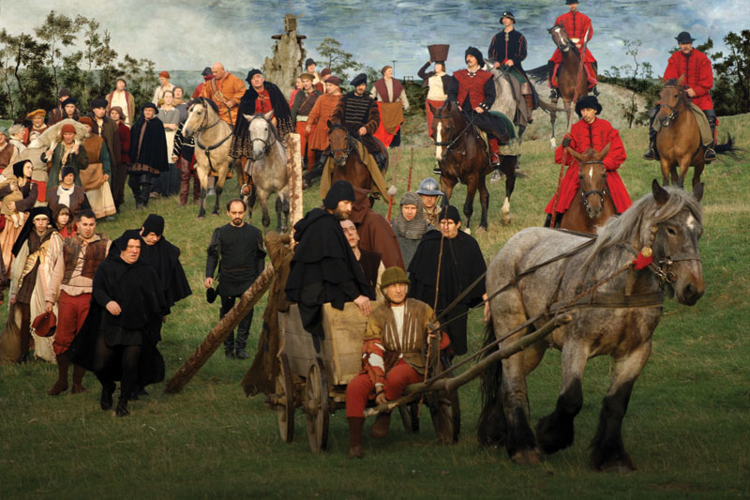
Not many folks have risen to this challenge — Peter Watkins, Derek Jarman, Victor Erice, Jacques Rivette and Peter Greenaway come to mind. The Polish filmmaker Lech Majewski joins their company. The Mill and the Cross is a historical and aesthetic evocation of Pieter Bruegel's 1564 painting "The Way to Calvary." But it is not a history lesson, nor is it a biography of Bruegel (who does appear, and is played with a peasant's taciturn gruffness by Rutger Hauer). Instead, Majewski meticulously recreates specific portions of the Flemish landscape Bruegel and his contemporaries occupied, as evidenced from his paintings and from available historical evidence (e.g., the European studies of Fernand Braudel). We are witness to an ambiguous space which is partly the recreation of what Bruegel actually "lived" — most notably the brutal domination of Flanders by the Spanish, and the subsequent persecution of all non-Catholics — and the imagined, transformed space of his envisioned painting, "The Way to Calvary."
One of the most basic contradictions within all of aesthetics is the fact that artists have struggled throughout the ages to express narrative themes with still images. From the elaborate prehistoric drawings recently examined in Werner Herzog's Cave of Forgotten Dreams, through multi-paneled altarpieces and Japanese scrolls, and of course massive frescoes like the ceiling of the Sistine Chapel, the story of art demonstrates this restless desire to imbue the frozen image with the breath of life, the fundamental motility of storytelling. The greatest art has taken this problem on dialectically, conveying history through its own medium-specific means. This has meant taking form in singular images — figurations of culture and history whose iconic power suspends time itself, rendering the question of stillness versus motion virtually moot.
With the advent of cinema, of course, this contradiction became a crisis, and painting, sculpture and even photography were cracked wide open, leading to all manner of strategies — modernist abstraction, the Cubist depiction of "time" within a flat plane, the abandonment of all objective representation, or even just the embrace of painting's ability to stand outside time. (A Jackson Pollock canvas, for example, is apprehended in an instant, and that instant keeps broadcasting itself over and over, or so the theory goes.) Then, or course, pop art brought narrative back, with a twist: "Marilyn," "Campbell Soup," etc. The art of the logo is that its backstory is intuited in an instant. The Abstract Expressionist canvas had found its dialectical opposite. And so the story continued.
But on the other side of things, filmmakers have been fascinated with using their medium to explore painting for nearly as long as film itself has existed. The influence has been productively, enlighteningly two-way. This has been most evident in the avant-garde, where artists have struck up literal agglomerations between the two media, generating time-based plastic art. Early experimenters like Oskar Fischinger and Hans Richter produced "motion paintings," and later innovators such as Stan Brakhage both painted on celluloid and, when using the camera photographically, wielded it more like a paintbrush. Probably the most notable example is 1971's Tom, Tom the Piper's Son by Ken Jacobs, one of experimental film and video's greatest and most indefatigable masters. The film consists of Jacobs' own rephotographed interrogation of a 1905 short film, which is itself based on William Hogarth's 1735 etching "Southwark Fair." Through slow motion, close-ups and physical handling of the film itself, Jacobs analyzes this complex, teeming scene, whose cluttered frame is foreign to an eye trained by the clarity of contemporary cinema.
This very clutter — the denial of a central plan — is what characterizes Bruegel's "Way to Calvary," at least as compared to most paintings (and certainly most films). "I want it to contain everything," Hauer says; as in the work of Hieronymus Bosch (Bruegel's single greatest influence), figures collide with figures, multiple scenes pull the spectator's attention in a hundred different directions. In addition to conveying a world out of balance, Bruegel's vision implies that only one true eye — that of God — could ever discern a plan from this chaos, should any actually exist. Majewski, for his part, maintains this crowded perspective while also maneuvering his camera very deliberately through the fray. In so doing, he allows us, like Jacobs before him, to contemplate "The Way to Calvary" element by element.
The canvas, commissioned by an Antwerp merchant named Nicolaes Jonghelinck (Michael York), was intended to bear covert protest not only against the rampant abuses under the Spanish occupiers, but more generally against the eclipse of reason and the loss of Christly love. As such, we see grim reality — soldiers hiking heretics on wheels as warnings, women buried alive — blended with Mary (Charlotte Rampling) watching helplessly as Christ is crucified, the Spaniards standing in for the Romans.
While there are pauses during which Bruegel explains his method to Jonghelinck, Majewski orchestrates the sequences of "The Way to Calvary" not as drama or as tableaux vivants but as something else: a slowed, display-oriented non-time that places us in a position hovering between absorption and judgment. Above it all on the hill, as God's surrogate, is the miller (Marian Makula), whose windmill slowly turns, a literal Wheel of Time grinding the Grain of Life. He watches the tyranny, from a position both central to and removed from Bruegel's scene. In a sense, in this remarkable and transporting film, Majewski affords us the same vantage point.
Email arts@nashvillescene.com.



Post a comment as anonymous
Report
Watch this discussion.
(0) comments
Welcome to the discussion.
Log In
Welcome to the discussion.
Keep it clean. Please avoid obscene, vulgar, lewd, racist or otherwise abusive language. Comments featuring hate speech or threatening or violent content will not be tolerated.
PLEASE TURN OFF YOUR CAPS LOCK.
Be truthful. Don't knowingly lie or mislead.
Be proactive. Use the “report” link on any comment that violates our comment policy.
Share with us. We'd love to hear your feedback.