
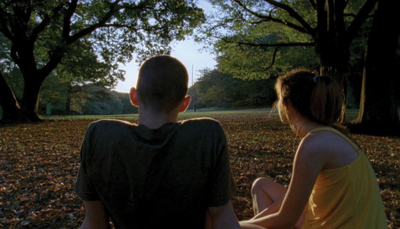

No assembly of student films is complete without two reliably overused ideas: Life Flashes Before My Eyes, and My Drug Trip. Standing alone, each provides an excuse to let it all hang out visually; better still, neither has to make much sense. Gaspar Noe's Enter the Void not only doesn't avoid these cliches, it actually combines them — which by all rights should make just about the lamest movie in creation (as those who suffered through The Trip last weekend at The Belcourt can attest). It doesn't. Two and a half hours later, Noe ejects you and your altered consciousness into either unsparing sunlight or enveloping darkness: Whichever the case, you leave the theater on rubbery legs.
For Noe, that's nothing new. At a Toronto screening of his Irreversible, still the most visceral experience I've ever had in a movie theater, I had to walk past the director leering by the exit, and my first impulse was to hit him back. (And he seemed so nice visiting The Belcourt for Harmony Korine's Trash Humpers premiere.) The movie's brutalities are many and legend, but far more punishing — in that backward-told tale rewinding from thwarted vengeance past unspeakable violence — is the serene "beginning" that's innocent of all the cruelty to come. Yet the farther I got from the movie, the less assaultive and more mournful it seemed: The tissue trauma healed, but the sense memory remained. The force and extremity of his movies make it easy to write Noe off as a showboating provocateur, but a romantic's damaged heart beats madly and erratically in them.
Enter the Void is excessive even by the standards of Noe's stylistic ferocity: a psychotropic phastasmagoria that sends a dying junkie's spirit soaring over the liquid neon streets of Tokyo. Written by Noe and his collaborator/partner Lucile Hadzihalilovic, the movie has little dialogue and needs less: The actors are less persuasive than the furiously subjective camera Noe uses as both a fixed and disembodied consciousness. Like Noe's avowed inspiration — the 1947 noir oddity Lady in the Lake, shot with the camera's P.O.V. standing in for star-director Robert Montgomery — it's an experiment in burrowing behind someone else's eyes, to the point the director uses black-frame blips to simulate blinks.
You don't want to read about this movie any more than you want somebody to tell you about a fireworks display. Once Oscar (Nathaniel Brown) meets his sorry end from police bullets in a filthy bathroom stall, Benoit Debie's camera sails up out of his body, then haunts disconnected scenes from his life – especially those involving his incestuously close sister Linda (Paz de la Huerta) — like a psychic vapor trail. The meaning is all in the ghostly drift of the images, the soupy hot color and weightlessness. Noe may introduce the influence of the Tibetan Book of the Dead in amusingly clunky fashion (basically "Hey, have you read The Tibetan Book of the Dead?"), but he whizzes from Oscar's death to afterlife to rebirth in a blaze of virtuosity: barrel-rolling camera moves that scale neon canyons or skim blocks from Olympian heights; an aural fogbank of ambient sound and throbbing techno beats; undulating CGI effects that represent innards, crab nebulae or coral reefs to evoke infinite innerspace. No other filmmaker working so prowls the outer limits of existence. Why is it that IMAX 3D has to be the province of crappy kids' movies, when someone like Noe is painting for skyscraper-sized canvases?
Which is to say that it makes no more sense to watch Enter the Void at home than it does to see 2001, Avatar or I Am Cuba on an iPhone. I recommend positioning yourself third row center, at least for Noe's carpet-bombing of a credit sequence — two concussive minutes of pulsating graphics that render the next week's ration of coffee superfluous. Life, in Enter the Void, only starts after death.
Email arts@nashvillescene.com.



