
Historians use the term "backshadowing" to refer to the fallacious practice of interpreting the past solely through the lens of the present. Free-market triumphalism, for example, often confuses history with ideology, failing to see how other social arrangements were not simply "pre-capitalist." The history of technology, in particular, is often subject to such backshadowing. Our own sense of presentist pride and the dazzling promotional machines of numerous tech companies (Apple especially) collude to convince us that yes, in fact, LG is correct: "Life is good." And somehow inevitable.
"Backshadowing," just like its more ominous cousin foreshadowing, is a way to arrange myriad events, many of which were certainly somewhat random, into a comprehensible story. Movies usually do not treat this process as particularly problematic. Instead, they set certain boundaries — basic situation, characters, goals, setting, complication, etc. — and explicate them with a basic transparency. This we call "realism."
But our conventional notion of realism isn't actually very "real." It elides a lot of things people do — waiting for buses, looking for our underwear after a sexual encounter, fumbling for the right words in an awkward social encounter, things like that. Bruce Willis never farts. Jennifer Aniston never stubs her toe, unless it will be the set-up for some comic setpiece. Things typically don't just happen.
But in the films of the so-called "mumblecore" directors (Andrew Bujalski, Joe Swanberg, Aaron Katz, Bob Byington and others), quite a number of things do just happen. This is not because the filmmakers are lazy or lack craft. Rather, they are interested in a few things that traditional realists are not. They are concerned with what we might call "the phenomenology of performance" — how groups of people actually interact in the presence of cameras and how this provokes a movement between actorly concentration and basic human self-consciousness. They are also interested in how, when realism is nudged beyond its usual Hollywood codes of ideal composure and absolute mastery, it becomes hyperreal, provoking a level of discomfort that is actually edifying for artist and viewer alike.
Bujalski has long been the most intriguing and ambitious of this group of filmmakers, in part because he has been the most willing to rid himself of any crutches (surface beauty, self-confession, outwardly "clever" humor) that would dampen his films' most potent (and at times irksome) trait: a passive-aggressive indecision with regard to form. In his first two films, Funny Ha Ha and Mutual Appreciation, Bujalski seldom would assert a style or a directorial attitude without almost immediately undercutting it, as if exhibiting any connection to film history would mark him as pretentious. His third feature, Beeswax, an Austin-based slacker comedy, mitigated much of this timidity, inverting nearly every cue its premise implies. It was a success.
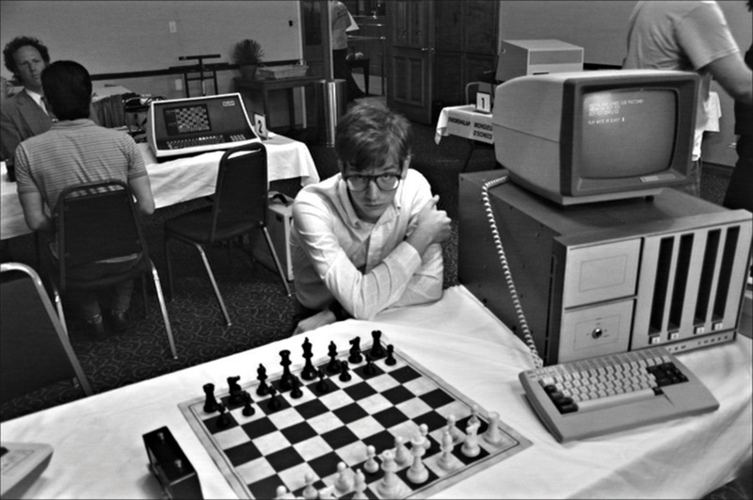
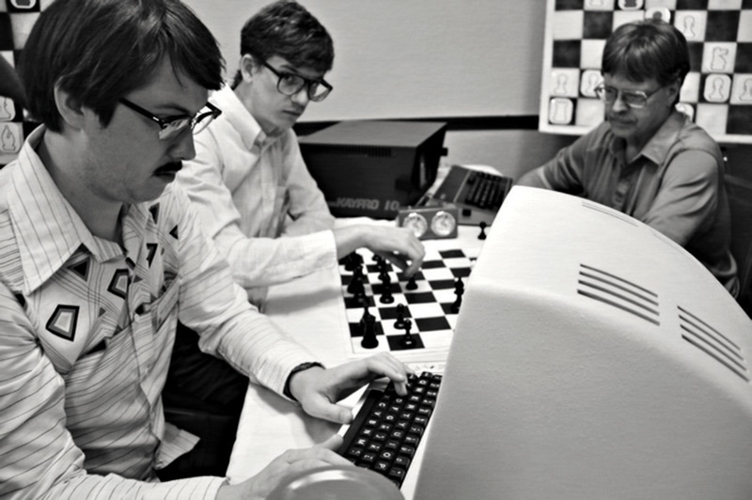
And now, with his fourth film, Bujalski has achieved something major. Computer Chess is in many respects a departure for the director. Set in 1980, it is his first period piece. And after working in 16mm, Bujalski has turned quite ostentatiously to outdated black-and-white analog video. (The expressive use of "period tape" is something Computer Chess shares with the recent Chilean film No.) On its surface, the film is meant to reflect the loose documentation of a weekend conference of computer programmers specializing in early artificial intelligence, specifically those who are working on autonomous chess programs. The gathering (at a rather crappy hotel) is half academic confab, half tournament, with teams of buttoned-down nerds (MIT, Stanford, U. of Chicago, a few independents) lugging their stone-age consoles around while human chessmaster Pat Henderson (film critic Gerald Peary) emcees.
Computer Chess is a comedy, and there are certain good-natured jabs at nerd and academic culture. The first-time presence of a "lady programmer" (!) (Robin Schwartz) is endlessly remarked upon, as if she were Morganna the Kissing Bandit. The haughtily anti-establishment programmer Michael Papageorge (Myles Paige) essentially calls everyone at the opening panel a fraud and then has to beg them for places to crash. The real achievement here is twofold. Bujalski gets all the period details right, which is admirable and not easy to do. But this is nothing compared to what he gets right in terms of historical understanding. He zeroes in on a moment when the human encounter with computing is brand-new, its trajectory largely unformed.
Computer Chess doesn't go back to this early moment in order to ironize it or showcase its naïvete. Instead, Computer Chess really looks at a scene, before it was a multibillion-dollar concern. There is no backshadowing at work here, only a reconsideration of unknown possibilities. In this regard it's clear that Bujalski feels a kinship with these programmers. His use of old analog video displays its aesthetic potential. Likewise, the film's formal structure, with its wandering attention, dispersed multi-character approach and looped sense of time, observes a more "networked" sense of plot, rather than the linear mode that traditional realisms tend to impose. Computer Chess, at the very core of its circuitry, refuses to dictate the past or prescribe the future. Bujalski has devised a cinema of knight's moves.
Email arts@nashvillescene.com.



