
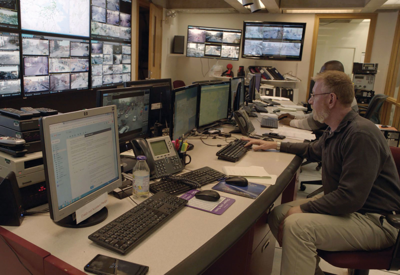


Over five decades, documentarian Frederick Wiseman has turned his camera on almost every kind of space imaginable, from mental institutions to meatpacking factories, from small towns to federal agencies. Wiseman has no time for the flash or fussiness of contemporary documentary form; in his films you will find no voice-overs, no talking heads, and only the slightest amount of context as to who people are. In that simplicity, he routinely uncovers the profound, finding out how America functions in simply observing its populace in action and at work. He’s prolific both in the constancy of his output and the intensity of his scope.
I’m almost surprised, given Wiseman’s career-long interest in local government, that it took him so long to make a film called City Hall, which is the name of his new in-depth look at everything it takes to make the city of Boston run. We attend budget meetings, spend time in boardrooms and see behind the image that a city projects to the world. Though the film is very broadly about Boston as a whole, it takes as its anchor the city’s 54th mayor, Marty Walsh, following him through a packed schedule of city council sessions, press conferences and speaking engagements to local organizations. Centering on Walsh allows Wiseman entrance to a varied spectrum of spaces and places, as the mayor touches almost every facet of city life. We follow him on a tour of his day-to-day activities as he holds court and takes comments at retirement homes, schools and community centers.
Walsh comes across as a down-home, Dunkin’-swigging Boston boy, born in Dorchester to Irish immigrant parents, who has a natural rapport with his constituents and a habit for speaking more frankly than most politicians would. There are moments when Walsh’s desire to connect with citizens on an emotional level comes across awkwardly — like when he attempts to relate to a Latinx political group by outlining Boston’s history of anti-Irish sentiment, or when he tries to connect with a crowd of veterans by sharing his personal struggles with alcoholism and addiction. But the mayor mostly appears as an honest man tasked with a momentous balancing act.
There’s a particular focus on Boston’s diversity, along with how city services attempt to meet the needs of its substantial immigrant population. On both the official and personal levels, we see Bostonians reconciling with the city’s particular history of racism while working out how to enact a more progressive future. It’s made clear, though never explicit, that city operations are significantly complicated by the Trump administration, which has denied and threatened the kind of federal aid made available under previous presidencies. Of course, Wiseman examines City Hall not just as a shorthand for government, but as a literal space, spending time with everyone involved in operations — down to the security guards who scan visitors on their way in.
Given Wiseman’s tendency to let his subjects spool out without interruption or intervention, your engagement with the film may vary from moment to moment depending on your interest in what a particular person is saying. Certain sequences stretch to the point of tedium, most notably an extended scene that captures a night of commemoration and reflection at a local veterans’ hall. But Wiseman always finds a way to bring his vast collection of threads and tangents back together.
In a sequence toward the end of City Hall that’s both patient and riveting, Wiseman captures a community forum moderated by city officials on the planned opening of a marijuana dispensary. The owners and investors of the weed shop — mostly white and Asian-American men — take the comments of a diverse group of citizens from working-class Dorchester, a neighborhood with a substantial Cape Verdean population. The community’s questions range from the practical, like how the store plans to deal with customer overflow and safety concerns, to the necessarily political, like how the owners plan to give back to Black Bostonians and contribute to the fight against mass incarceration.
It’s this scene in particular where Wiseman’s thesis on urban management comes to life: The operation of a city is a complex negotiation between personal citizens, private business and public services, ever-changing and always in a state of flux. A city is an active dialogue between its inhabitants as much as it is a physical place.



Post a comment as anonymous
Report
Watch this discussion.
(0) comments
Welcome to the discussion.
Log In
Welcome to the discussion.
Keep it clean. Please avoid obscene, vulgar, lewd, racist or otherwise abusive language. Comments featuring hate speech or threatening or violent content will not be tolerated.
PLEASE TURN OFF YOUR CAPS LOCK.
Be truthful. Don't knowingly lie or mislead.
Be proactive. Use the “report” link on any comment that violates our comment policy.
Share with us. We'd love to hear your feedback.