
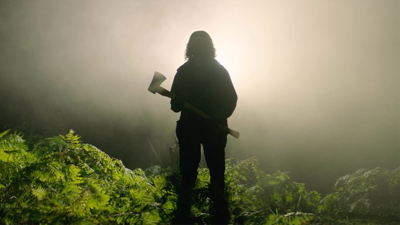


With In the Earth, you’ve got to love a film that sets itself up to be visionary and gross, as well as embodying a dialectical conflict. On one side are the ancient mysteries of the earth — sacrifices, gods, pagan magick. On the other is the reach of science — frequencies, patterns, recurrence. The mind and the body have to work together to map out the sensory unease afoot in these woods, and writer-director Ben Wheatley skews toward the psychotropic earthiness of his A Field in England in this modern horror epic, made during the pandemic, but compelling COVID-19 to act under another name. Wheatley is a fascinating director, weathering even the fake-out grenade of problematicism that last year's Rebecca remake for Netflix ended up being, and at his best, he’s hysterical, ghoulish, deeply political and steeped in narrative purpose.
The film treats its plague as but a facet of the story, which is honestly the best way to process viral (ha!) narratives at the moment. It acknowledges the shared experiences of the audience, but does not allow it to determine the shape of the story or the realizations of its characters. If anything, it uses its mask-and-disinfectant-procedure moments as a kind of three-card monte shorthand — placing the viewer into a world very concerned with the unseen particles in and around us, but leaving defenses unprepared for the other unseen menace lurking just outside of perceivable time.
If you’ve marveled at 1972’s The Stone Tape and wondered Why doesn’t anyone make more films like this?, then In the Earth is what the kids call “extremely your shit.” Happily extending its underground roots into pre-Roman occupation sylvan mystery and the pulsing sheen of ’70s prog-sci-fi, this is a film you don’t just watch so much as you zone out within its gnarled grasp. It embodies the organic process of starting out focused and then hitting a realization that diffuses and refracts that focus into a web of possibilities, with that initial certainty becoming quicksand. In the Earth delights in unraveling your emotional sweater — a cinemascope ritual that calls to the social animal, hidden away.
This kind of folk-horror is having a moment right now, and that will continue to be the case as we fall further and further into the climate crisis. If petrochemical dependence and acidizing oceans could be thwarted or reversed, there is no doubt in my mind that as a culture we’d start building the appropriate wicker altars right now. There’s no shortage of middle management, cryptocurrency world burners and reckless CEOs to feed the crackling fires in those monolith bellies to improve our collective global situation.
Martin (Joel Fry) is preparing to walk into the woods. There’s something awry deep within the trees, and past lover and sometime friend Dr. Olivia Wendle (Hayley Squires) is out there in the middle of it, trying to gather data and answer questions. It’s a special kind of emotional reckoning when an ex is involved and you, the world or all of the above might die. And ultimately, it doesn’t matter whether or not an ancient cult is operating or if some preternatural phenomenon is unraveling reality. Because the end result is the same. That’s the thing about despair — it’s everywhere. The curse of humanity is that we’re one of the few (if possibly only) organisms conscious of our own mortality, which allows our existence to have some kind of meaning even as it also can spur fatalism to take over the entire process of living. It’s a delicate balance, and nobody gets it exactly right, except for maybe Odetta and Paul Verhoeven.
There’s a part of my instincts that says if you go into the woods, you may have to run the risk of having your skull bashed in; nature is the primordial stage that the human drama unfolds on. There’s a certain kind of gore — let’s call it artisan campfire surgery — that hits really hard and triggers visceral empathic responses, and that’s going to happen here. Martin goes through a lot while trying to find Olivia, whose scientific expertise is the stone causing these ripples to reverberate outward, into the infinite. And Alma (Ellora Torchia), who starts out as a wilderness guide/emotional sherpa, goes through even more. By the end of it, everyone — whether in the film or just watching it — is going to get a biochemical remix up and down their spine, DNA treated like so much alphabet soup.
There are few disclaimers that offer more promise (for the nonphotosensitive or nonepileptic, that is) than stroboscopic light warnings. In the absolute worst case, you get a short term optical reset. At best, you start processing information in a way that is completely different than you’ve just been experiencing (Flashdance’s “Imagination” sequence, with its spandex, supervillain coat, white-tile background, business realness and Kabuki makeup, is a great example of this, using strobe to detach the image from its signifiers and get to the menace it has been depicting all along; Branigan, begin again). In the Earth uses its strobing to take the viewer’s brain and blow on it like it was a temperamental NES cartridge, and it stays with you, deep in the reptilian brain, entwining itself in the chemical gumbo that is you.
Find the above mentioned Flashdance “Imagination” sequence below. (Turn it up loud and kill the lights.)
#Flashdance #Imagination #Musicalman2012



Post a comment as anonymous
Report
Watch this discussion.
(0) comments
Welcome to the discussion.
Log In
Welcome to the discussion.
Keep it clean. Please avoid obscene, vulgar, lewd, racist or otherwise abusive language. Comments featuring hate speech or threatening or violent content will not be tolerated.
PLEASE TURN OFF YOUR CAPS LOCK.
Be truthful. Don't knowingly lie or mislead.
Be proactive. Use the “report” link on any comment that violates our comment policy.
Share with us. We'd love to hear your feedback.