
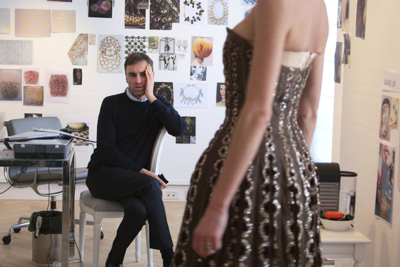


A good documentary can stimulate interest in almost any subject. Talking to a friend who holds Roger Ebert’s work in contempt about Steve James’ Life Itself last year, I said, “Think of it as a film about a man who finds the love of his life at 50, then gets humbled in the years he has left when his voice is taken away by cancer.” When the topic is as rich and filled with innate drama, personality and color as the fashion industry, the task would seem that much easier.
There’s been a mini-New Wave of films about fashion recently, both documentary and narrative: dueling biopics about Yves Saint-Laurent, Albert Maysles’ Iris, Lina Plioplyte's Advanced Style, and now French director Frédéric Tcheng’s Dior and I. While Tcheng’s doc manages to debunk some of the myths about the fashion world — its subject, designer Raf Simons, is not a misogynist whose ideal of beauty is an anorexic 12-year-old — it doesn’t make anyone want to know more about the milieu who isn't already interested.
Part of the problem is that Tcheng's narrative set-up, in which Simons has to create a new line of haute couture in eight weeks, is a well-worn staple of reality TV. Shows covering fields ranging from makeup artistry to running a restaurant have turned creating a new body of work into a quasi-athletic challenge. Dior and I gives equal time to Simons and the people toiling away for him. To his credit, Tcheng seems greatly interested in the seamstresses without whom the Dior empire would crumble. He’s much less fascinated by models, none of whom he interviews or spends much time observing outside their duties on the catwalk.
Dior and I juxtaposes cinema vérité views of the Dior workplace with interviews with Simons and Dior craftspeople. Tcheng’s voice is never heard, though. In an unnecessarily arty touch, an actor does a voice-over as Christian Dior, while archival footage of the brand’s early days is shown. As it turns out, Simons gets many of his ideas from the art world, which creates some issues the film never addresses.
Looking at the abstract spray-can paintings of Sterling Ruby, which the New York Times called “gangster Rothko,” Simons gets the idea to copy their images and place them on dresses. This is difficult, but he’s able to print the blurred designs. In the music industry, this would be called sampling; Simons would have to pay Ruby a fee or risk getting sued. He even refers to the clothes as “our Sterlings.” Yet he gives the artist no public credit, much less money. He also lifts ideas for his catwalk from Jeff Koons, but given Koons’ history of swiping images from pop culture, that’s arguably fair use.
The triumphant finale of Dior and I is admittedly a thrill. But Raf Simons’ success was never really in doubt. He comes across as a nice guy but a somewhat bland figure. The excess detailed in the Saint Laurent films is well behind us — which is good for Simons’ health, but perhaps not so good for documentary viewers looking for something beyond formulaic structures.



