
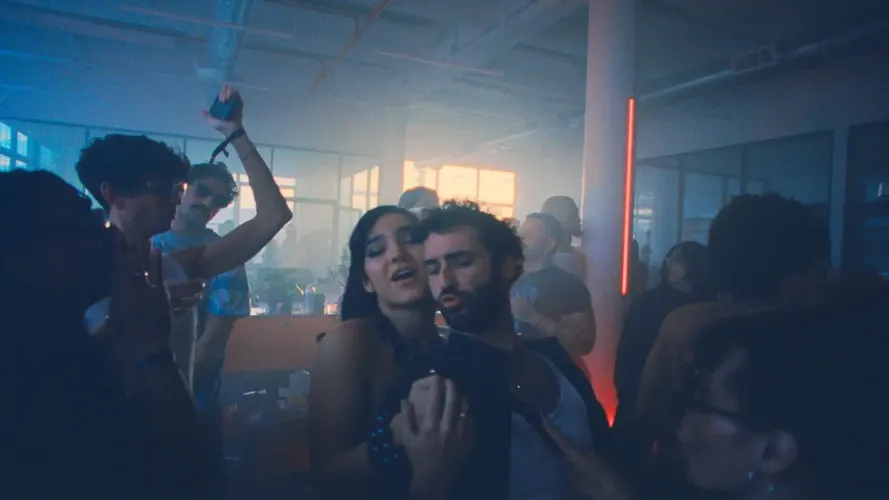
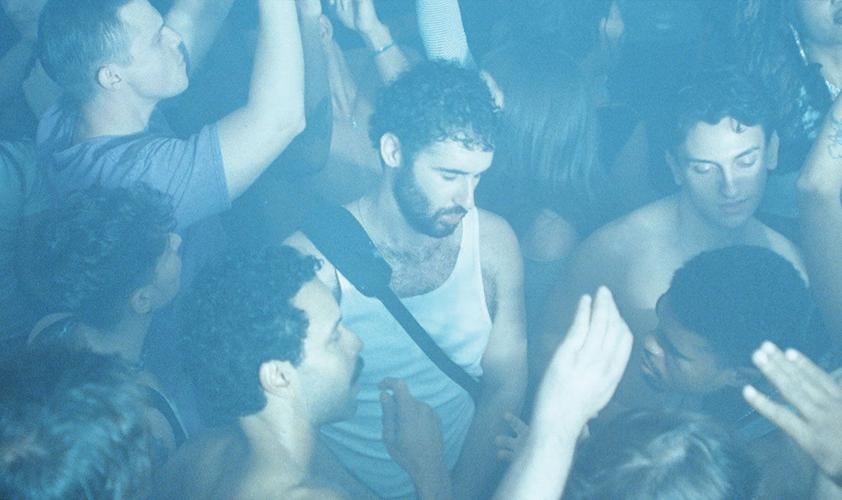

Club Labor has a lot of what we look for in a suitably liberating and decadent nightclub environment. The crowd is happy to be there, diverse and into the music. Whatever everyone’s preferred disco supplement may be is abundant and of quality. And promoters Peter (writer-director Jordan Firstman) and Sophie (Cara Delevingne) seem to have their shit together. It’s a lovely, sweaty, sexy slice of life of the mid-2010s, just before You Know Who was elected. And then, after we’ve steeped in this exquisite little period piece — what with the Rihanna sing-along and a backroom three-way — we cut to The Now, with all of the living of the past decade on everyone’s face. It is deeply effective and absolutely brutal, and it lets you know from the jump that you’re watching a film that understands what a toll the past decade has taken on us all.
And then comes Arlo (Reggie Absolom, who is just great). The result of the aforementioned three-way, this mildly precocious British child has been brought to America following the death of his mother, which makes everyone’s lives swerve all topsy-turvy. We’re never ready for the violent disruption that ripples out from an unexpected death even when we (think we) have our shit together, and on top of that you have a gay New Yorker introduced to a 10-year-old son he never knew he had. It’s a lot.
But thankfully, Club Kid — Firstman’s first feature — wants to cover all the emotional possibilities, and to do so in the most entertaining way possible. You’ll laugh, you’ll cry, you’ll question your fashion choices. And you’ll be bowled over by how this film, which truly loves its unapologetic queer demimonde and “yes, and” attitudes toward drugs, is such a heartwarming crowd-pleaser that understands exactly what an audience will accept and reject.
Firstman reads the comments. And that has given him a distinct advantage in the long game that has led us to this film. His arthouse breakthrough — playing the lead in Sebastián Silva’s 2023 film Rotting in the Sun — was built around a funhouse-mirror version of his own online presence, but then evolved on screen into something more complex, and something very much ahead of its time when it comes to cinematic analysis of influencer culture. If you add Firstman’s work on the series Search Party, English Teacher and I Love L.A., you’ll find that in addition to reliable supporting performances, he’s been running a long-term experiment to see how people react to low-key branding and implicit critique. All of which is to say that Club Kid, aside from being a sincere and meaningful dramedy that is very conscious of what it represents, is also testing just how gay modern audiences are willing to get.
Club Kid has seen Big Daddy and The Wiz and Party Monster and C.H.U.D. and Hannah and Her Sisters and all the other films about the chaos of life and being part of an evolving community in New York City. It understands wacky neighbors (much love to the iconic Colleen Camp) and silent signifiers, and Firstman is doing an incredible job of tearing these things down to their denominators and building something different on that foundation. Social bureaucracies, and vibrant and visceral nightlife, and rent-controlled apartments, and what physical space means when everyone is so packed in. Also the artist Shygirl is there. New York is a city built on possibilities, and so is Club Kid.

Club Kid
When we hear that phrase “club kid,” the first thought that comes to mind is the tribe of misfits and fashionistas who made themselves into low-key legends on Ricki Lake and in gossip columns of the early ’90s. Their rise and fall is documented in the assorted texts of the Party Monster universe, with club impresario Peter Gatien and killer Michael Alig and disgraced former Mayor Rudy Giuliani all helping destroy that era in NYC nightlife. But the idea (and the ideal) managed to outlive the sad truth, and it percolates in anyone with a sense for social planning and with a sufficiently outsize personality. (Some of them even crossed over into the mainstream, like Chloe Sevigny and Natasha Lyonne.)
As a successful promoter, Peter is living the club kid dream. But in Arlo, with his DJ dreams and love for music (and for the only people who showed love to his mother), we literally have a club kid, and that simple title all of a sudden is drawing the viewer into something a tad more complex than initially expected. There’s no cinematic moment in the past couple of years that hit me as hard as when the two visit a potential new space for Club Labor, and the sound system cranks the 1986 jam “Bryllyant” by Boytronic. It’s one of those moments that transcends its moment, speaking to a dance floor four decades gone, ravaged by first the plague and now by the simple, inexorable passage of time. It’s one of the most beautiful disco moments in 21st-century cinema.
It’s funny how structured for mainstream appeal this film is. It is an unapologetic crowd-pleaser that consistently delivers on a very real emotional level — but to get there you have to get through the drugs and the gay sex and the strobe-lit dance floors of pounding purple mist. It’s not too much to ask of allies, for real, but there’s a defiant insistence to not telling a PG-13 version of this story that strengthens its impact.
(Spoiler: This doesn’t turn into every movie about recovery, which is a trap a lot of well-intentioned films about one’s relationship to their party years often do. This is defiantly not a film about recovery, specifically for the reason that every film about recovery inevitably becomes the same film.)
I don’t even know if it’s an intentional alignment, though it probably is, but what Peter and Arlo have in common is a need for everyone around them to be having a great time. It’s a noble attribute for a nightlife impresario, but it’s also something that you find in people who want to craft stability and stasis around themselves through fun rather than force. How close do you keep your friends on the edge? How do you best stabilize the chaotic? You’ve got to find the emotional groove around you and play its song. And damned if Jordan Firstman hasn’t found the path to making a hopeful, deeply funny and honest movie about the ceaseless battles we’re all constantly fighting. To quote the great philosopher Sterling Void: “I hope it’s going to be all right — I hope the music plays forever.”



Post a comment as anonymous
Report
Watch this discussion.
(0) comments
Welcome to the discussion.
Log In
Welcome to the discussion.
Keep it clean. Please avoid obscene, vulgar, lewd, racist or otherwise abusive language. Comments featuring hate speech or threatening or violent content will not be tolerated.
PLEASE TURN OFF YOUR CAPS LOCK.
Be truthful. Don't knowingly lie or mislead.
Be proactive. Use the “report” link on any comment that violates our comment policy.
Share with us. We'd love to hear your feedback.