
The late George Kuchar was one of the true masters of the avant-garde, and at the same time one of its true anomalies. George and his twin brother Mike hailed from the queer/camp underground segment of the experimental film universe, a loose amalgamation of free-love-era visionaries and outcasts that included Andy Warhol, Kenneth Anger and Jack Smith. Like those cinematic outlaws, the Kuchars found an unlikely cheering section (and a surrogate family of sorts) among seemingly more serious-minded avant-gardists. This was work that appealed to Ken Jacobs and Stan Brakhage as much as it did to John Waters.
The truly curious thing about George Kuchar's films (he and Mike stopped working together in the early '60s) is that, even by the "underground" standards of Anger and Warhol, they are far more committed to narrative and performance than almost anything else coming out of the avant-garde at that time. This accounts in part for Kuchar's enduring appeal, but it also demands that we see his films in a different light. What did those high-minded formalists see in Kuchar, and what can we see now?
When we look at these beautiful and hilarious films today, naturally we are immediately struck by their camp value. But they are so much richer than mere parody. Kuchar's mode was most often a straight-faced deflation of the pretenses of Hollywood's Golden Era, the fanfare and the sparkle, the outsized emotion and the glamorous promise. Melodrama and film noir were Kuchar's lingua franca, and in this regard he was an astute critic in his own time. He saw that so-called "B-pictures," like those of Douglas Sirk or Edgar Ulmer, were the domain of the legitimate grandeur that the David O. Selznick productions always implied.
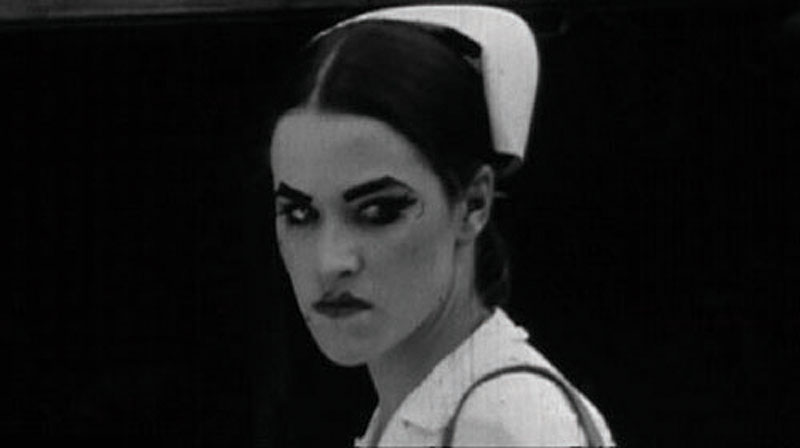
And so, in The Devil's Cleavage — one of Kuchar's only feature-length films, and part of a must-see Light and Sound Machine screening 7 p.m. Thursday at Third Man Records — the writer-director combines the explicit poverty of means (obvious overdubbing, cheap sets, slightly-off hair and makeup, etc.) with a bracingly direct poetry of the gutter. Ostensibly this is the story of a lovelorn nurse (Ainsley Pryor) who, after eliciting more intimacy from her Schnauzer than her layabout husband, goes on an erotic odyssey to Oklahoma. (Doesn't everyone.) But the episodic narrative is more like a string of high-key black-and-white assignations, stripped-down confrontations and Dutch-angle entanglements, all underscored with brief, sassy repartee.
The word is lurid. And yet Kuchar (much like Sirk) uncovers a deep visual poetry within this squalid display. The Devil's Cleavage is a comedy, but one that skillfully builds its characters' broken dreams right into the filmmaking itself. We're given no skyhook for judgment; we're down in the muck.
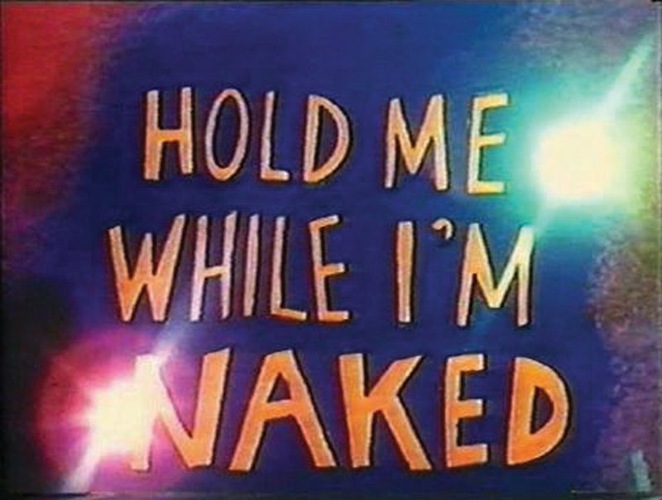
Screening along with Cleavage is the 15-minute short "Hold Me While I'm Naked," probably Kuchar's best-known work and without a doubt one of his masterpieces. Shot in candy-coated 16mm colors that are a thing of the Kodak past, "Hold Me" stars Kuchar himself as a frustrated film director trying in vain to use his project as a way to get a gander at the boobies of his reluctant starlet (Donna Kerness). In time, his actors abandon him, and he experiences a crisis of confidence: Am I an artist, or just a loser with a camera?
"Hold Me While I'm Naked" is a delicious slice of self-excoriation, and impossible not to identify with, if you've ever wondered whether you're the only one not invited to the party. Together, both films clarify the full range of Kuchar's artistry, and why his work resonates beyond mere camp or parody. These are films that, in their own unique way, engage with questions of class and sexuality, with the challenge of making an "industrial" medium personal and private, and with reclaiming the discards of popular culture through fandom, critical engagement, formal acuity, and fierce love. In his own tart-tongued way, George Kuchar turned the camera-stylo into a poison pen.
Email arts@nashvillescene.com..



