
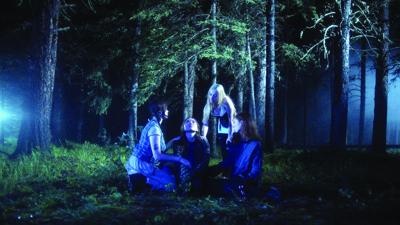

We are in the midst of a queer horror renaissance — and it’s a perfect antidote for our current Christofascist era. This summer, scary movies about queerness and religion are everywhere, each presenting community as a path to transcendence. In Jane Schoenbrun’s Teenage Sex and Death at Camp Miasma (coming to the Belcourt in August), Gillian Anderson seems to have developed a zealous devotion to the slasher Little Death. In Adrian Chiarella’s debut Leviticus, two teenage boys flee a conversion therapy demon. In CAMP, a witchy Chattanooga Film Festival selection from Canadian director Avalon Fast, the character Clara (Alice Wordsworth) declares: “God brought me to the devil, and to my closest friends.”
CAMP is not an easy movie to watch — but if you speak its language, it’s positively hypnotic. Stylistically, it’s impressionistic and dreamlike: While the term “Lynchian” has been overused as shorthand for “weird cinema,” CAMP directly nods to the Twin Peaks mastermind with lingering liminal shots, fourth-wall disruptions and unmooring tableaus. Fast calls their work “girl horror,” and pulls from predecessors Picnic at Hanging Rock, Yellowjackets and Heavenly Creatures, as well as the moody animation and lush wild landscapes of ’80s dark fantasy films. At one point in CAMP, a teenage girl reaches out of an attic window into a painted indigo sky, drawing in beams of stardust. At another, blinding light from a massive white cross coats a dark lake where a girl is swimming.
Narratively, CAMP also asks us to accept uncomfortable sympathies from the start. We follow Emily (Zola Grimmer), a young woman at the center of two freak accidents: a vehicular manslaughter when she was a teenager, and her best friend’s accidental overdose in her car, on drugs Emily gave her. Emily’s grief and self-hatred over both deaths distorts time. Her trauma is inconvenient and embarrassing, erupting in awkward answers to Truth or Dare at parties and explosive fights at home with her dad (Michael Tan).
When Emily’s dad convinces her to spend a summer as a counselor at a mysterious Christian camp for “damaged kids,” however, she’s embraced immediately. She befriends a tight-knit coven of fellow counselors: chipper Rosie (Cherry Moore), lonely Nev (Lea Rose Sebastianis), introspective Hope (Ella Reece, with some striking monologues) and Clara, with whom she begins to form a deeper connection. Kick-started by “sacrificing” a fellow staff member’s virginity to gain more power, the group’s disaffected hijinks grow increasingly dark. It’s the kind of all-consuming, obsessive female friendship common to sapphic coming-of-age, and Fast leaves room for multiple interpretations. Has Emily found her people — or been pulled into something sinister through the high of feeling seen? Are the girls to blame for the extreme places they go to create solace?
Queer stories don’t have to be didactic to be honest, especially when they center the messy, ego-dissolving process of figuring out who you are. What Fast has accomplished with CAMP is a rare feat — one that heralds the arrival of a new queer auteur to watch.



Post a comment as anonymous
Report
Watch this discussion.
(0) comments
Welcome to the discussion.
Log In
Welcome to the discussion.
Keep it clean. Please avoid obscene, vulgar, lewd, racist or otherwise abusive language. Comments featuring hate speech or threatening or violent content will not be tolerated.
PLEASE TURN OFF YOUR CAPS LOCK.
Be truthful. Don't knowingly lie or mislead.
Be proactive. Use the “report” link on any comment that violates our comment policy.
Share with us. We'd love to hear your feedback.