
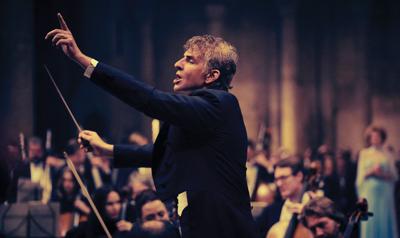

In a post-Dewey Cox world, it’s hard to make a sincere Great Musician biopic and come out unscathed. Maestro is the rare film that actually proves the subgenre still has some life left in it.
Here Bradley Cooper follows up 2018’s critically and commercially successful A Star Is Born remake with another musically focused star/director/co-writer outing — and he pours everything into Maestro. Say what you want about Netflix’s auteur-driven efforts (they almost always feel about an edit away from making that crucial good-to-great leap), but the streaming giant usually gives its directors carte blanche. Maestro is no exception.
Recent attempts at Great Musician stories have debuted to varying degrees of success, but none has really moved the needle creatively. Interestingly, Cooper’s lived-in performance as Jackson Maine in A Star Is Born lost the Best Actor race to Rami Malek’s over-the-top theatrics in the shockingly successful Bohemian Rhapsody — a classic example of an old-school Great Musician biopic — at that year’s Academy Awards. Maestro is more experimental than other recent biopics. It aesthetically resembles works from Old Hollywood (in both its color and black-and-white segments), but the way scenes and time periods bleed into one another feels more indebted to ’60s European cinema.
Cooper once again gives it his all in front of and behind the camera. His performance as Leonard Bernstein is fully committed, capital-A Acting, but he is stretched a bit thin at times with everything this wide-ranging role requires. I’d like to see what he could do while operating strictly behind the camera in his next outing. That’s not because he’s not a talented actor, but because it’d be interesting to see what a Bradley Cooper movie looks like when the director isn’t also in every scene.
About two-thirds of the way through Maestro, an extended scene featuring Bernstein conducting gives Cooper the chance to spread his wings as both a performer and a director. It’s a moving moment that signals a tonal shift toward the film’s more emotional final act. It also signals that the story belongs just as much to Carey Mulligan’s Felicia Montealegre — that’s a key shift from the usual focus of Great Musician biopics, in which a legendary performer’s partner is often flimsily written, ignored or outright forgotten.
Mulligan, shot to accentuate her Old Hollywood look and voice, is mesmerizing as the Broadway performer who became Bernstein’s wife and lodestar. Montealegre is not quite Bernstein’s muse — despite their shared interest in the arts, we don’t often see them collaborating in the film — but she keeps him level. The somehow Oscar-less Mulligan (also a riot in a small role in Emerald Fennell’s divisive recent thriller Saltburn) should be included in any Best Actress conversations during awards season. It’s one of her best performances yet.
Other notable performers show up throughout, including Maya Hawke and Sarah Silverman (the latter in a rare dramatic role!) as members of the Bernstein family, and Matt Bomer and Josh Hamilton as figures in Bernstein’s social circle. But the movie belongs to Mulligan and Cooper. Their performances, and Cooper’s clear affection for Bernstein and for filmmaking as a whole, raise the film above recent entries in the biopic genre. But it also shows what the genre is now capable of. Just look at last year’s Tár, the biopic of a (yes, fictional) musician that wasn’t boxed in by worries about historical accuracy and artist estates.
Even with the film’s flaws, there’s a reason Martin Scorsese and Steven Spielberg signed off as producers of Maestro. It’s a classic second movie — a little less conventionally entertaining matinee Hollywood, a little more cerebral and rough around the edges. It might not be as rewatchable as A Star Is Born, but it proves that Cooper is here to stay as a major director.



