
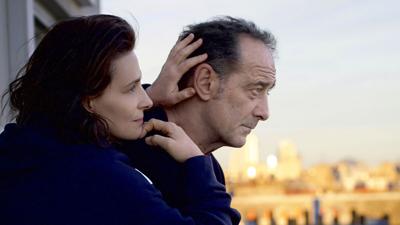

Claire Denis’ Both Sides of the Blade is basically a story about two types of dick — good-bad dick and bad-good dick — and the woman who can’t decide which one to stick with.
Radio-show host Sara (Juliette Binoche) is having a fine time with the good-bad dick she’s got — represented here by her husband Jean (Vincent Lindon). We see them in some sunny locale, holding hands, making out in the water, being lovey-dovey. But their affectionate, comfortable union is rocked when they return home and learn that Sara’s ex François (Grégoire Colin) is back in town. It turns out he’s opening a sports agency that he wants Jean, a former rugby player, to be part of. Both Jean and Sara act like François popping back up in their lives isn’t a big deal. But considering the history these three share (Jean did a decade-long prison stint for something, we don’t know what, that François was involved in), it certainly is. This is especially true for Sara. The mere mention that François is in the vicinity turns her into an emotional mess.
Blade is another torn-between-two-lovers tale, told this time in a pandemic universe. Denis and co-writer Christine Angot developed and filmed it during France’s lockdowns, adapting Angot’s 2018 novel Un Tournant de la Vie for COVID-crazy times. People walk around figuratively and/or literally wearing masks, keeping up appearances until they can take them off and finally be themselves. Chief among them is Binoche’s Sara. Once she reconnects with her former flame in the second half of the film, she becomes two people: a woman who loves her husband and a woman who desires her side piece.
The last time Denis and Binoche worked together — 2018’s Robert Pattinson-starring space flick High Life — the director had the Oscar winner doing all sorts of twisted sexual things. (Remember that shape-shifting sex machine?) It almost seems like Denis made this film just so Binoche could go back to doing something in her wheelhouse — much like when Denis directed Binoche in the 2017 rom-dram Let the Sunshine In (another collaboration with Angot). After all, Binoche has made an art out of playing French ladies who clamor to break out of their bourgeois shackles and do something lustful and liberating.
As the man who foolishly thought his girl could keep her cool around a back-in-the-day lover, Lindon is more reserved than stereotypically cuckolded — this situation is just one of many things he has to deal with. Another of his responsibilities is his surly, mixed-race teenage son (Issa Perica), who stays with Jean’s mom (former Jacques Rivette regular Bulle Ogier) and wants to drop out of school. Jean tries to keep a cool head throughout — that is, until the inevitably volatile climax.
Both Sides of the Blade is a simmering, sensual melodrama played out in a blunt, bitterly neo-realistic fashion, complete with such Denis touches as vague storytelling (actress/Atlantics director Mati Diop shows up in a couple scenes as — I think — a family friend) and an ambiguous ending. Denis seems to relish showing how a tawdry story of passion, infidelity and betrayal would play out in the real world. (Denis’ longtime composers Tindersticks provide a foreboding score that snarkily suggests this is basically a suspenseful thriller.)
With so much out there ready to take us out — viruses, guns, the Supreme Court — let this movie serve as a cautionary tale for those who chase bad-good dick instead of sticking with the good-bad dick they have at home.



Post a comment as anonymous
Report
Watch this discussion.
(0) comments
Welcome to the discussion.
Log In
Welcome to the discussion.
Keep it clean. Please avoid obscene, vulgar, lewd, racist or otherwise abusive language. Comments featuring hate speech or threatening or violent content will not be tolerated.
PLEASE TURN OFF YOUR CAPS LOCK.
Be truthful. Don't knowingly lie or mislead.
Be proactive. Use the “report” link on any comment that violates our comment policy.
Share with us. We'd love to hear your feedback.