

Blue Heron might feature one of the world’s most genuinely compelling instances of a very specific 2010s Instagram trend: taking a photo of someone taking an iPhone photo. The new film opens on Sasha, a young woman holding up a phone to capture the rocks of Vancouver Island. As she finds a point of focus, voiceover reflects on her childhood: “Thank you for those memories. They’re all I have now.”
Blue Heron — which opens at AMC Thoroughbred Friday and expands to the Belcourt next week — sits somewhere between We Need to Talk About Kevin, Short Term 12 and The Florida Project. The film follows Sasha (Amy Zimmer) as she excavates her childhood to understand what happened to her older brother Jeremy, who she calls “as sweet as he was unpredictable.” Her past is based on that of director Sophy Romvari, who in a personal essay for the Canadian Broadcasting Corp. called the debut full-length film her “most significant attempt to capture just how fallible memory is.”
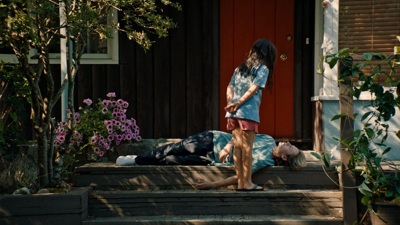
In Sasha’s refracted memories, Jeremy terrorizes the family with erratic behavior, but he’s also a caring older brother. In one early transgression, he shoplifts a blue heron keychain, which he gives to Sasha. As Jeremy’s rebellion escalates to police encounters and threats of harm to himself and others, the family’s crisis contrasts with the film’s bucolic setting, their latest home in a series of moves after emigrating to Canada from Hungary. This sense of place creates a dreamy, summertime feel, as well as more lingering tension. What emerges is a warm but frank look at family and mental health, never maudlin as it strikes an understated emotional chord.
There’s no melodrama, for instance, when the parents accept a life-altering offer from social services related to Jeremy’s care — but the scene is no less heartbreaking. Instead, the children's mother simply confesses their decision into a phone, shell-shocked. Next to her, Sasha’s father intently films the kids playing in the backyard. It’s as if he needs proof that they were happy, to establish some formal record of a complicated emotional truth — a compulsion his daughter inherits. When we meet Sasha as an adult, she’s become a filmmaker, interviewing a care team about how her brother’s case might have been handled differently. Later, she steps directly into her childhood while recording, this time in the role of the social worker.
In sequences like these, Romvari doesn’t just explore Jeremy’s behavior, but also how the rest of the characters relate to it: the things that children do and don’t understand, and the adults’ projections of what his actions say about them. Sasha’s mother in particular carries guilt not just over failing Jeremy but for what others might think of them. “People are talking about it,” she warns Sasha as a child, refusing to let her invite a friend over. When Sasha is an adult, a vision of her brother gently pushes back on her own narrative of their childhood, telling her, “I think there’s a lot you don’t remember.”
It’s a compelling zoom-out, and a refreshing take on the mental health drama, a genre that can tend to grant one-sided dignity to the people in a struggling character’s orbit. Instead, the family members at the heart of Blue Heron are all complicated and flawed, muddling through a complicated situation. In short, they feel real — and this striking, honest debut signals the arrival of a director to watch.



