
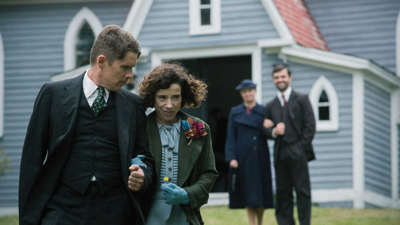


Set and largely shot in Canada, filmed by an Irish director with American actor Ethan Hawke and British actress Sally Hawkins in the lead roles, Maudie risks being the North American equivalent of a messy “Euro-pudding” cross-continental casting extravaganza. While Hawke sometimes struggles with his accent, the mid-20th-century Nova Scotia setting is convincing, even though the film was in fact shot in Ireland and other parts of Canada. Director Aisling Walsh never seems to have made her decisions by committee. The film’s problems instead lie elsewhere: Hawkins’ performance portrays real-life painter Maud Lewis’ introversion so boldly that it becomes passive-aggressive.
Maud was hobbled by rheumatoid arthritis for much of her life, but she was able to go on painting until her illness — eventually complicated by emphysema — became extremely grave. This brings us to the problem with Hawkins. We all know that a perfectly healthy performer play-acting a disease or disability can make for a quick path to acclaim, or even an Oscar: After all, it makes obvious how much work they’re doing in a way that more subtle performances don’t. Hawkins tries incredibly hard to show how Maud’s disease affected her physically, but her performance is massively heavy-handed — you can see Hawkins pulling Maud’s strings the whole time the character is suffering.
As for Hawke, he fares better, showing off an impressive emotional range that includes extreme rage. Maud initially serves as the cleaning lady for his character, Everett, but due to a lack of space, they share a bed and eventually become lovers. Everett is sexually attracted to Maud, but she insists on marriage before sex, and they do ultimately tie the knot and share a relationship that lasts until her death.
Maudie brings together two tropes but never fully embraces either: “two misfit lovers find each other,” and “a woman finds her voice as an artist under the thumb of a domineering man.” More than most period pieces, the film expects the viewer to enter under the spell of the time it depicts. As a result, though it was written and directed by women, it doesn’t exactly play as a feminist film. Everett’s less attractive qualities are presented completely without comment — even when they extend to domestic violence. A film that recently opened at the Belcourt and was also directed by a woman, Sofia Coppola’s The Beguiled, is far more successful in re-creating what it might have been like to live through an unenlightened era while also depicting the consequences that befall a predatory man.
Walsh manages to combine locations seamlessly: You’d never guess Maudie was shot in both North America and Europe. Guy Godfree’s cinematography and Walsh’s use of color, which particularly relies on delicate shades of blue, subtly evoke the vision of a painter. A subplot involving Maud’s lost child is thrown into the film with very little delicacy, but the meat of Maudie lies in the character’s growing passion for her work and her ability to master her craft. Both Walsh and Hawkins express this pretty well. It would be a much different film if Maud was less physically frail, lived in an urban context where she could directly join in the art world’s markets, and was able to compete with Everett as an equal more easily.
For all its strengths, Maudie is never entirely convincing. It depicts a time within living memory, but its world seems exceedingly archaic. Perhaps it’s revealing that the real Maud and Everett, who are shown in vintage newsreels at the end of the film, look far older than Hawkins and Hawke ever appear — though Hawkins’ dowdy and plain appearance is far from a typically glamorous Hollywood portrayal. Depictions of female artists in the past have to bridge the values they lived with and a world that now at least attempts — some of the time, anyway — to be far more liberated and open. Maudie ultimately just seems like a quaint exercise, more like visiting a history museum than watching a woman who truly lived.
Email arts@nashvillescene.com



