
In 2002, I discovered the filmwork of Bill Morrison in an unusual way. I happened to be on the jury of a film festival, one of five people charged with selecting the best experimental film submitted that year. One work clearly stood out from the rest, a feature-length montage compilation called Decasia.
Comprised entirely of found footage, Morrison’s Decasia is a project that works on multiple tracks. The early silent nonfiction films he has appropriated for his film, from cinema’s pre-narrative days, are almost all examples of Westerners using the camera as a tool of exploration. We see Bedouins crossing the desert, Sufi dervishes spinning in unison, skiffs tossed by angry waves as they cross distant oceans — primarily the emblems of colonialism.
At the same time, Morrison not only permits but foregrounds the degradation of the film itself, a physical talisman of the time and space that these films have traveled to reach us in the present. Part of this is just chemical. The films were shot on nitrate stock, a highly unstable medium that caused more than a few projection-room fires in cinema’s early days.
But in Decasia, we witness a true battle between form and content, as the representational depth of the films struggles against the worried, bubbled-up surface of the filmstrip. Images of a distant, often problematic past pulsate before us as their material substrate, the very fact of entropy, works to reclaim them.
Morrison’s work falls into a particular sector of experimental filmmaking. Even within the found footage genre, this historical reclamation approach represents a subset, which includes other excavators of the past, such as Hungary’s Péter Forgács and the Italian team of Yervant Gianikian and Angela Ricci Lucchi. Working in a different vein, filmmaker Phil Solomon uses accelerated chemical distress in order to make his celluloid images seem unstable, even molten, regardless of the actual age of the original material. But with Decasia, Morrison successfully staked out an approach to both film’s transitory nature and its inevitable role as a metaphor for human memory.
Unfortunately, Morrison has proven over time to be an artist without a great deal more to say. He has managed to build a very successful career producing works that, from a formal standpoint, are essentially reiterations of Decasia, but with less structure or organizational acumen. What he has found, it seems, is that while some experimental films are tough going for the non-specialist, there is an inherent beauty to decaying celluloid.
Having found a way to please at least some of the people all of the time, Morrison no longer pushes past his own signature style, stringing semi-independent film passages together without a clear organizational schema. As luck would have it, the compilation method of assembling a film (“one damn thing after another”) has become a dominant aesthetic in the visual culture of the Internet (the “supercut”), so Morrison’s avant-garde shortcomings are simultaneously strong suits for broader popular acceptance.
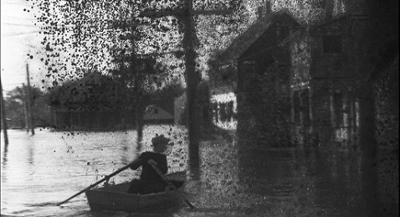
This brings us to his latest feature-length work. The Great Flood, from 2013, is comprised of documentary footage from the 1927 Mississippi River flood, one of the most destructive natural disasters in U.S. history. In addition to the misery the flood wrought upon thousands of Southern sharecroppers, it also provoked a major northward migration of predominantly African-American families, forever shifting the demographics and cultural shape of America.
Morrison has a great deal of fascinating footage, and the historical significance of his subject is unquestionable. But there is a stodginess that permeates The Great Flood. It is at the same time historically vague and artistically hamstrung.
For one thing, Morrison organizes the film by chapter headings (“sharecroppers,” “levees,” “presidents,” etc.) that cordon entire categories of imagery off from one another. This maneuver directly mimics the file-folder titles that Roy Stryker used to organize photographs from the F.S.A. during the New Deal. What’s more, the method guarantees that The Great Flood cannot get a head of steam going. There is no filmic rhythm at work, only denotative illustration. As if to drive home the point that this footage is too important to treat aesthetically, Morrison ends each section with a graceless, computerized fade to black. Nothing ends; it only stops.
But perhaps the biggest problem with The Great Flood has to do with its rather stunted relationship between sound and image. Decasia’s success was due in no small part to Morrison’s work with composer Michael Gordon, whose driving minimalist score provided an agitated counterpoint to the flicker and pulse of the damaged film stock. By contrast, The Great Flood’s score seems to hover above and apart from the film, like a background accompaniment designed simply to kill an intolerable silence.
This is particularly disappointing since the music was composed and performed by jazz giant Bill Frisell. Taken on its own merits, the music is not particularly inspired. Frisell’s guitar sound has an antiseptic sheen to it, each note articulated to the point of an academic declaration. The horn phrasing is even chillier. Considering that the music is intended to speak to the images by working through certain jazz and blues motifs appropriate to the period, the near-total disconnect is all the more confusing.
Both Morrison and Frisell have produced work in the past that derives both meaning and pleasure from chance, instability and the creative power of destruction. So how did it come to pass that The Great Flood is the project where funk went to die?



