
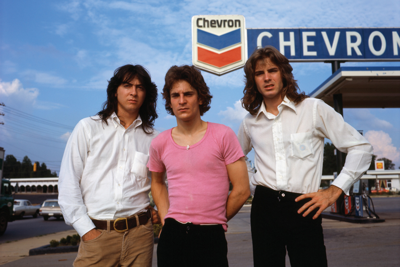
Editor's note: On Friday, The Belcourt opens Big Star: Nothing Can Hurt Me, a documentary about the much-loved 1970s Memphis group that exerted the kind of influence over power pop that the Velvet Underground did over punk. On Friday, producer Olivia Mori will appear after the 9 p.m. screening for a discussion with music supervisor Rick Clark; on Saturday, Big Star drummer Jody Stephens "and friends" will perform an acoustic set after the 9 p.m. screening.
To talk about the film and the band's influence, we asked a direct source: Nashville power-pop pioneer, celebrated music-maker and rock historian Bill Lloyd. Not only did Lloyd name his early band The December Boys in tribute to the group's classic "September Gurls," he actually enlisted Stephens to play on his second solo LP Set to Pop. Now music director for The Long Players, Lloyd shared his thoughts on the movie, and on why the Big Star cult continues to grow.
A film about Big Star would have seemed like a far-fetched idea to even their staunchest fans during the '70s and '80s. Their records were hard to find and even harder to explain when you tried to put your finger on what was so wonderful about them. Was it the crystalline sound of Chris Bell's and Alex Chilton's chiming guitars? Was it the glorious groove and clamor of Jody Stephens' drums, or the Southern Teenage Suburban Anglophile way they wrote and sang their songs? Their fans, many of them fellow musicians, spread the word with missionary zeal. For believers, dropping the name Big Star in conversation wasn't some lame hipster move. It was about sharing a personal discovery.
My own discovery came at a record store where I was working in the summer of 1978. A copy of their second album Radio City from 1974 ended up in the "play bin" at the store, and I could finally hear what I had been reading about in Creem and Trouser Press. Radio City spoke directly to me like someone from my neighborhood. There were no Tales from Topographic Oceans. Lyrically, it was all about "Sittin' in the back of a car / Music so loud can't tell a thing." That's exactly what my friends and I did. Repeatedly. "Hanging out down the street / Same old thing we did last week."
Musically and sonically, Radio City was full of retro-pop moments that conjured up The Beatles, The Who, The Kinks, The Byrds — all the sounds and styles I couldn't get enough of, and seemingly out-of-sync with the times. That 4-year-old album became part of my summer of '78 listening rotation (along with Tom Petty and the Heartbreakers' second and Graham Parker's Squeezing Out Sparks). Cassettes were made for the car and cooked in the summer dashboard heat.
There were many listeners who'd been similarly Star-struck, who felt the band was speaking directly to them. By the end of the '90s, there were cover versions of Big Star songs from Cheap Trick, The Bangles, Matthew Sweet and others. There was hero worship from other artists such as The Replacements' Paul Westerberg, who even wrote a song called "Alex Chilton." Many of them tried to recapture what they'd loved about those records in their own music.
I was no different. When I was recording my second solo album in 1992, I was anxious to get back to the same kind of sounds I loved on those Big Star records. A Memphian with musical and social history with the group, my friend Rick Clark, put the pieces in place so we could record at Ardent Studios with Jody on drums and John Hampton engineering. To say I love Jody's drumming is an understatement. I still think his playing and the drum sound on Radio City is, in feel and sound, simply the best. We cut two whole songs — overdubs, singing, mixing, everything — in one long day, and I am still so pleased we did it. Jody even sat in with my band at SXSW that year.
Clearly, the cult of Big Star overshadowed their initial lack of commercial success. Word of mouth proved more powerful than one might imagine. Albums were reissued and repackaged. Their critical acclaim continued to grow. After decades downplaying the band's legacy, Chilton did an about-face and agreed to play some Big Star gigs along with Jody Stephens and members of The Posies. A live Big Star show became a beautiful living example of the power of recorded music to reach beyond the length of a marketing plan.
Aside from the music, the intrigue surrounding Big Star was fueled by the human story. Group founder Chris Bell died in a car crash in 1978. Chilton passed suddenly of a heart attack in 2010, and original Big Star bassist Andy Hummel succumbed to cancer only four months later. This left Jody Stephens as the group's surviving member.
Books and magazine articles had already delved into the group's turbulent dynamic. Reports of drugs, depression and self-destructive behavior were published, fueling an awareness of the darker side of their tale. It was time for a good documentary on the band that could let some light in and show the beauty behind the pain at the heart of their story.
This is exactly what Nothing Can Hurt Me does. It creates an engaging flow of old and new interviews, a treasure trove of rare video and photos — and, of course, the music itself — that should delight the fans and fascinate the curious. The film never skirts the uncomfortable issues, but it addresses them in a way that shows compassion for all those left to tell the tale. It's not all melancholy (although I do believe that some of the best Big Star tracks are sonic icons of melancholia). There is an underlying feeling of sweet justice in the interviews as rock critics and fellow musicians pile on the praise to this music that had been ignored for too long.
As a retrospective, Nothing Can Hurt Me is equal parts beauty and sadness. The hope still held at the end of this story comes from the realization that it's all still there in the grooves of these records. Just try listening to Chris Bell sing, "Every night I tell myself / 'I am the cosmos, I am the wind' / But that won't get you back again," and not feel something. The songs and sounds are preserved for all to find. A Big Star record can work its magic at any time.
Email arts@nashvillescene.com.



Post a comment as anonymous
Report
Watch this discussion.
(0) comments
Welcome to the discussion.
Log In
Welcome to the discussion.
Keep it clean. Please avoid obscene, vulgar, lewd, racist or otherwise abusive language. Comments featuring hate speech or threatening or violent content will not be tolerated.
PLEASE TURN OFF YOUR CAPS LOCK.
Be truthful. Don't knowingly lie or mislead.
Be proactive. Use the “report” link on any comment that violates our comment policy.
Share with us. We'd love to hear your feedback.