
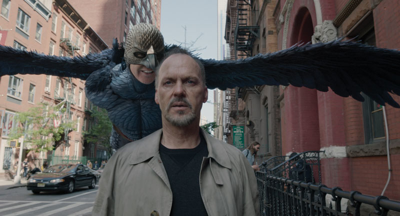

There are movies this year I've liked a lot more than Birdman, but no other that left me in such a giddy, jumpy, pleasurably caffeinated mood. It has less to do with the formal stuntwork — which simulates a single elaborately choreographed take, à la Hitchcock's Rope — than with the unflagging momentum of the performances within it. All the actors have blazing eyes, alive in the moment and daring each other to their limits: They're walking a tightrope and juggling scissors.
They've clearly been cast for that quality, starting with Michael Keaton, who carries the movie on his shoulders as a onetime action hero who bolted a sure-thing career of superhero sequels. Years later, he's invested what money and clout he has left in an esteem-reclamation project: a Broadway adaptation of Raymond Carver's What We Talk About When We Talk About Love. The play isn't the movie: this guy is the movie, staving off flop sweat, a thirst for booze and self-doubt — not to mention the voice in his head, which hurls accusatory rants in a growl that sounds more like Christian Bale's gargling Batman than Keaton's own — as he stalks backstage with Das Boot-level stir-craziness in the days leading up to opening night.
Keaton became a star doing a third-rail specialty act in movies like Night Shift and Beetlejuice — comedies that power-surged whenever his hyper-alert presence showed up. Some actors, like Dean Martin, made an ensemble better through a deceptively sleepy, unifying ease. Keaton is the opposite: He makes other actors look better the way a fuse box fires up every light. His trademark tic is a clenched wince, a flickering reaction to fate's latest kick in the balls. His best performances, and this is one, are thunderstorms of such flickers — few actors are as much fun to watch thinking and reacting on the fly.
At its nervy, electric best, Birdman is a jam session of similar talents. Jazz drummer Antonio Sanchez keys the mood with his solo score, a live current that sizzles, pops and startles, altering your pulse for hours afterward. (Think the dude in Boogie Nights throwing firecrackers, only for most of a movie.) The director, Alejandro González Iñárritu, doesn't have a loose temperament — his taut control here, though rarely less than impressive, is to freewheeling improvisation what Devo is to Charlie Parker. The showiest moves muffle some of the surprises: We're too busy anticipating, say, how that actress will literally disappear once the camera pursues her around a corner, because we know she's just gonna.
But as the embodiment of González Iñárritu's everything-connects sensibility, Birdman's playful visual flow is a lot more appealing than the tediously literal world-is-a-circle sermonizing of the director's problem dramas 21 Grams and Babel. González Iñárritu stages the movie as ellipses of serpentine camera swoops and sidesteps that terminate in two-character scenes — duets about the risk of failure that let the actors play off each other at length. The first meeting of Keaton and Edward Norton (a hilarious wonder as a brazen jerk of a Brando-like stage legend) is an actor-vs.-movie-star cutting match of riveting focus.
The intensity never lets up, but the emotional notes change depending on the duet partners: the simmering erotic sparks between the play's co-stars, Andrea Riseborough and Naomi Watts, who happen to be in varying stages of breakup/breakdown with the male leads; the anxious camaraderie between Keaton and long-suffering lawyer-producer Zach Galifianakis, who shows more range than he's been allowed before. As Keaton's embittered, recovering daughter, Emma Stone isn't exactly a surprise — she's showed enormous promise in a lot of movies — but her precisely modulated spite here brings flesh and blood to a sketchily drawn character.
If the movie starts as a grittier variation on a backstage farce along the lines of Michael Frayn's Noises Off, it gets increasingly bathetic in its final third. The clunky, overemphatic writing and plotting (by González Iñárritu, Nicolas Giacobone, Armando Bo and Alexander Dinelaris) show the seams Emmanuel Lubezki's masterful camerawork tries so hard to conceal. The jabs at soul-sucking social media and entitled New York critics might sting if the movie didn't employ them as cheap ironic devices (or if it showed some consistency about how they work).
But Birdman never falters as a love letter to actors, people who paradoxically remove their masks when they step onstage. Late in the movie, González Iñárritu juxtaposes two scenes involving flight: one of a character lazily circling the skyline in long shot, and one evoked simply by Stone's upturned, wide-eyed face peering out a window. The former is a lovely CG effect, all the more lyrical for its matter-of-factness. But the real magic's in the latter. Even when its characters are speaking dialogue that stays resolutely earthbound, this weird, risky, thrilling movie is full of the special effect only actors can provide — the gift of convincing us that even if we don't always believe the things they're saying and seeing, they do.
Email arts@nashvillescene.com.



