
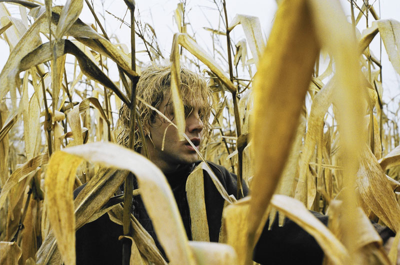
Thanks in part to the success of his most recent film Mommy, Canadian wunderkind Xavier Dolan's previous film Tom at the Farm is receiving a belated but well-deserved release in the States. While the two films are clearly the work of one highly unique and gifted auteur — one whose movie-brat sensibility and formal wizardry are on ample display in both cases — Tom at the Farm provides an interesting contrast to the operatic sweep of Mommy, or for that matter, Dolan's early film Laurence Anyways. While Dolan favored a broad emotional canvas with those films, and an appropriately exuberant technique (Mommy's confined aspect ratio that opens up with its protagonist's heart, Laurence's multiple styles and textures), Tom tends to remain focused and, if not exactly subdued, then certainly devoid of unnecessary flourishes or apparent irony. In fact, if you've been skeptical of Dolan's cinema so far, Tom at the Farm is probably the film most likely to impress you.
Dolan himself plays Tom, a man whose lover Guillaume has just died. In the midst of his grief, he must leave the city to travel to rural Québec to meet Guillaume's family, only to find that they did not know that their dead son was gay. They meet Tom with confusion, then suspicion, and eventually matters become outright violent. Of particular note is the aggression Tom faces from Guilllaume's brother Francis (Pierre-Yves Cardinal). At its base, Francis' hostility is pure homophobic bullying. But as things devolve, Tom senses that Francis is revealing something else: a kind of jealousy about the life Guillaume got to lead, his menace toward Tom taking on a perverse sadomasochistic quality. In his grief, Tom becomes increasingly confused, wanting to flee but also finding this "rough trade" version of Guillaume attractive despite all his better judgment.
Dolan's formal coup in Tom at the Farm, ultimately, is to arrange the slowly ratcheting violence of homophobia not as an edifying realist film but as a psychological thriller in the vein of Hitchcock or Chabrol. Dolan avoids easy moralism while at the same time refusing to soft-pedal the redneck hatred Tom (and, in absentia, Guillaume) experiences at the hands of Francis. Dolan is striving for affect rather than sympathy. The shock cuts, the canted angles, the screech of the Herrmannesque strings — Tom calls on their accumulated power to jangle the nerves, to wreak havoc on the spectator's senses. Homophobia, so often relegated to the realm of sociology, becomes in Dolan's hands a matter of collective physiology, a palpable hit.
Email arts@nashvillescene.com



