

"Once upon a time in Nazi-occupied France," reads the chapter heading that opens Quentin Tarantino's Inglourious Basterds—a commando mission in counter-mythmaking where a movie theater, a projector, a handy editing deck and a great big heap of flammable film stock (not to mention the climaxes of Carrie and The Wizard of Oz and the theme song from Cat People) team up to wipe out the Third Reich's high command. It's a movie about the power of movies to change history, in that celluloid parallel universe where memory and imagination stand off with the record.
How fitting that Tarantino's chapter heading tips its visor hat to the movies of Sergio Leone, an alternate history of America conjured up from gunsmoke and mirrors. The first time I saw Once Upon a Time in the West, screening this weekend as the finale to the Belcourt's Sergio Leone Month and its summer-long series of Westerns, I was a kid watching the WNGE "Award Movie" on Sunday afternoon, on the floor of my grandmother's living room. For lots of reasons, it was the worst possible way to watch one of the most visually striking movies ever made. But I can still see this image, burned into my mind's eye: a gaunt bald gunslinger standing impassively, staring into the camera, as a drip from the ceiling fills the wide brim of his hat with a thup! thup! thup!
Over the years, I've found something more to appreciate every time I've seen Once Upon a Time in the West. But every time, it leaves me feeling like an awestruck 10-year-old. It has something to do with the scale of Leone's gloriously excessive 1968 Western. Every dusty street is a football field's width. Every grizzled face, shot in screen-filling close-up, looms like a head on Mount Rushmore. Every gunfight is a duel of the gods. A viewer becomes an HO-scale brakeman walking through a regular-sized trainyard. In this, the most elaborate and exhilarating of his grandiose pistol operas, Leone took the Western he envisioned as a child—an Old West of quick-triggered warriors, enormous open spaces and superheroic deeds—and transferred it to the screen with its mythic distortions intact.
Apart from the scale (and the title), there's nothing childlike about Once Upon a Time in the West. An inextricable mix of cynicism, violence and delicate lyricism—as voluptuous and perverse as you'd expect from a story dreamed up by Bernardo Bertolucci (The Conformist) and Dario Argento (Suspiria)—the movie was a critical and commercial failure when released here in 1969, as the genre's audience was either riding into the twilight with the Duke or grooving on the revisionist bloodbath of The Wild Bunch. It was not the time to be romanticizing manifest destiny, even if Leone's quasi-Marxist take equates business with bloodshed.
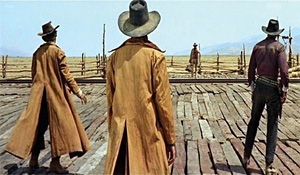
Over the years, though, a funny thing has happened. Leone's outsized rethink of the Western, an exaggerated pastiche of the John Ford films and gunfighter mythology he absorbed as a boy overseas, has gradually edged aside the John Wayne and Roy Rogers models in the popular imagination. You can see it when you close your eyes: the figures at opposite ends of a dust-blown street, the close-ups of "two beeg eyes" glaring edgily, the duster coats whirling like a bullfighter's cape. Thanks to Leone's invaluable collaborator, composer Ennio Morricone, you can hear it, too: the matadorial trumpets, the celestial female vocals, the trebly electric guitar that stabs and slashes.
Morricone's score clarifies a convoluted plot that concerns four main characters: a shadowy avenger (Charles Bronson); a prostitute, Jill (Claudia Cardinale), on her way to a blood-soaked wedding day; a scruffy outlaw named Cheyenne (Jason Robards); and a pale-eyed angel of death known only as Frank. He is played by Henry Fonda, who demolishes his decades of good-guy rectitude at the moment of his terrifying entrance. This is Tom Joad's evil doppelganger—a guy who's present wherever there's a fight so hungry people can eat, all right, but always working for those with a whip hand on the drawstrings of plenty.
Morricone composed the music before the movie even started shooting, and it is as much screenplay as score. Each character has a theme—Jill's motif is a soaring solo wail, Cheyenne's a pokey, halting clip-clop—and the composer interweaves them, stating the connections between characters without a word of dialogue. No one needs to state that Frank and his pursuer are bound; Morricone's menacing theme uses an ever-present harmonica to link them. Bronson's harmonica is literally an instrument of vengeance. It's the totem he wears around his neck, for a reason he means to explain to Frank at the point of death.
Oh, there's so much more. There's the tremendous opening sequence, in which Western icons Woody Strode and Jack Elam converge on a railway depot to the John Cage-like accompaniment of various squeaks and clatters. There's the hangdog decency of Robards' Cheyenne, the outlaw doomed by the suits moving West. And above all, there's the almost inhuman perfection of Leone's widescreen images, with their rhythmic alternation of flyspeck long shots and bulbous close-ups. Each frame has a painterly precision and clarity, as if the director had somehow eliminated anything standing between the screen and the image he had in his head. Once Upon a Time in the West is the kind of movie whose total intoxication with moviemaking can lead to a lifetime's love.
Email jridley@nashvillescene.com, or call 615-844-9402.



Post a comment as anonymous
Report
Watch this discussion.
(0) comments
Welcome to the discussion.
Log In
Welcome to the discussion.
Keep it clean. Please avoid obscene, vulgar, lewd, racist or otherwise abusive language. Comments featuring hate speech or threatening or violent content will not be tolerated.
PLEASE TURN OFF YOUR CAPS LOCK.
Be truthful. Don't knowingly lie or mislead.
Be proactive. Use the “report” link on any comment that violates our comment policy.
Share with us. We'd love to hear your feedback.