
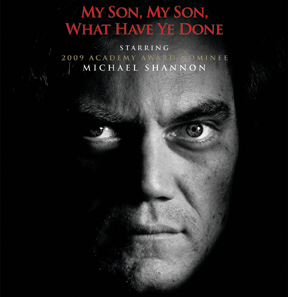

If you don't know Michael Shannon's name or face, that's probably to his credit. An exciting actor who can turn bullying, baby-faced or bug-eyed as need be, the towering Kentucky native has the unnerving ability to vanish into a role, whether in his Oscar-nominated turn in last year's Revolutionary Road or his triumphant crowning of Ashley Judd as the queen bee of William Friedkin's deranged cult movie Bug. In keeping to his own career plan, he's cutting a swath through movies of all types, from Jerry Bruckheimer blockbusters to regional indies such as the fine 2007 drama Shotgun Stories, delivering unique and impeccable performances all the way.
Currently Shannon stars in Werner Herzog's true crime/Greek tragedy riff My Son, My Son, What Have Ye Done? Following that, he'll appear later this year as notorious music-industry figure Kim Fowley (an experience he calls "an absolute blast") in Floria Sigismondi's biopic of '70s femme rockers The Runaways. With the David Lynch-produced My Son, My Son opening Friday at The Belcourt, the actor spoke with the Scene about his latest film and working with the fearsome Herzog.
How much research did you do into the Mark Yarlovsky case, the 1979 matricide that inspired My Son, My Son...?
I did none.... I did absolutely none, to be totally honest. And the reason was that Werner didn't want me to. There was somebody else who was going to do this role, and that person did a lot of research and read a lot of interviews and got very opinionated about how the movie should be, and Werner decided he didn't want to work with him because he'd done too much research. He didn't want whoever was playing the part to be imitating Mark.
Which makes sense as it isn't a true-crime story; it's a Herzog film. Given the legendary stories about some actors' experiences on Herzog sets, did you ever have any moments of trepidation?
When Werner offered me this job, he told me up front that it was going to involve some travel, and that we'd be going to this city in northwestern China called Kashgar and that we'd be going there without a permit and that we'd be going there to film a scene. And he just wanted me to know up front that if I took the job that that was something I would have to do, and would I be all right with that. And he was very sweet about it. He said, "I will do my utmost to make sure that nothing bad happens to you...." Werner doesn't like to torture people, and he's actually very considerate. At least he is now. Now, I can't speak for years ago when he made other films, but now he's older and he's more reasonable.
Your character, Brad McCullum, is very much a performer: He's built a persona for himself around a series of grand gestures. How did you metabolize those impulses when assembling him as a character?
I think it's a classic scenario; after Brad goes to Peru with his friends, he comes back and he feels totally empty and lost, and he's looking for something to give him some sense of purpose. And I know that I myself gravitated toward acting as it's something that makes you feel special; playing a part can be very empowering, and I think when he's doing the play that that character gives him so much more identity than he had. But he goes to the theater and he finds this part, and I think the play gives him a kind of religion.
There's a sense from many of the scenes leading up to Brad's violent act that something absolute and inexorable has been set into play; that certainly embodies some of the themes of the Oresteia—the plays used in the film—of relentless vengeance. Spiritual crisis can lead to such a place.
Look where he lives. That's not me slagging San Diego, I love San Diego. But every day we'd arrive on this location and I'd look down that hill and there'd be this feeling... like you could get lost here, standing on this hill looking down at the water. You could feel rudderless. And it's frightening. Unfortunately, in this world, spirituality gets used for a lot of profane measures, and when that's the case, it's a dangerous time for everyone.
There are several scenes in the film between you and cult favorite Grace Zabriskie of Twin Peaks fame, and I found that they walked a remarkably fine line between tenderness and emotional violence. The two of you cast as mother and son is a truly inspired choice; what was it like working with her?
We clicked very fast.... It's very interesting with Grace. I'd seen her in several of David Lynch's films and she'd scared the hell out of me, and then you meet her and she's the sweetest person in the world.
OK, now the gloves come off. In this film, you have scenes with both flamingos and ostriches. Which would you say was the more difficult bird to deal with?
Ostriches are just heathens. They're really rotten; I didn't want to interact with them at all. The flamingos, well, they would peck at me sometimes, but it didn't really hurt. I liked the flamingos.
There's something monstrous about ostriches.
They're diabolical.
Probably some residual anger about not being able to fly. In conclusion, now that you're here, we have to ask you about a personal favorite, John Waters' 2000 film Cecil B. Demented.
One of the best things about a John Waters film is that you get on his Christmas card list. And every year, you get his Christmas card, and he makes them himself. I've got a lot of great memories from that film. The main one was going to his house for the read-through and being shown around his house. Then he set us down in his living room, and he said, "I want you to have a gang mentality, and I'm going to play you a record of something that I think'll help you understand the qualities that I'm looking for." [Every] now and then you'd hear someone sort of yelping in the background, and I said, "Where the hell did you get this?" Apparently, if you care to, you can get a recording of the end of Jonestown.
Email arts@nashvillescene.com.



Post a comment as anonymous
Report
Watch this discussion.
(0) comments
Welcome to the discussion.
Log In
Welcome to the discussion.
Keep it clean. Please avoid obscene, vulgar, lewd, racist or otherwise abusive language. Comments featuring hate speech or threatening or violent content will not be tolerated.
PLEASE TURN OFF YOUR CAPS LOCK.
Be truthful. Don't knowingly lie or mislead.
Be proactive. Use the “report” link on any comment that violates our comment policy.
Share with us. We'd love to hear your feedback.