
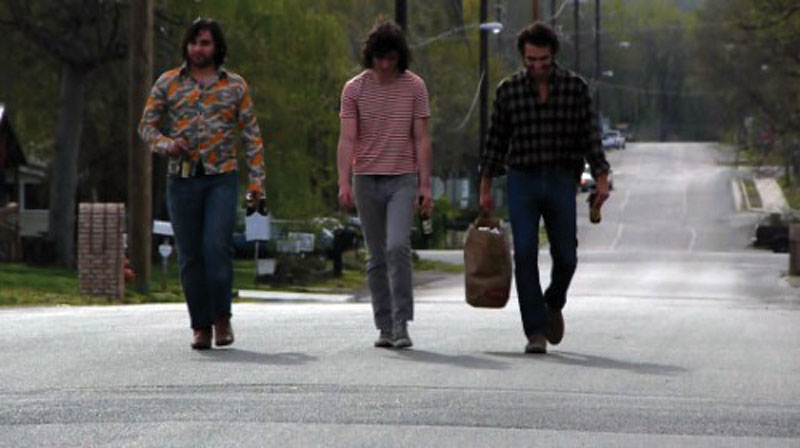
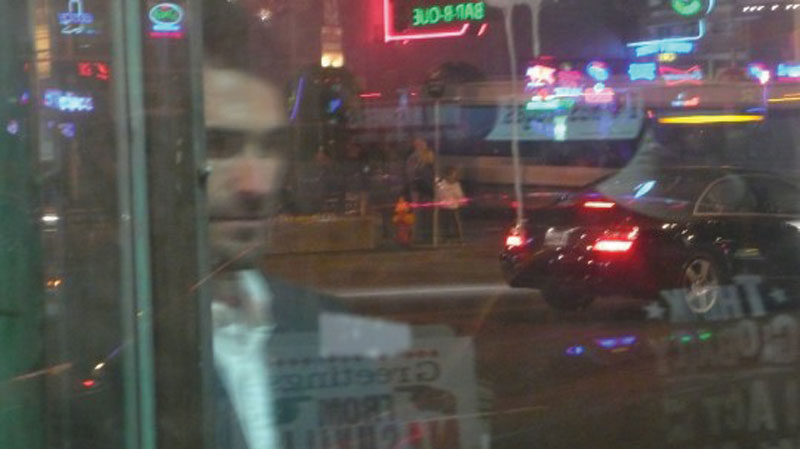
Editor's note: Next Wednesday, Sept. 7, at 7 p.m. in Vanderbilt's Sarratt Cinema, the university's International Lens film series offers a free screening of a movie that has built a significant buzz since its U.S. premiere at April's Nashville Film Festival. It's Música Campesina (Country Music), shot locally under run-and-gun conditions by a remarkable visitor: the acclaimed Chilean novelist, critic and filmmaker Alberto Fuguet, in town last year for a Vanderbilt residency.
Fuguet's writing (notably his 2003 novel The Movies of My Life) draws upon a lifelong love of film — a tradition in Latin American fiction that extends from Borges to the cartwheeling phastasmagorias of Cuban novelist G. Cabrera Infante (whose 1971 cult classic Vanishing Point recently screened at The Belcourt). But the Santiago-born, California-raised Fuguet is forging an equally notable career as a writer-director, with strong early reviews for Música Campesina from the festival circuit as most recent proof.
Next week's screening will be hosted by producer Sarah Childress and cinematographer Ashley Zeiger. In the meantime, we asked Fuguet, named one of 50 Latin American leaders for the next millennium by Time magazine, to share his thoughts about the city and the making of his film.
I had never seen Altman's Nashville (and I fancy myself a film geek) and I had never been to Nashville. I didn't know anybody who lived there, and to be honest, it wasn't on my list of places I cared to visit. Just as I come from somewhere "off the map" (i.e., Santiago, Chile), Nashville was a place — a myth, perhaps — that I knew existed but had no real idea about, except for some clichés that, eventually, would come in handy.
Now, as I write this, as I skim through my Moleskins and mini notebooks from Staples, I realize that Nashville is inextricably part of my life and always will be. Funny how things work out. It is, no doubt about it, my "second city," my home away from home, the place I will always return even if I never visit it again. There are other cities that I have lived in for a lot more time than my less-than-a-month in the penthouse of the Americana apartments, a couple of blocks away from my official writing headquarters: the great J&J's on Broadway. It's true that I'm more likely to feel more comfortable in Buenos Aires or have more friends in Lima or New York, but there is something very deep and private about my relationship to Nashville. It is very easy to establish, but perhaps not so much to disentangle, the feelings I have for the city.
Not too long ago, I was invited by Ted Fischer and the Center for Latin American Studies at Vanderbilt to write and cast and lock locations and shoot a movie in Nashville. And this is where the mystery appears, the epiphany, the memories: Once you shoot a film, once you have discovered a city and its people, once you have put your characters and actors in it, once you have bonded with people who are now going to be forever alive on the screen (whatever screen it may be) with your name and feelings and longings and fears, that city will always be yours. It will always be a part of you.
# # #
Perhaps a month ago, Pablo Cerda, my main actor and the only other Chilean in the movie, flew from Santiago to Lima, Perú, to a festival there. It was in Lima where we met the president of the jury: Geraldine Chaplin. We talked about Nashville, the film and the city. She asked:
- How is it now?
- Well ... I guess it has changed ... the airport is not the airport in the movie. I wanted to film the last scene at the Exit/In but it's more of a heavy-metal venue. It doesn't look at all like the scene where Keith Carradine sings "I'm Easy."
- I love that song.
- Me too. I wanted to use it but we ended up quoting Nashville by filming at the Parthenon — at night, because it looks like lime Jell-O.
What I didn't tell her was the real reason I filmed at Centennial Park. A pedantic professor from the Spanish department, one of the first people I met in town, really looked down upon the city and felt it was so "American." In some academic and Eurocentric circles, "American" is usually a bad word. He was in fact appalled that I knew so much about the city in the few days I had been there. He kept saying: Isn't it so kitsch that they have a Parthenon? Do they actually think they are Greek? Done: I was going to set a scene there. The same location where Nashville ends. But it would be a night scene, it would be an intimate scene and it would be in Spanish.
I tell Geraldine Chaplin, who played Opal, the British radio reporter from the BBC, that my character Alejandro Tazo is based on her. She looks at Pablo and doesn't see the connection. Pablo smiles and says:
- I play the fish out of water; the foreigner.
Before leaving for Nashville I of course saw Nashville, and what at first scared me soon soothed my creative knots. For all its wonders and coups, I felt Altman's film was somewhat satirical, perhaps even condescending, a sort of West Coast view of a place it didn't really want to understand so much as toy with. Maybe I was misreading it. But many people I met in Nashville told me stories of Nashville and how it wasn't liked that much when it opened in the '70s. A note in my notepad: Tazo must fall for Nashville; film it not as a tourist, but as someone who has a total crush on it.
I wanted to capture a Nashville that was less country, more hipster, say, and to film mostly in places that are not so much monuments. I was interested more in alleys. The Nashville of Altman was a Nashville that doesn't exist anymore. My Nashville was more cosmopolitan, diverse — even Hispanic.
# # #
My movie is now finished and it's begining to travel the film-festival circuit. In my country, it will premiere locally (what nationality is it, really?) at the Valdivia Film Festival and begin its theatrical run in Santiago in late October. The film is called Música Campesina (Country Music) and, now that I have some distance, it's not so much a film about a thirtysomething Chilean named Alejandro Tazo ("Tazo like the tea") but more a "boy meets city" type of film. Last week, our movie — because that is what it is: our movie, the movie of all of the students, professors and new friends who collaborated on that crazy less-than-three–weeks gestation and intense six-day shoot — was screened four times at the pristine and Sistine Chapel-like Walter Reade Theater at New York's Lincoln Center as part of its "Latin Beat" series. A total honor and quite an experience. The first American reviews began to appear and I liked them.
At the Q&As afterwards, I learned a couple of things about the movie I wrote and shot in-situ during the month of March 2010 — among them that perhaps the movie is not quite Chilean or Latin or Hispanic, as we thought. After all, it is 70 percent in English, 100 percent shot in Nashville, and the character drinks Jack Daniel's while talking all day about Johnny Cash. I personally feel it's a Latin American movie but people began to question if it actually was. Is it a country-strong movie from Tennessee? I don't think so either. What is it? Hybrid. That is the word we stumbled upon. Hybrid.
# # #
Last April I arrived for a strange, dreamlike, less-than-48-hour stay in Nashville. I was to show Música Campesina for the first time in front of the people who made it — and what made me more edgy, to screen it, in the midst of the Nashville Film Festival, for "the natives," as my character says in his broken English.
I arrived very late at night at BNA and rented a car. It was after 1:30 a.m. when I registered in a downtown hotel. I was wired and antsy. I left the hotel, got in the car, hooked my iPod to the radio and put on the movie soundtrack and began to drive around, just as I did the first time I arrived and got lost and ended up at a gas station off Trinity Lane and knew that was going to be one of my locations.
I drove the empty streets, windows down in the warm, soft breeze, watching the blinking yellow traffic lights swaying. I passed J&J's, where Ashley, my DP, and I looked at classic American painters and photographers. I passed the laundromat on 21st Avenue, where the girl began to scream and didn't let us film. I passed the great Belcourt Theater, where I felt grounded and safe; passed Ken's Sushi, where my producer Sarah Childress and I discussed the movie's structure while eating edamame. I drove along Charlotte Pike past Bobbie's Dairy Dip and Wendell Smith's, where one of my favorite scenes takes place, and detoured north near the tracks where the streets have the names of the states and the shotgun houses have porches.
I then fled towards Murfreesboro Pike, where everybody said I would be killed, and to the great and sketchy and run-down Drake Motel ("stay where the stars stay"). I passed the great McKay's Used Books that my new friend and actor and AD and fellow film fanatic James Cathcart took me to, just as he took me to places, late at night, for a drink, after location hunting, that ended up being locations: Printers Alley, the Arcade, the Melrose Billiards on Franklin Pike.
I ended up, that strange memory-stalked night, sitting alone at the same location, on the steps of the Parthenon, all green, looking at the Batman Building far away in the distance. I was home. This was my place. These places, these people, would always be part of me. I now had a new movie, a movie about Nashville. And as the sun was rising, I understood I had a film that was also about me.
Email arts@nashvillescene.com.



Post a comment as anonymous
Report
Watch this discussion.
(0) comments
Welcome to the discussion.
Log In
Welcome to the discussion.
Keep it clean. Please avoid obscene, vulgar, lewd, racist or otherwise abusive language. Comments featuring hate speech or threatening or violent content will not be tolerated.
PLEASE TURN OFF YOUR CAPS LOCK.
Be truthful. Don't knowingly lie or mislead.
Be proactive. Use the “report” link on any comment that violates our comment policy.
Share with us. We'd love to hear your feedback.