
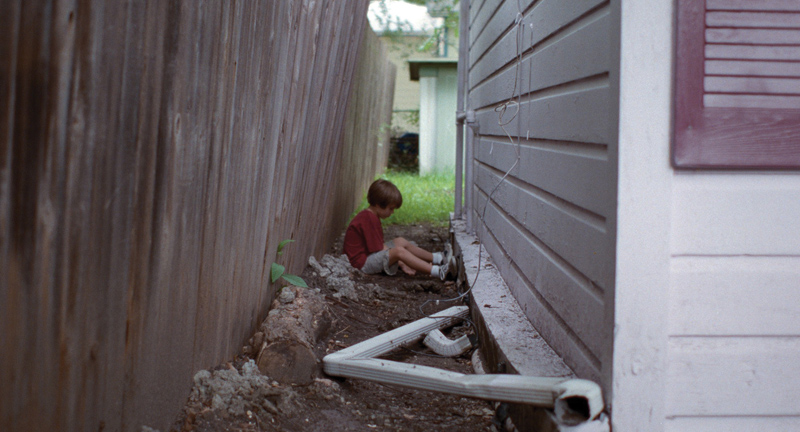


Even in a career that's approaching canonical status — from Dazed and Confused to the Before trilogy (Sunrise, Sunset, Midnight) — Richard Linklater's Boyhood has achieved a rare level of critical and audience consensus. Its popular appeal is all the more surprising considering the project's unusual nature. Shot a few days each year over the course of 12 years, it follows Mason (Ellar Coltrane) — along with his divorced parents (Ethan Hawke and Patricia Arquette) and sister (Lorelei Linklater, the director's own daughter) — as he grows from 6 to 18, and ends on his first day of college.
Narrative takes a back seat to simple observation, something at which Linklater excels. His filmography is filled with gems that explore and distend time even as they examine the bonds of community, whether in the Austin underground of his 1991 debut, Slacker, or in the paranoid futurescape of his animated dystopia A Scanner Darkly. Boyhood is a dazzling addition to that body of work. The Scene talked to the writer-director last week on a muggy day in New York.
How did you develop the script for Boyhood? Did you write it on a year-by-year basis?
Year by year. It was designed to go incrementally where everyone was taking me, where my preconceived ideas met reality. It was all under the structure of a pretty solid architecture. I knew the ending of the movie, I knew the main events. That was all pretty much set to some degree. There were adjustments every year.
Were you ever worried that something would happen to one of the actors that would screw up your plans or, even worse, make it impossible to finish the film?
If it did, I'd hope my first response wouldn't be about the film. We all could get a call about some loved one. It would be a life problem. We all go through life with that as a possibility. The odds are that it wouldn't happen. And it didn't. So here we are. You can't go through life looking at all the downsides. It was fun to collaborate with the unknown future. That was our wild card.
I grew up in New England, and the idea of giving a 15-year-old boy a gun as a birthday present seems really alien to me. How do you think the film reflects the particular culture of Texas?
Well, I think it's Southern. No, I think there's a cultural difference in certain parts of our country when it does come to guns. They're family heirlooms. In that scene, I point out that his grandfather's daddy gave him that gun. I don't see these things as huge threats. It's a cultural divide. Most people who get guns are safe with them and don't shoot up schools. If you grew up around them, you see them differently. I see the gun issue as urban versus rural, not liberal versus conservative. If you're rural, you can have a Democratic representative against gun control, but in urban areas, you have conservative politicians suggesting we should have limits on how many weapons someone should own.
If you made a film as formally unusual as Slacker now, do you think it would lead to making studio films?
Probably not. That's how times have changed. Slacker might get into Sundance today, but it would be some kind of sidebar. I doubt it would have the opportunity to have the kind of cultural resonance it had 23 years ago. It's harder to get indie films seen, really.
Boyhood has documentary elements, and you've made one documentary, Inning by Inning. Would you be interested in making another documentary?
I have a lot of documentary subjects I'm interested in. They're just a lot of work and take a long time. Maybe I'm not a natural documentarian. I like working with actors and fictional storytelling. I don't know if it would be my strong suit, but I do have a lot of stories I'd like to explore in the documentary realm. I just haven't done it yet.
The pacing of Boyhood feels very unusual, particularly in the first half. How did that develop?
I was just trying to depict the characters' reality. If you think I don't have any plot devices that are moving the story forward, it's all just life flowing. I was trying to capture that. Perspective changes as Mason gets older and gains agency. As a little kid, you just go where your parents tell you and do what they want you to do. Your older siblings and parents dominate your life, along with school. Through it, there's an emergence of self. It becomes more his movie. The pacing naturally feels a little different because he's grabbing the story in his own way. It mirrors how life feels. Time goes quicker the older you get. The film builds up that momentum.
Ethan Hawke's character seems very impressed with his own coolness, but Patricia Arquette's character does much more of the real work of child-rearing. What's your take on him?
Well, he's a dad who's discovering himself as a dad. He's very consciously trying to figure himself out. She didn't have that choice. She's just in it. We don't know what went on between them before the movie starts. We don't know why they broke up and he went away. People can project that, but I think he's made a choice to become a part of these kids' lives. That's kind of heroic. He makes compromises just to achieve that. Some people say, "He gives up his dreams," but I think we become who we're supposed to be. We are the sum of our choices.
There were a lot of indie distributors 12 years ago who are no longer around. You lucked out in choosing IFC Films to work with.
People ask me about something happening to a cast member, but the odds are that me and the four main cast members are going to be around. The odds were an anomaly that the entity and the guy who greenlit the movie would still be around and in their same positions. In our industry, no one would've taken that bet. All these years later, it's pretty cool and not statistically probable.
At one point, Boyhood was the most critically acclaimed film of the 21st century. Are you afraid of a backlash?
I don't think there's going to be a critical backlash, because I've made a lot of films that have gotten good reviews. I think you need to make a huge blockbuster to engender that kind of response. I would welcome being in that position! It's hard to predict the future, but I'm not worried about it.
I'm only aware of two negative reviews of it so far.
That's what I've heard. I haven't even read those.
One of them was in a leftist academic journal, which picked up on the gun/birthday scene and predicted that Coltrane's character would turn out to be a serial killer.
That says so much about them. We would joke about that. That's kind of funny that anyone would really think that way. We have a couple hundred million guns floating around, so if everyone who picked up a gun became a serial killer, there wouldn't be any people left. If you do the math, it's a little crazy. The serial killer impulse has nothing to do with guns. It has to do with being a psychopath and being smart enough to get away with it.
Email arts@nashvillescene.com.



Post a comment as anonymous
Report
Watch this discussion.
(0) comments
Welcome to the discussion.
Log In
Welcome to the discussion.
Keep it clean. Please avoid obscene, vulgar, lewd, racist or otherwise abusive language. Comments featuring hate speech or threatening or violent content will not be tolerated.
PLEASE TURN OFF YOUR CAPS LOCK.
Be truthful. Don't knowingly lie or mislead.
Be proactive. Use the “report” link on any comment that violates our comment policy.
Share with us. We'd love to hear your feedback.