


As social media platforms have developed and provided a public outlet for once-private thoughts, bored soldiers in the U.S. military, with restless fingers and time on their hands, have turned to the internet as a means of expression. Often this results in viral dance videos set to pop songs that serve as inadvertent propaganda. But just as frequently, social media offers a space for the enlisted to express their frustration with the machine they find themselves employed by and subject to. I recently saw a TikTok filmed by an American infantryman in his barracks — the soldier making it walked around the bunks, asking the members of his platoon the same question: What would they tell their Army recruiter if they could talk to him now? The minute-long video is a compilation of one answer, delivered resolutely and repeatedly, by multiple soldiers: “Fuck you.”
Soldiers and veterans speaking out online against the military is just the latest mutation of a very old strain of political activism. The newly restored documentary F.T.A. (alternatively standing for “Free the Army” or “Fuck the Army,” take your pick), directed by Francine Parker, is a vibrant artifact of this repressed and obscured movement. In the popular consciousness, the Vietnam anti-war movement has generally been characterized as middle-class, intellectual, restricted to the college campus. It has been mostly erased from media and excluded from popular textbook histories — aside from, say, scenes of veterans throwing away their medals in Forrest Gump. But there was an incredibly organized and dedicated anti-war coalition among active-duty troops during the Vietnam War, a true radical insurgency that built solidarity among a multiracial contingency of working-class servicepeople — men and women, enlisted and conscripted.
An underground network of newspapers and coffeehouses grew up around military bases during the war, uniting a patchwork collective of troops fed up with fighting for lies and wanting to push back against military service that they felt was, in many ways, a kind of imprisonment. Though this movement may have begun out of a kind of self-interest — exhaustion with the conditions and a desire to just go home — it eventually grew into a deeply committed radical block, linked to a variety of anti-imperialist and anti-racist struggles. At home and overseas, actions by GIs varied from consciousness-raising conversation to disobeying orders — like the 43 Black soldiers at Fort Hood who refused to be deployed as riot control to the Democratic National Convention in 1968. In some instances, enlisted men even turned violently against their commanding officers. Though there were sharp consequences for this kind of activity, the front lines in some ways made fertile conditions for leftist organizing, bringing together a diverse body who might have been isolated or alienated from one another along racial, regional or other lines. History classes will never let us forget “cowardly” draft dodgers, but we have forgotten the almost 50,000 heroes who deserted an unjust conflict.
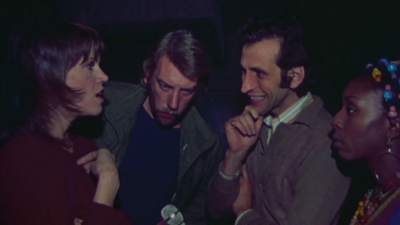
Seeking to foster this movement and bring it to the public, actors Jane Fonda and Donald Sutherland assembled a self-described “political vaudeville” troupe in the early 1970s for a tour of sites near American military installations in the Pacific Rim. F.T.A. documents that tour, blending performances, sketches and songs with conversations between soldiers about their convictions, their struggle and the process of political education brought on by witnessing the horrors of war. Unsurprisingly, the film was pulled from distribution a week after its release, and most copies were destroyed.
The stage show itself feels fairly dated, a spirited blend of profane, pun-heavy, Cole Porter-style show tunes and comic skits in the vein of the Smother Brothers, something of a deliberate riff on the state-sanctioned jingoism of Bob Hope’s gaudy parade of military bases. It’s the context this tour resides within that makes F.T.A. so fascinating and incisive — in their show and their discourse with the troops, Fonda and Sutherland address a whole network of concerns: racism from officers toward infantrymen and against the Vietnamese, the sexism and harassment experienced by women who work for the military, how enlisted men use gallows humor and dark irony to rationalize slaughter, and America’s presence as an occupying force around the world.
F.T.A. is most powerful when it pulls out to look at the empire the United States has carved out in the Pacific Rim. When visiting Okinawa, the F.T.A. company stands in solidarity with the island’s occupied population, and gives a slot in the show to an Okinawan folk group, who sing of generations who have suffered under imperialism: “Japanese invasion, American occupation, nothing has changed.” F.T.A. makes the case that the United States did not declare war on Japan to stem the tide of imperialism, but rather to become an empire itself, donning the mantle once worn by a literal emperor and treating other nations as repositories for arms and laboratories for destruction.
Toward the film’s end, the troupe visits Japan, taking special time to highlight one of the most unspeakable acts of war ever committed — the atomic bombings of Hiroshima and Nagasaki. While looking at photos of mutilated, radiated corpses, one of the musicians in the company says, “This is Vietnam, this is Palestine, this is everywhere the war machine is.” Though the times have changed, the message of F.T.A. is still infuriatingly relevant. This new restoration connects the present to the past just as the film — and the movement it depicts — connected individual men on the front lines of a devastating and unnecessary war to revolutionary struggles around the world.



Post a comment as anonymous
Report
Watch this discussion.
(0) comments
Welcome to the discussion.
Log In
Welcome to the discussion.
Keep it clean. Please avoid obscene, vulgar, lewd, racist or otherwise abusive language. Comments featuring hate speech or threatening or violent content will not be tolerated.
PLEASE TURN OFF YOUR CAPS LOCK.
Be truthful. Don't knowingly lie or mislead.
Be proactive. Use the “report” link on any comment that violates our comment policy.
Share with us. We'd love to hear your feedback.