
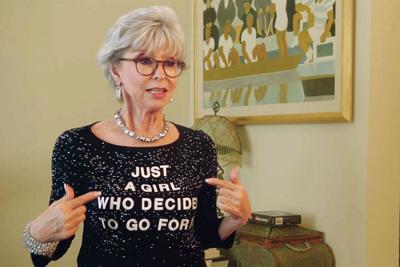

Rita Moreno is all spry vivaciousness in the new documentary Rita Moreno: Just a Girl Who Decided to Go for It. She still has a svelte dancer’s build and is always prepared to make any stage or dance floor hers, and that’s what she does in the film’s opening moments while throwing her own 87th birthday party — slaying everybody while wearing a fiery red dress. In one scene Moreno watches a bunch of Cuban performers dance for a crowd, eventually getting up to join them. When it comes to putting on a show, the girl can’t help it. “Being a natural performer — I mean, I was just born that way,” Moreno says in voiceover.
Yes, Moreno can still cut a rug. And if anyone deserves a celebration, it’s her. Of course, she’s a Latina trailblazer, the first woman to land an EGOT (receiving an Emmy, a Grammy, an Oscar and a Tony). But as this documentary shows, she’s had to go through a lot of trauma, heartbreak, rejection and self-loathing to get there, not to mention the assorted bullshit female entertainers of color in Hollywood have long been met with.
“I can’t think of anybody I’ve ever met in the business who lived the American Dream more than Rita Moreno,” says Norman Lear in the doc. The legendary TV guru of course cast her as the sassy abuelita on the acclaimed but short-lived One Day at a Time reboot that bounced from Netflix to cable. But much of Moreno’s life was hardly a dream. Born in Humacao, Puerto Rico, (“the one town that had the hospital,” says Moreno), she moved to America with her just-divorced mom, looking for that better life all immigrants crave when they get here. When they moved to New York, little Rita got hit with a lot of racial slurs that still sting.
Nevertheless, the aspiring young performer managed to get an MGM contract thanks to Louis B. Mayer thinking she looked like “a Spanish Elizabeth Taylor.” Unfortunately, the early days of her movie career often saw her typecast as exotic foreign girls — Spanish, Mexican, Asian. Even after Moreno won a Best Supporting Actress Oscar for her performance as Anita in 1961’s West Side Story, Tinseltown still wanted her to play women with thick accents and limited vocabularies.
Her treatment off-screen was even worse. It probably won’t come as a shock to hear Moreno talk about how powerful predatory men would tell her point-blank what they would love to do to her. The most upsetting of these stories is how she was raped by an agent she still unfortunately continued to have a working relationship with. This doc will also have you cursing Marlon Brando’s name — he and Moreno had an on-again, off-again relationship that took a toll on her physically, especially after she got pregnant and Brando made her get a botched abortion.
Gloria Estefan, Eva Longoria, Lin-Manuel Miranda, fellow EGOT queen Whoopi Goldberg and Moreno’s Electric Company co-star Morgan Freeman are some of the folks who salute Moreno during their talking-head interviews. Director Mariem Pérez Riera uses this documentary to show not only how Moreno should be celebrated for opening doors and creating avenues for Latina women in entertainment, scoring awards and accolades on TV and on Broadway when the film industry gave her bupkis — but also how she should get some flowers for being a hellraiser for women’s rights. With most of the documentary having been shot during the Brett Kavanaugh Senate confirmation hearings (there’s footage of Moreno watching the hearings with obvious disgust in her dressing room), we see how this performer — who went through hell to have her voice heard on and off camera — still gets riled up over the same ol’ shit she had to take oh-so-many years ago. Even so, Moreno still exudes an infectious positivity. Just like at her birthday party, she will always get up and keep moving.
Yeah, Moreno has won a lot of awards. But after viewing this doc, you may feel like she deserves a gotdamn Purple Heart or a medal for bravery or something. She did receive a Presidential Medal of Freedom back in 2004. That’ll have to do for now.



