
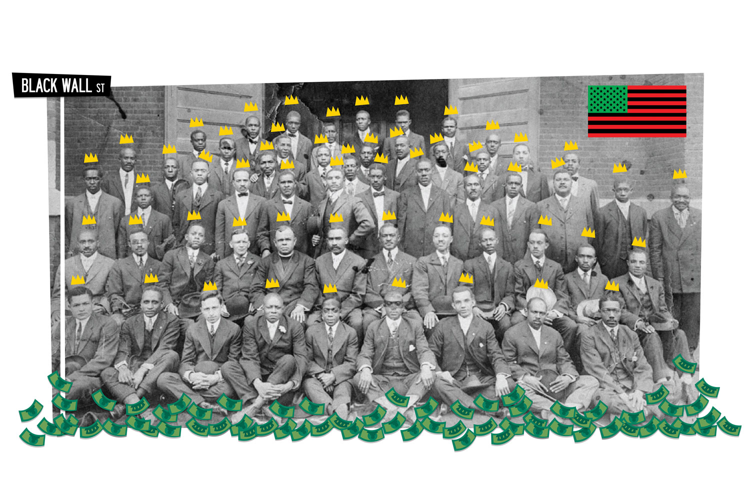



"Black Wall Street," Xavier Payne
Thelma Golden, curator and mastermind behind the Studio Museum in Harlem, has called art “a catalyst for cultural change.” That’s the definition I always return to when I wonder why I should care about art while there are white supremacists running people over in cars and politicians saying racist sculptures are a part of history worth holding onto. After all, if it’s true that there’s a serious debate happening about the merits of white nationalism in our community, why the hell should anybody care about anything else?
The answer, of course, is that visibility is important. With that in mind, it’s hard to imagine a more powerful call for cultural change through art than Don’t Tread on Me, an exhibit that includes a six-billboard campaign. Artist Xavier Payne has used simple motifs and historical references to create work that makes the discontent around Nashville’s gentrification visible. It also has the potential to activate resistance, like ACT UP’s pink triangle or David Hammons’ “African-American Flag.”
“The narrative of Black Americans has centered around the battle to gain one’s own sense of independence and identity,” Payne explains in an email to the Scene, “and I find that battle strikingly similar to the attitudes of America’s founding fathers.”
The billboards, which were created with support from the Metro Nashville Arts Commission and the National Endowment for the Arts, are located along the historically black Jefferson Street corridor. Payne has appropriated the coiled rattlesnake from the Revolutionary War-era Gadsden Flag, as well as its phrase “Don’t Tread on Me,” to illustrate the severity of an issue, while also grounding it with historical relevance. The struggle to establish ownership over land has a real and valuable place in democratic society.

Two more billboards appropriate another stalwart of American culture: The Simpsons. In Payne’s hands, these characters are decidedly black. Whether it’s a Simpson, Santa, Jesus or a Stormtrooper from Star Wars, a mainstream character being portrayed as black can make some people feel comforted — and others uncomfortable. Says Payne, “Black Bart and Lisa Simpson are meant to represent the future of Black America as well as the presence and influence of Black American people in American popular culture.”
Days after the Charlottesville, Va., protests, Kara Walker, one of the most celebrated artists of our time, sent out a press release about her upcoming exhibit at New York’s Sikkema Jenkins Gallery by saying, “I don’t really feel the need to write a statement about a painting show.” Payne quoted it on his Instagram account.
“It’s too much,” Walker says, “and I write this knowing full well that my right, my capacity to live in this Godforsaken country as a (proudly) raced and (urgently) gendered person is under threat by random groups of white (male) supremacist goons who flaunt a kind of patched-together notion of race purity with flags and torches and impressive displays of perpetrator-as-victim sociopathy. I roll my eyes, fold my arms and wait.”
The world is changing, and if artists continue as if it’s business as usual, their status as catalysts for cultural change will quickly disappear. Don’t Tread on Me — especially the billboards that stake their claim better than any racist dog-whistle wink-and-nudge ever could — shows how simply, bravely, urgently necessary art is.



Post a comment as anonymous
Report
Watch this discussion.
(0) comments
Welcome to the discussion.
Log In
Welcome to the discussion.
Keep it clean. Please avoid obscene, vulgar, lewd, racist or otherwise abusive language. Comments featuring hate speech or threatening or violent content will not be tolerated.
PLEASE TURN OFF YOUR CAPS LOCK.
Be truthful. Don't knowingly lie or mislead.
Be proactive. Use the “report” link on any comment that violates our comment policy.
Share with us. We'd love to hear your feedback.