
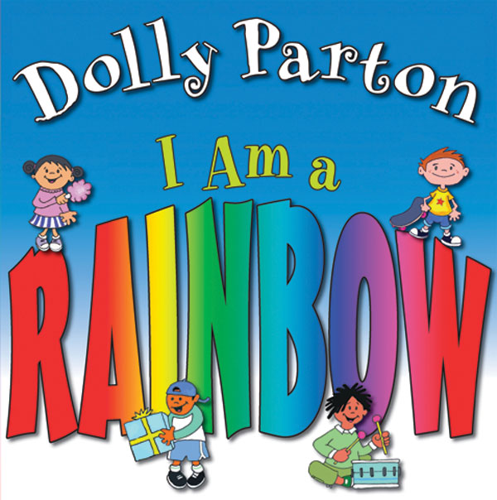
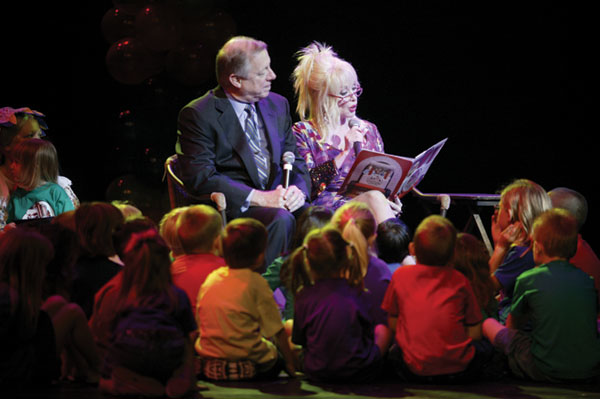
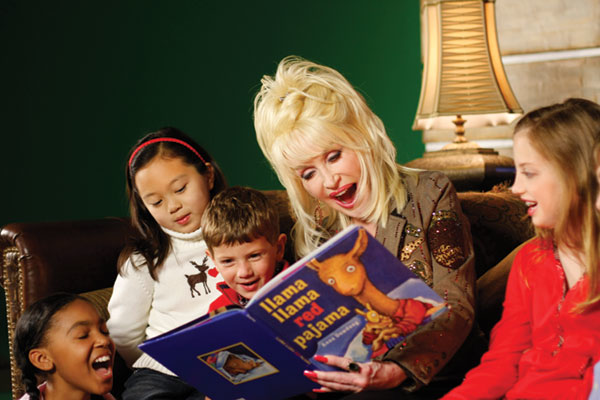
Even if you have no clue who won what at the CMA Awards — and even if you don't know what CMA stands for — you probably know a thing or three about Dolly Parton. The sartorial spectacles, the pyrotechnics of her blonde coiffure, the bodacious figure. The urgent, pleading chorus of "Jolene," and the jaunty "9 to 5." The 41 Top Ten country albums and the 25 No. 1 singles. Parton is almost universally adored, not just for her songs, but for her sunny, shiny, sweeter-than-sweet-tea persona, her gusto and her wit. It's virtually impossible to name another member of Music City royalty who can claim a following of such diversity.
But even Parton's biggest fans may be unaware of her less flashy role as "The Book Lady" — a nearly magical figure who leaves books in the mailboxes of boys and girls everywhere. At least that's the way some children have come to think of Dolly, thanks to her groundbreaking program The Imagination Library, which distributes one free book a month to every child from birth to age 5 in more than a thousand communities across the country who signs up. Enroll a child in the program at birth, and by the start of kindergarten, she'll have a collection of 60.
Founded in 1997, the Imagination Library is a generous and potentially life-altering gift to low-income children. Research has shown they are read to less often than children from higher-income families — a disparity that puts them at a disadvantage in school from day one. But, at Parton's insistence, hers is not a program strictly for poor kids. Partly to avoid the stigma that can be attached to programs that serve the needy, the Imagination Library is set up to enroll any child in a participating community regardless of family income.
Parton launched the Imagination Library small-scale and close to home, first sending books to only Sevier County children who soon dubbed her "the Book Lady." The program began expanding to other communities in 2001 — those communities provide funding, and the Library provides infrastructure. Governor Phil Bredesen began the process (now complete) of making it available to children statewide in Tennessee in 2004. Since then, its growth has been exponential. Today, children in 47 states and the U.K. and Canada receive books from the Imagination Library — nearly 600,000 children each month.
The books are chosen by a selection committee of reading experts and teachers who meet annually to review the Library's titles and adopt 10 to 20 new ones. They ensure that a child won't receive repeats of those already sent to older siblings in the family, and that the offerings are age-appropriate and in keeping with themes established by the Library — that is, "love of reading and learning; regard for diversity of people, their roles, culture, and environment; promotion of self-esteem and confidence, appreciation of art and aesthetics."
The program isn't just far-reaching; it's effective. A 2007 study sponsored by the Tennessee Board of Regents found that pre-K and kindergarteners who receive the Imagination Library books fare better on key learning attributes than kids who haven't received the books. And a new study from the University of Tennessee suggests the tremendous long-term impact the Imagination Library may have. In a paper published in the journal Reading Psychology, U.T. education professor Richard Allington showed that simply giving disadvantaged children free books is more effective in boosting reading scores than three months of summer school.
Parton recently talked about the role books played in her childhood, her hopes for the Imagination Library's future, and more.
Growing up, what was your exposure to storytelling? To books?
Well, first thing is we really didn't have any books in our home — too many kids and not enough money or space. So storytelling just came with the territory. All of my relatives seemed to have that gift, but most of the time it came out in song. The one book we did have was the Bible, and some of my fondest memories were the times Momma would read me those wonderful stories.
Was there a special teacher, or family member, who inspired you to love reading?
I don't ever remember learning to read — I just always remember reading. As I said, my Momma reading to me got my imagination working, but it all just came to me natural and easy.
How did you come by reading material when you were a child?
We just didn't have much at home. I do remember the Sears catalog, but it always had a bunch of pages ripped from it. We used to tear out a page that showed something we really wanted, 'cause if we couldn't have it, at least we could look at the picture.
Which writers do you most enjoy reading these days?
Earlier this year I read all of Diana Gabaldon's Outlander series — I loved them all. Now I am returning to the classics and just having a ball reading them.
What are some of your favorite titles in the Imagination Library?
Of course, The Little Engine that Could is my favorite — it's really the symbol for the Imagination Library. The message is timeless, and I always like to think of myself as the little engine that did!
Do you ever hear from children whose lives you've touched through the Imagination Library?
All of the time. I get the sweetest notes, pictures and emails. We just gave away our 25,000,000th book at Dollywood to a little boy from Birmingham. Kumar is his name and he is the cutest little boy you ever saw. Just being with him and his family was a great thrill ... and reminded me why we do what we do.
Imagination Library books go out to all kids, regardless of need. Why not focus on children who don't already have books in their homes?
I have always felt we shouldn't leave anybody out or single anybody out. Besides, it would probably cost more money to decide who needed it than it does just to give everyone a book.
If children outside the South want to understand and experience the world you grew up in — that of the Smoky Mountains — what books would you encourage them to read?
My autobiography! There are so many great books about the South. Just start with any one you can find, and it will lead you to the next one ... and the next one ... and the next one.
Did you believe from the beginning that the Imagination Library would grow to the size it is today? What are your hopes and dreams for its future?
Really and truly, I had no idea this would get so big. The main reason it has been so successful is all of the local sponsors who have made my dream their own. I get too much credit for all that has happened, so it's important to me that everyone understand this has been a journey of a thousand people. As for the future, who knows? Now anything seems possible — every child in the U.S., Canada and the UK — more countries, more books, and most of all more smiles on kids' faces! I love it.
For more information, or to enroll a child, visit dollysimaginationlibrary.com.
To read an uncut version of this interview — and more local book coverage — visit Chapter16.org, an online publication of Humanities Tennessee.



