
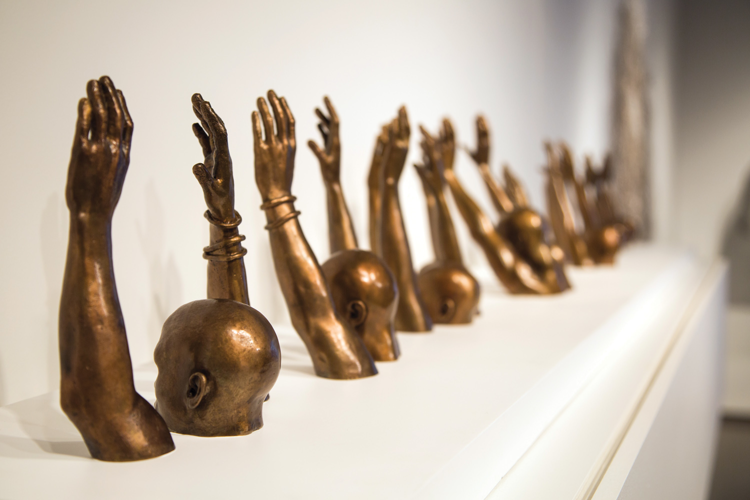


In February, Nashville’s 21c Museum Hotel will take a page from art critic John Berger’s playbook with Seeing Now, a multimedia exhibition that raises big questions. The show riffs on a quote from Berger’s influential 1972 book The Ways of Seeing. “The relation between what we see and what we know is never settled,” Berger wrote. “Each evening we see the sun set. We know that the earth is turning away from it. Yet the knowledge, the explanation, never quite fits the sight.”
If that seems too philosophical, viewers can think in more contemporary terms. How do we make meaning from the barrage of visual cues we absorb, even before we take the first sips of coffee in the morning? It’s like that old dizzying carnival ride, the Rotor — or the slightly more modern Gravitron — which pins both the brave and the stupid to the wall with centrifugal force. We’re seduced by advertisements, even when we know they’re out to manipulate us. The exhibition asks us to consider how our visual perceptions shape our lives and the lives of people around us.
Curator Alice Gray Stites assembled a roster of more than two dozen artists from the U.S. and abroad. Some works go for a literal play on perception. In Norbert Brunner’s “You Are Enchanting” — a light-box piece — the image isn’t clear until the viewer takes a closer look. Other artists address the limits of perception in the age of surveillance, like Spanish conceptual artist Mateo Maté, who merges military camouflage with landscapes.
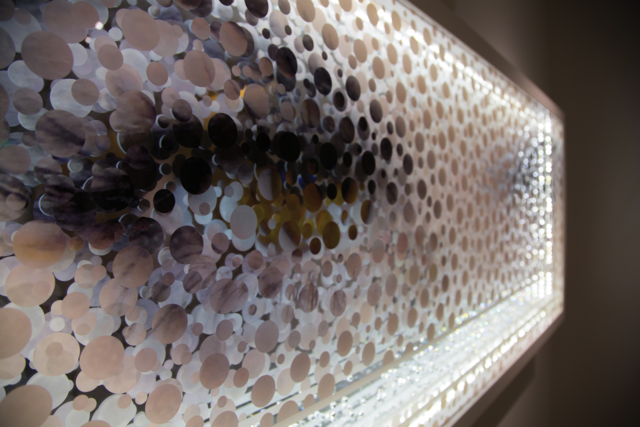
“You Are Enchanting,” Norbert Brunner
The works that engage with issues of injustice may be the most potent pieces in Seeing Now. We’ve all had the experience of watching an event unfold and coming away with a completely different account and perspective than someone else who witnessed the same event. Think, for instance, about the 2014 death of Eric Garner at the hands of the NYPD. How does our perception of that event influence the way we interact with our communities? With our fellow citizens? With local police? And moreover, how does our perception of marginalized people influence the way we vote, shop and behave? Seeing Now will likely prompt self-reflection.
Viewers might recognize Hank Willis Thomas from his work in 30 Americans, a group show that opened at the Frist in 2013. Thomas uses historical representations of people of color to analyze racialized coding. The new exhibition also includes photography by Palestinian/Israeli artist Nidaa Badwan, who documented the tiny bedroom in Gaza where she exiled herself for 100 days to protest the occupation of the Palestinian territories.
The hotel’s spacious gallery, coupled with Stites’ knack for stellar execution, should be a major draw, and 21c’s central location in downtown Nashville will allow it to reach a broad audience — i.e., people who might not typically seek out contemporary art. Seeing Now will function as a relevant and meaningful conversation-starter in a time marked by division. But it bears remembering that issues raised in the exhibition — racism, Islamophobia, environmental destruction, surveillance — are not new.
We don’t need an exhibition like Seeing Now “more than ever.” We’ve needed it all along.
Email arts@nashvillescene.com



