
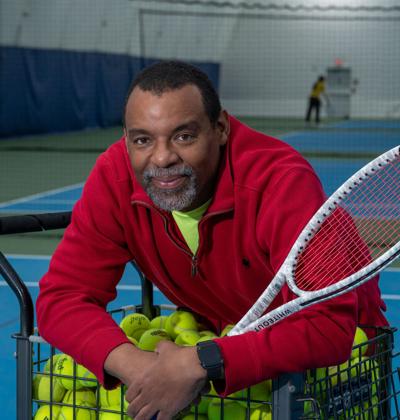


Rodney Williams at Hadley Park Indoor Tennis Facility
“ In my 20s, I would almost say I was addicted to playing tennis,” says Rodney Williams, laughing, on a bench outside Hadley Park Indoor Tennis Facility. “Two or three hours a day, four to six days a week. If you do something enough, you’re gonna be good at it.”
Rodney is a different kind of celebrity in Nashville’s tennis world. He’s earned a mononym and gets name-checked across the city — as in, “I have to go see Rodney,” a colloquialism for being down a racket due to string issues, or simply, “Tell Rodney I said hey.”
Equal parts coach, technician, player and local historian, Williams recently marked 50 years at Hadley Park, where he’s officially employed as a recreation leader by Metro Parks. Williams started teaching lessons 30 years ago, about when he organized his life around taking care of his father, who had suffered a bad stroke. Tennis gradually took over his life. Stints followed coaching tennis at the University School of Nashville and working at a tennis nonprofit.
“ Teaching tennis became like a really easy way to make money, and I had time that I could give to my father,” Williams explains. “My big takeaways from the game: Pay attention to how your feet move; prep your racket as early as possible; don’t try to hit the ball as hard as you can; and then move your opponent around.”
A typical week includes daily lessons, clinics and the administrative work that comes behind Hadley’s sign-in desk. Teams come from Belmont and Tennessee State University to hit, mainly drawn by Hadley’s all-weather bubble. Players set up matches and weekly meetups. Williams credits Joe Goldthreate, a 2020 Black Tennis Hall of Fame inductee, as Hadley’s erstwhile resident coach and the founding force behind the nonprofit that is now the Friends of Hadley Park.
Another draw that has made Williams so popular — his unorthodox love for racket stringing. He describes the cumbersome, frustrating maintenance work as his personal flow state, born from necessity.
“I had taken four rackets out to Nevada Bob’s, an old tennis store on Old Hickory Boulevard, and they told me it would be a week,” Williams remembers. “At that point in time I was playing almost every day, and I needed a racket. So when I got my rackets back, I decided I was gonna learn to string.”
He learned stringing from local Hadley legends Terry Shields and the late Reggie Rouse, names Williams mentions with reverence. Decades ago, he strung courtside out of the back of a pickup truck. Today, stringing is a side gig that benefits scores of players across Nashville who are otherwise looking to save money, time or gas coordinating pickups and dropoffs.
Williams remembers sitting courtside watching his dad, who would play for hours on the weekends. This was sometime in the 1970s — it’s hard to pinpoint exactly when, but he knows where, walking around the back side of the facility. Outside on a warm March morning, Williams dates each court by memory, starting with the tennis center’s enormous central complex.
“Actually, we’re sitting on the first base line of TSU’s baseball field,” Williams says, gesturing across John A. Merritt Boulevard where Tennessee State University’s academic buildings rise up on a hill.
Two single courts predate the 1950s. Two more — possibly clay — came in 1953, if memory serves, says Williams. Then four to replace the baseball and softball diamond, then two more and finally, the fur indoor courts that make Hadley a destination for year-round hitters.
American tennis is currently experiencing a cultural renaissance. In recent seasons, U.S. fans have cheered No. 25 Emma Navarro, No. 18 Iva Jovic, No. 6 Amanda Anisimova and No. 5 Jessica Pegula — but none more than world No. 4 Coco Gauff, a Wimbledon and U.S. Open champion and the only currently competing American with a major tournament win. Two American men — Taylor Fritz and Ben Shelton — have comfortably made their way into the world’s top 10, while four more sit in the top 30. A simultaneous pickleball boom — “It’s fun, but not as fun as tennis,” says Williams — has sharply increased demand for courts and brought more attention to racket sports generally.
Tennis’s distance-friendly structure also led to a COVID-era playing resurgence, while pop culture has glamorized the sport with celebrity cachet and the 2024 blockbuster Challengers. Wealth still dominates, but tennis — once considered a country club game — has gradually been democratized, thanks to public facilities like Hadley.
“Everybody came out here to play — Black, white, doesn’t matter,” says Williams. “I grew up out here and got to play with people who I knew didn’t have two pennies to rub together, and at the same time, lots of guys had lots of money. There was a state Supreme Court justice who played tennis out here. There may be differences, but people stand across the court from each other, and the only thing that matters is who can make the ball bounce twice first. This is just a cool place to play tennis.”

Profiling some of Nashville’s most interesting people, from a Paralympic gold medalist and a longtime horror host to a 'Drag Race' alumna and more



Post a comment as anonymous
Report
Watch this discussion.
(0) comments
Welcome to the discussion.
Log In
Welcome to the discussion.
Keep it clean. Please avoid obscene, vulgar, lewd, racist or otherwise abusive language. Comments featuring hate speech or threatening or violent content will not be tolerated.
PLEASE TURN OFF YOUR CAPS LOCK.
Be truthful. Don't knowingly lie or mislead.
Be proactive. Use the “report” link on any comment that violates our comment policy.
Share with us. We'd love to hear your feedback.