


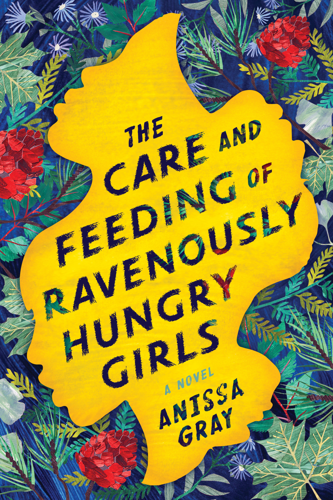


Anissa Gray’s debut novel, The Care and Feeding of Ravenously Hungry Girls, opens in a Michigan jail, where Althea Butler-Cochran is locked up. Her teenage daughters are staying with her youngest sister, Lillian, and the middle sister, Viola, is on her way home from Chicago for the trial. Though it has a gripping plot, Care and Feeding is, more than anything, a character study. The sisters’ mother died when they were kids, and with their father mostly absent, Althea was burdened with the responsibility of her siblings’ care. Locked in the routines of adulthood, they have managed to avoid confronting the trauma they experienced as children. But Althea’s crime turns their world inside-out.
Using a rotating point of view, Gray plots her novel deliberately, revealing the details of the case — and of the Butler sisters’ past — piece by piece. An Emmy Award-winning journalist, Gray writes prose that is is compact, specific and honest — there may not be a wasted word in the book. The resulting journey is surprisingly moving, and it eventually lands in a wholly unexpected place. Gray answered questions by email.
It seems the novel sets out to answer the question “Am I my sister’s keeper?” What about sibling relationships drew you to explore this classic — but complex — dilemma?
I have four siblings — one brother and three sisters — so I have a lived understanding of the complexity of sibling dynamics. The relationships we have with our brothers and sisters can be some of the longest in our lives, and those relationships can sometimes swing between fierce rivalry and undying devotion. I was interested in exploring what happens to a family when a major life challenge forces everyone to stop and see who they’ve been to one another — and who they want to become.
You go very far back into this family’s history. Did you plan to explore their past from the beginning, or did you discover it as you tackled the present action of the story?
I did not plan to explore much family history at all. The Care and Feeding of Ravenously Hungry Girls was initially intended to be a story about just one of the characters, Viola, and her experience working as a therapist in an eating disorders clinic. It was based on some of my own experiences in treatment. But I found the narrative to be too narrow in scope. So I took a closer look at the other people in Viola’s life. It was when I started viewing her through the lens of family that I could see there was a richer, much broader story to be told about family, loss and the many ways we try to fill those hollow spaces.
The novel’s first-person point of view rotates through the sisters. Whose was the most fun to write?
I can’t say that any of the sisters were necessarily fun to write — they all carry some heavy emotional baggage. However, the youngest sister, Lillian, was perhaps the most satisfying to write. Without revealing any spoilers, I can say that Lillian suffered terrible abuse and neglect. And while she doesn’t have what I would call a happy ending, she does have a hopeful one.
Althea is inscrutable for much of the book. Was she to you? Did it take you a while to crack her open?
It did take quite some time to get to know Althea. She was, in fact, the most difficult character to write. There was a kind of peeling back of layers with Althea, and I tried to re-create that on the page for readers.
The book’s minor characters ended up having a lot more weight than I expected, teaching the sisters — and reader — a lot about grace and forgiveness. Without giving too much away, can you talk about the role of ancillary characters in pulling out major themes in the novel?
Even with ancillary characters, my goal is to make them believable and accessible. I think the character Mercedes is a good example of that. She’s Althea’s best friend in jail, but she’s much more than a sidekick. She’s a fully formed character with her own story to tell. What I think is most interesting about Mercedes is how she navigates that line between transgressor and savior. Her story speaks quite clearly to questions about forgiveness and grace.
To read an uncut version of this interview — and more local book coverage — please visit Chapter16.org, an online publication of Humanities Tennessee.



