
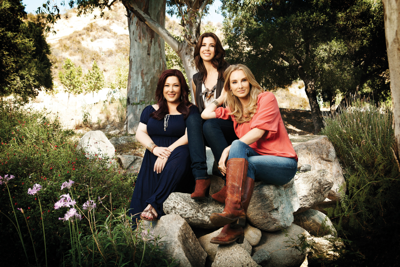


It is possible to dig the music of Wilson Phillips without taking history into account. The trio has made a dazzling array of superb pop songs, all of them finding a way to address complex emotional situations with undeniable grooves and the smoothest of production. They found a way to take the very state of California and turn it into a resonance chamber for soap opera situations, with the end result being FM monsters of soothing catharsis. Without Wilson Phillips, producer Glen Ballard wouldn’t have found his way into the perfect synthesis of sheen and shout that made Alanis Morissette’s Jagged Little Pill a touchstone a few years down the road. You can hear, in the first two Wilson Phillips records, the beginnings of the last great epoch in pop music before grunge shifted the paradigm.
“Hold On” is a marvel. Written for a friend having a rough go in recovery, it has endured, resurfacing in narratives outside of bro, rockist and thoughtless idioms. In both Harold & Kumar Go to White Castle and Bridesmaids, it is a song that rallies the heart and kicks the soul into motion — it is an anthem for protagonists who are going through it, and it becomes a timeless beacon of strength. That’s the most secret weapon in the Wilson Phillips array: In their intricate harmonies, these women have crafted songs that can transform a chicken-shit day into a chicken-salad day. When you listen to a song like “Release Me” or “You’re in Love,” or “You Won’t See Me Cry,” you’re getting nostalgia points (if that aligns with where your nostalgia derives). But you’re also getting the emotions behind a Greek tragedy, with vocal arrangements that work as a fully realized emotional discourse.
Wilson Phillips isn’t just Cali dilly-dallying. These women are the sound of America dealing with the ’70s and ’80s. All of the mellow joys of The Mamas and the Papas and The Beach Boys, they’re still iconic, and they’re still awesome. But what Carnie Wilson and Chynna Phillips and Wendy Wilson have done is take all that establishing baby-boomers-in-the-’60s emotional baggage and addressed what that means for the next generation. In that magical, protean space where Generation X and its instinct for turning chaos and trauma inward held sway, Wilson Phillips took all the subtext of the 1960s — all of that brightly lit “clock that always said 12:30” ideology and how it played out over the next generation — and they made elegant and catchy smooth rock that told the story behind the scenes. And of course they never got the credit they deserved, except for selling millions and millions of records.
Having Wilson Phillips play Nashville as part of Pride this year is an incredible opportunity. People like to joke about the Pride circuit, as if the LGBTQ community is a social safety net for disco divas, rock remembrances and up-and-coming queer artists. But here’s a chance for a community that has been extracting respect to whatever possible extent for officially just under 50 years to blissfully connect — if just for a little while on a Sunday evening — with a genuinely inspiring group of women who fought their way up through patriarchy at its most rockist with exceptional songcraft and harmonies to die for. A radio anthem is like a bellini for the soul and a therapy session, all in three minutes and change. And the legacy is there, one that encompasses a continuum that goes from “Safe in My Garden” to “Roller-Skating Child.”
But damned if what means the most right now, in this world that we’ve got, is the chance to be “Impulsive” and find our own way through.



