


Nashville Women's Ice Hockey
“If you live in Nashville, Tenn., and you’re feeling like you want to support women’s hockey this week, I’m going to give you three free ways you can do it,” Haley Schattschneider says in a February video for the Nashville Women’s Ice Hockey League.
Schattschneider is part of a group of Nashville Women’s Ice Hockey players — alongside Bree Landry, Melissa Raber, Kerry Morris and Hannah Garfinkle — who run the rec league’s social media. They shared calls to support women’s hockey in the wake of the Winter Olympics, after legendary gold-medal victories for the men’s and women’s hockey teams were soured by a sexist joke from President Donald Trump at the women’s expense. The local league’s advocacy has seen viral success: At their spring/summer social at Ford Ice Bellevue, the group described a flood of support and interest, even being recognized “from the internet” by strangers at the NWIHL’s Professional Women’s Hockey League watch parties at East Nashville sports bar Chapstick.

Evolving from a pop-up ‘smut truck,’ Slow Burn fans the flames of the local reader community
The Team USA controversy is part of a recent confluence of events in hockey fan culture that Morris calls “a perfect storm.” Women’s sports have generally been on the rise lately, and the PWHL has seen a particular boom. Originally founded in 2023, the PWHL now sees its teams sell out “takeover games” at Madison Square Garden and TD Garden, the typical homes of the New York Rangers and Boston Bruins. As Schattschneider points out, there’s also an influx of new fans from the romance series Heated Rivalry, which depicts a queer love story between two closeted professional men’s players. All of it has unleashed a wave of interest not just in the game, but in finding affirming spaces within hockey — challenging the misogynistic and homophobic culture that often dominates the sport.
The NWIHL’s expansion has been a long time coming. The league began as a small but dedicated group in the early Aughts, originally forming a single team and eking out one hour of allotted time a week to play at Centennial Sportsplex. In another of the league’s videos, veteran player Teresa “TSpy” Spychalski recalls early efforts to recruit by cold-approaching women skaters at Centennial’s public ice hours. These days, though, NWIHL runs seasons at both Centennial and Bellevue, the latter through a collaboration with the Nashville Predators.
“We went from one team to two different leagues,” marvels Landry, who started playing rec at Centennial after playing roller hockey growing up. The current season at Bellevue has six teams, and almost 90 players — the most the league has seen to date.

Nashville Women's Ice Hockey
“We’ve been trying to build women’s hockey for 26 years,” says Kirsten “Parksy” Parks, a founding member of the league who now plays goalie for the team Parksy’s Angels. Parks, a lesbian and decorated Army veteran, was recently celebrated as the Preds’ Pride Night Hero of the Game after fellow player Liz Homic nominated her. After serving during the “Don’t Ask, Don’t Tell” era and leaving the military due to mistreatment by “good old boy” colleagues, she “bawled [her] eyes out” at the recognition.
“That night, I was seen,” she says.
Feeling seen by one another is a common sentiment in this group. Beer league hockey, with its late games famous for creeping into the wee hours of the morning, is thankless enough on its own. On top of that, many of the NWIHL’s longtime players were used to being the only girls on the ice before joining. Morris and Garfinkle recall isolating memories of changing alone before childhood games, and Parks remembers women getting bullied during games by male rec players.
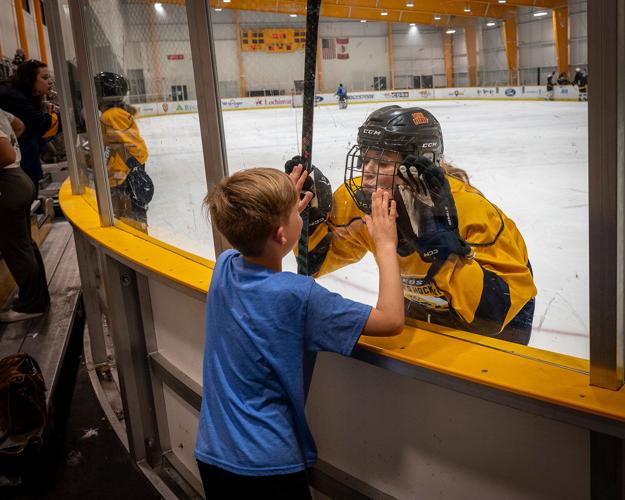
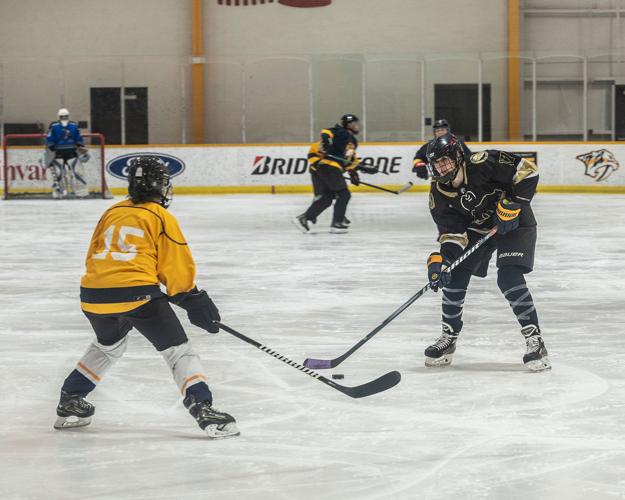
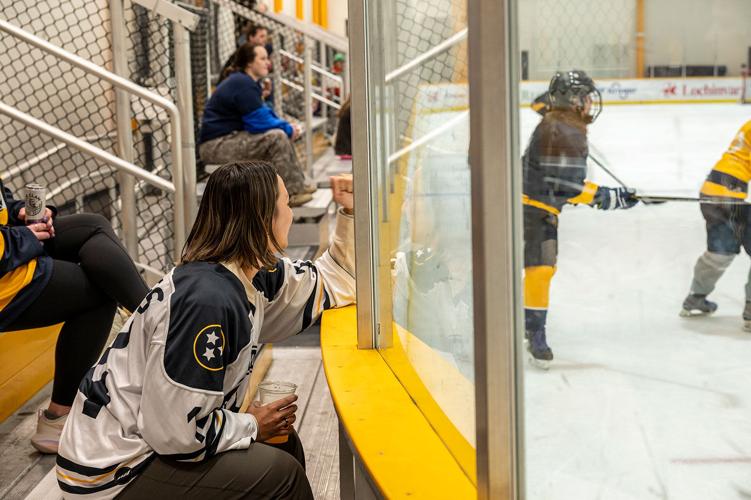
The women’s league has given them a much-needed sense of community, and you can feel it on the ice. Women laugh as they wave at friends and family and pass the puck, their sticks and socks bedecked in hot-pink or the colors of LGBTQ Pride flags. Off-duty players exchange pointers and root from the stands, pounding the boards and calling out nicknames and inside jokes.

Supporters at a Nashville Women's Ice Hockey game
Raber says joining the league is “the first time [she’s] made friends as an adult.” She and Schattschneider didn’t grow up with hockey; instead, they found the sport through Ford Ice Centers’ Learn to Play program. Learn to Play offers 10 weeks of lessons and discounted hockey equipment, which is notoriously expensive. The program began three years ago after the Predators applied for a grant through the NHL’s Industry Growth Fund — a result of a landmark collective-bargaining agreement between the NHL and its players, with a mission of drawing new fans.

Nashville officially eliminated for postseason play after loss to Sharks, L.A.'s win over Seattle
“Growing the game of hockey isn’t just for kids,” says Jennifer Boniecki, director of amateur hockey and fan development for the Nashville Predators and Ford Ice Centers. “It’s growing adult hockey, [and] it’s growing girls’ and women’s hockey.”
In that first year, with support from the grant, the Learn to Play program cost $350 per person. Since then, the program has continued, but with a higher price tag of $1,150 — a barrier for entry that the women’s league is trying to bring down.
“I would say our entire mission is to make [hockey] more accessible,” says Garfinkle. In the wake of its online success, the league has gotten the ball rolling toward attaining nonprofit status, a suggestion from Raber that would potentially create a path to sponsor new players. There’s also been discussions of hosting tournaments and adult hockey camps.
As the league expands, it’s too early to tell how the Preds’ recent takeover of Centennial’s operations will affect women’s hockey there, though Boniecki and some of the players are hopeful that the Centennial league will continue to grow. But Boniecki emphasizes that, ultimately, the heart of the league isn’t the Preds, but the players’ drive — a sentiment that Parks echoes.
“The ones who made this league are the women,” Parks says. “Because they’re the ones who wanted it.”

A four-part look at recreational leagues and high-level clubs



Post a comment as anonymous
Report
Watch this discussion.
(0) comments
Welcome to the discussion.
Log In
Welcome to the discussion.
Keep it clean. Please avoid obscene, vulgar, lewd, racist or otherwise abusive language. Comments featuring hate speech or threatening or violent content will not be tolerated.
PLEASE TURN OFF YOUR CAPS LOCK.
Be truthful. Don't knowingly lie or mislead.
Be proactive. Use the “report” link on any comment that violates our comment policy.
Share with us. We'd love to hear your feedback.