
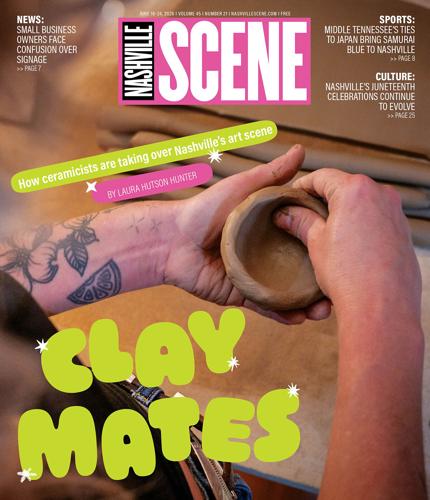

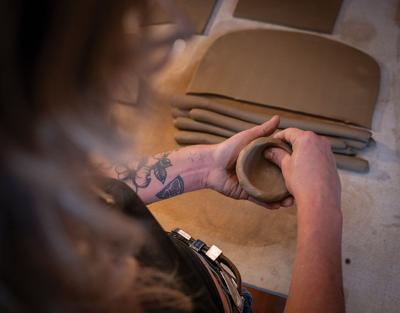
It’s June in Nashville, and it seems like there are ceramics in every gallery.
At Julia Martin Gallery in Wedgewood-Houston, Ash Atterberry has set out a display of ceramic tulips around a grass-green mound. Each tulip can be picked up and placed inside the tiny hole on top of the mound in something like an art-gallery version of planting a flower. The work is called “Pick a Flower, Leave a Flower,” and the first 10 visitors to the gallery will get to keep a tulip.
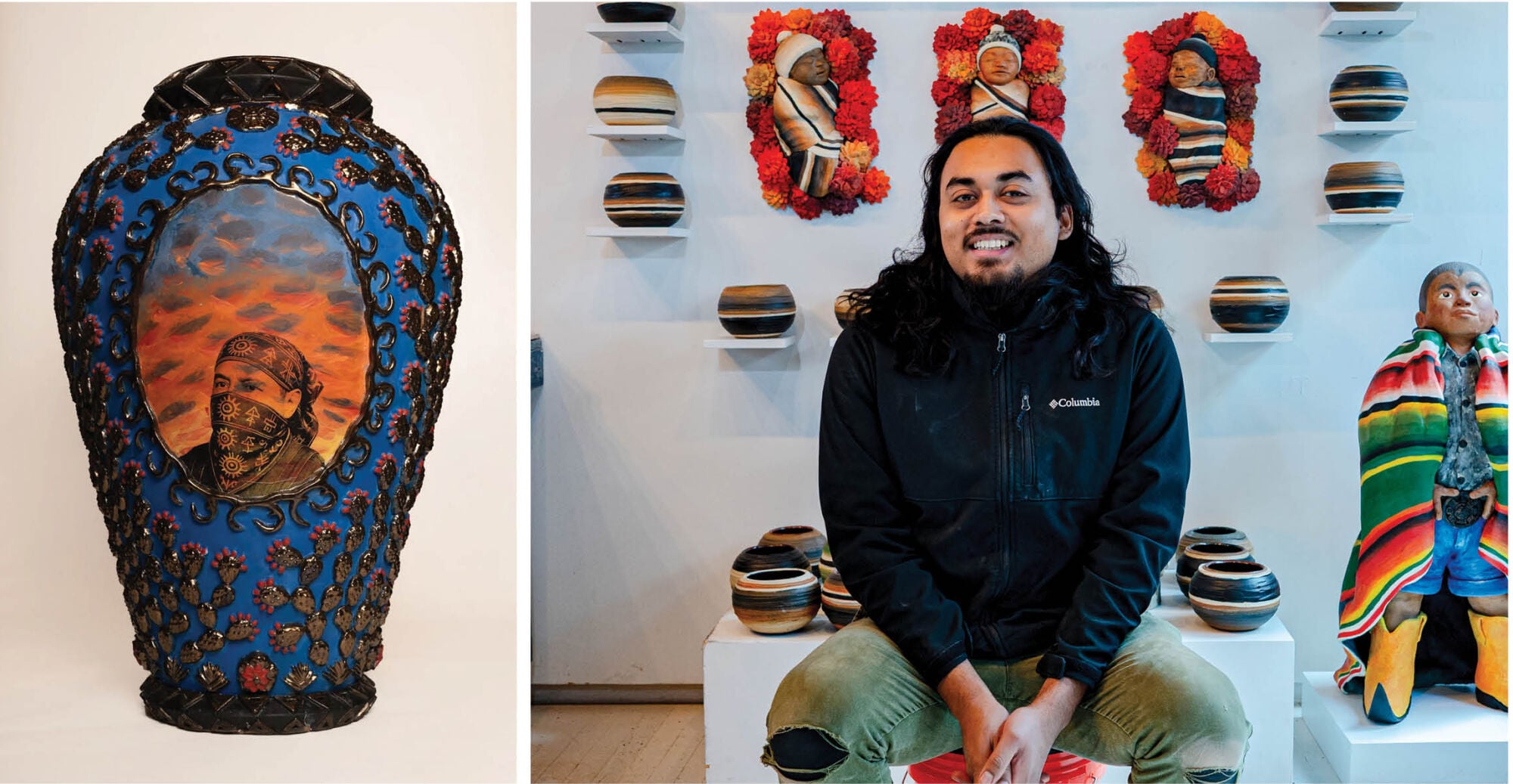
Downtown at Tinney Contemporary, a ceramic vessel from César Pita is given center stage in Hear, Hear! — a group show of work made during the inaugural residency at Arcade Arts. Pita’s ornate piece is installed on a pedestal, and its polished surface shines as radiantly as the mirror-like gallery floors.
A connective spirit runs through the growing cluster of Nashville artists working with clay. Perhaps that’s the reason clay has attracted some of the city’s most compelling artists. But just as important as that connection is the medium’s playful spirit, its outsider status and the ritual involved in making ceramics. The artists we profile here are just a few of the many ceramicists who make up an interconnected web of craftspeople with an outsized influence.
Clay invites experimentation and collaboration. The sense of community among ceramicists runs deep — ritual is embedded in the process, as is an awareness of lineage and the makers who came before. Despite its rich traditions, clay is still often overlooked within the fine arts. But that marginal status might be the medium’s greatest strength, because it’s in the margins where change often begins.

Ash Atterberry
Ash Atterberry
Handwings Ceramics
Ash Atterberry is originally from Illinois, and she left home to study ceramics, moving frequently throughout her 20s. She lived in Arkansas, Seattle and California before moving to Tennessee, where her friend Rebecca Blevins, also a ceramicist, had recently set up shop.
“I’ve always thought of myself as an artist, just with the medium of clay,” Atterberry tells the Scene.
“One thing about ceramics,” she explains, “is that it is harder to do on your own. It definitely is easier with a community, plus it’s more fun with a community. I think that that’s really special about ceramics. I also like drawing and painting and taking photos, and those all kind of exist somewhere within my work. But for me, nothing feels finished until it’s in clay.”
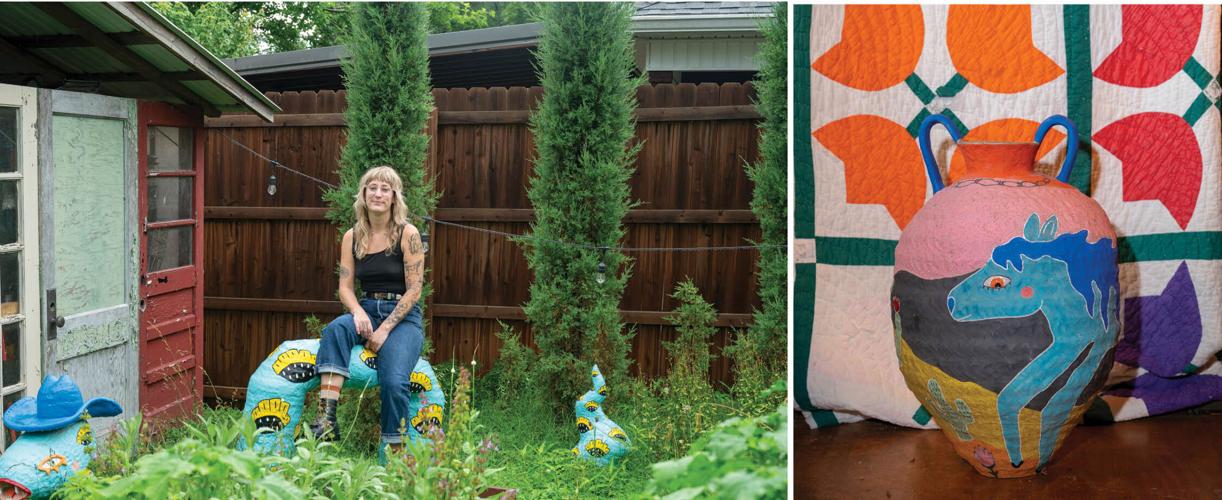
She is inspired by folk art, and the mundane things that people tend to overlook. A ceramic dish called “Smoke Plate” looks like it might be a self-portrait. A blond woman with a cigarette in her mouth is ensconced in a wispy line of smoke that works like a halo.
Atterberry is one of three ceramics artists who have been part of Julia Martin Gallery’s six-month artist residency, and seeing all their work together makes it clear just how ubiquitous ceramics are. Megan Curtin subverts traditional nude sculpture to make vessels that are part Venus of Willendorf and part Bauhaus costume party. In a neighboring room are Brooke Gillon’s moody miniature stoneware vessels “Tear Jar 1” and “Tear Jar 2,” and a massive offering bowl shaped like Medusa’s head.
“The world is so uncomfortable now,” Atterberry says. “It’s so hard to look at the things that are happening around us and just see such horror. When I’m making these things, the feelings I’m having aren’t necessarily sweet and cute and fun, but it’s my way of digesting the world, and looking at the things that bring me comfort, the places I’ve spent time that I think are beautiful.”
“I’ve always felt clownish — I’m just really goofy, and so I think that just kind of naturally comes out. I feel like all the critters have some sort of like humor to them as a comedic relief.”

Harry Kagan
Harry Kagan
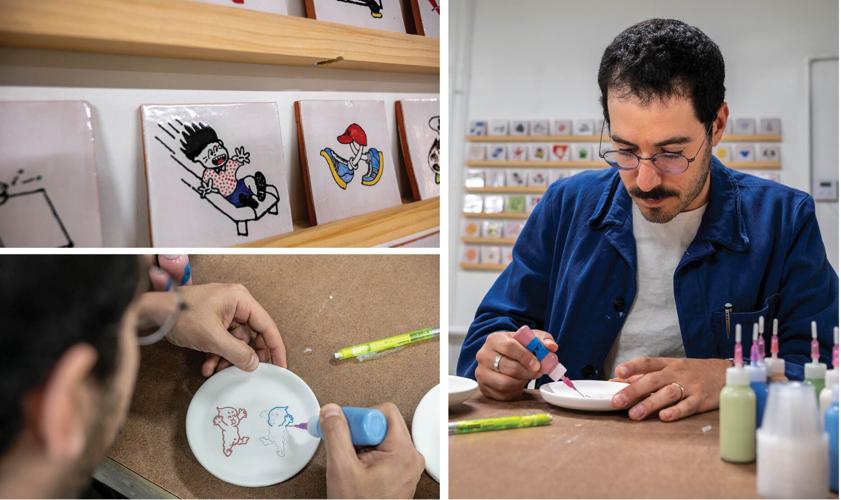
Atterberry’s “Smoke Plate” would fit perfectly in Harry Kagan’s studio. He’s an artist and musician who developed an interest in ceramics relatively recently, after spending time in Mexico visiting his mother-in-law.
“I had kind of fallen out with painting,” he explains. “It wasn’t motivating or inspiring me anymore. But something about the gloss and the elemental aspect of tiles was appealing.”
In the style of traditional Talavera ceramics, Kagan paints his clay tiles with images you might imagine were made along the margins of a composition book. Sometimes the tiles simply contain phrases — “New Age Music” and “Sublime Sun Tattoo” are good examples of Kagan’s tongue-in-cheek style. Making a hyperspecific reference inside something as utilitarian as ceramic tile is inherently funny, but Kagan is remarkably serious about clay.
“It helped me revive my artistic, and even spiritual, practice,” he says, crediting his friend Jess Cheatham, who runs the hugely influential Salt Ceramics, with recently giving him a crash course on how to throw clay on a wheel. “The physical elements that you’re working with — water and earth and air — they’re forcing you to work at their pace. You can’t really cheat.”
This is a common experience among clay artists — there’s a ritual to working with clay that almost every ceramicist connects with. For Kagan, it’s an antidote to living in contemporary times.
“Modern society has made me such an instant-gratification hog,” he says. “It’s a humbling experience to allow yourself to be surprised by how things turn out.”
In an essay about ceramics, legendary art critic Peter Schjeldahl wrote: “Ritual is use plus contemplation.” So while making a ceramic mug is a type of ritual, for example, using that mug for your morning cup of coffee is a ritual as well.
“From an art industry standpoint, it’s a really fulfilling way to offer accessible art objects to people,” Kagan continues. “The utilitarian aspect of pottery and of ceramics is another key to why it’s not given the same sort of artistic attention that painting has. Because it’s like, ‘Oh, well, this is going on my shelf in my kitchen, and I’m using this to drink coffee out of.’ And for me, I’m like, ‘Yeah, isn’t that incredible?’”
César Pita
César Pita
César Pita’s ceramics practice has traveled all across Nashville. He was one of the inaugural artists-in-residence at Arcade Arts, and he worked as a teaching artist at Buchanan Arts. Most recently, he had a yearlong residency at The Forge, which provided him with the space to build large-scale sculptures for restaurant Maíz de la Vida in The Gulch.
This level of infrastructure is vital for ceramics artists who are just starting out.

Pita’s ‘Raíces en Arcilla (Roots in Clay)’ is on view through Dec. 28 at Elephant Gallery
“It’s not like you can just buy an easel and some paints, and set up in the corner of your bedroom,” Pita explains. “You need a well-ventilated space, you need this really expensive equipment. So a shared community is great.”
That connection to community is integral to Pita’s practice.
“I think clay, for me, has a very rich history,” he explains. “It’s something that’s been in the hands of a lot of my Mexican ancestors and a lot of my family, and it’s something that I always choose to use and kind of honor. Using the clay colors as the final finish, instead of putting a gloss and clear glaze over it, and celebrating the different darker skin tones.”
Pita’s work falls into two broad categories — vessels and sculptures. But even Pita’s vessels are sculptural. Take, for example, “Nuestras Manos, Nuestra Tierra,” the piece currently on display at Tinney. It’s a traditionally shaped vessel with a rendering of a man with a bandanna wrapped around his face, surrounded by a flowering cactus motif. This over-the-top treatment is reverent and shows off the artist’s attention to detail. That’s a hard-earned skill, and something Pita wishes more Nashville-based artists would experiment with.
“Artists need to take more risks,” he says. “There’s a correlation between the power of art and the effects that it can have on people in communities. I think about the superhero line: ‘With great power comes great responsibility.’ Art definitely has a lot more to offer than just being cool.
“It is scary to be different — especially in our political climate,” he continues. “But I think playing it safe is a big detriment to anybody’s community.”

LaKesha Lee
LaKesha Lee
Artist and faculty fellow at Watkins College of Art at Belmont University
LaKesha Lee is a multimedia artist with an ebullient personality, and it makes sense that she’s drawn to the communal spirit of ceramics. Although she incorporates multiple disciplines in her practice — including textiles and photography — clay is the medium where she’s currently finding the most resonance.
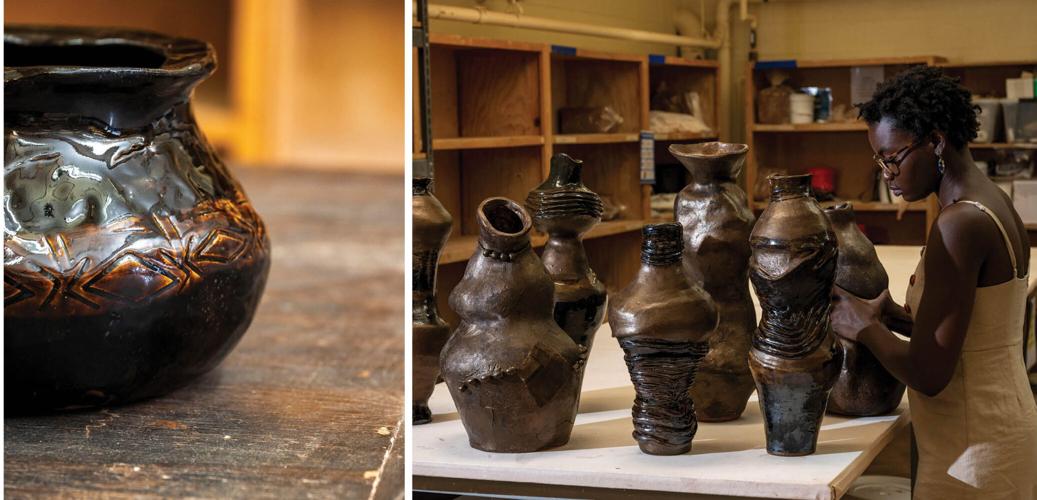
“I started looking into the location where my family came from in Alabama,” Lee explains from her studio at Belmont, “and how my great-grandmother was a field slave up until she was 4 years old. I thought about how my family and my ancestors had been field slaves, and how they died in that soil, and how by creating these vessels, I’m re-creating them into the vessels, as the life that lives within the piece.”
Lee arrived in Nashville almost exactly a year ago — she has been a faculty fellow at Watkins College of Art at Belmont University since 2025 — but she found the ceramics community to be immediately supportive, both inside and outside academia.
“The ceramics community is amazing,” she says. “The support from [Raheleh] Filsoofi at Vanderbilt — amazing. The support from The Clay Lady — amazing. People are very supportive. If you’re in need of help, people show up. They want to see you thrive.”
Her vessels have an undeniable organic quality, and Lee experiments with unconventional finishes to push her practice even further. For her current work, she has used bronze pigments and shoe polish to achieve a deep copper sheen in her clay. The effect is almost bodily, a quality she highlights by adding long seams that work like partially healed wounds.
“When you touch clay, it is so malleable that you’re able to leave fingerprints in it,” she says. “It’s like if someone hits you and they leave a bruise, your body feels that and reacts to that. And so I was also thinking about epidemiology, and the way that our bodies keep the score — if your mother experienced trauma while she was pregnant with you, you will also have that fear or that trauma, because it’s been passed down to you physically into your DNA.

Virginia Griswold
Virginia Griswold
Artist and executive director of Buchanan Arts Center
“Geographically, we’re in the clay belt,” Virginia Griswold explains from the garden outside Buchanan Arts Center, where she acts as executive director. “There’s this really amazing, rich history of using ceramics here to make functional wares, for survival.” She is inspired by historic figures like David Drake — known as Dave the Potter — an enslaved man who wrote his name and verses of poetry into the pots he made, subverting historical ideas of enslaved people as illiterate and potters as unproud.
“Clay is affirming,” she says. “When your finger presses into the material, it reflects that presence. It’s also very forgiving. … And because it’s a humble material, I think folks bring less pressure to the experience of working with it. It really lends itself to a communal atmosphere. It doesn’t have the pressure and the weight of a ‘fine-art’ material, and maybe it doesn’t even have the weight of art history in the same way.”
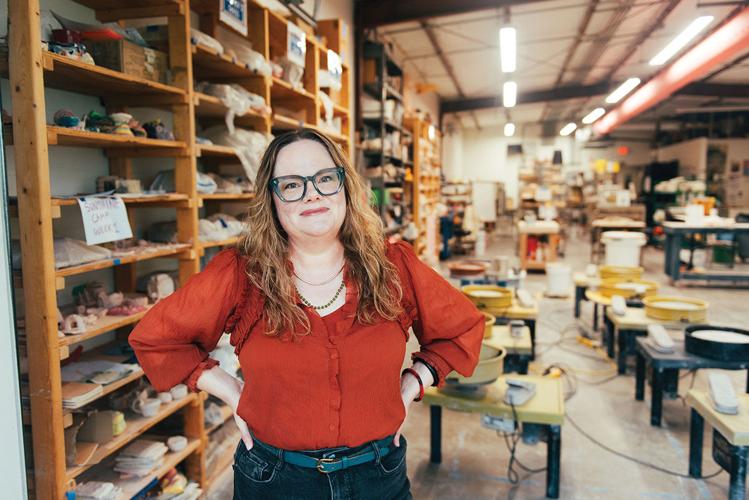
There are ceramics studios throughout Nashville, and many clay artists hop around from place to place. On one stretch of Gallatin Avenue in East Nashville, for example, Nashville Pottery is just a few minutes from Potluck Teahouse. Longtime Nashville ceramicist Danielle McDaniel, better known as The Clay Lady, has a multibuilding campus on Lebanon Pike. Buchanan Arts is in North Nashville, and Griswold is quick to point out the relationship the studio has with the historically Black community in that part of the city. “Clay lends itself well to overcoming barriers,” she explains. “It’s egalitarian in that way.”
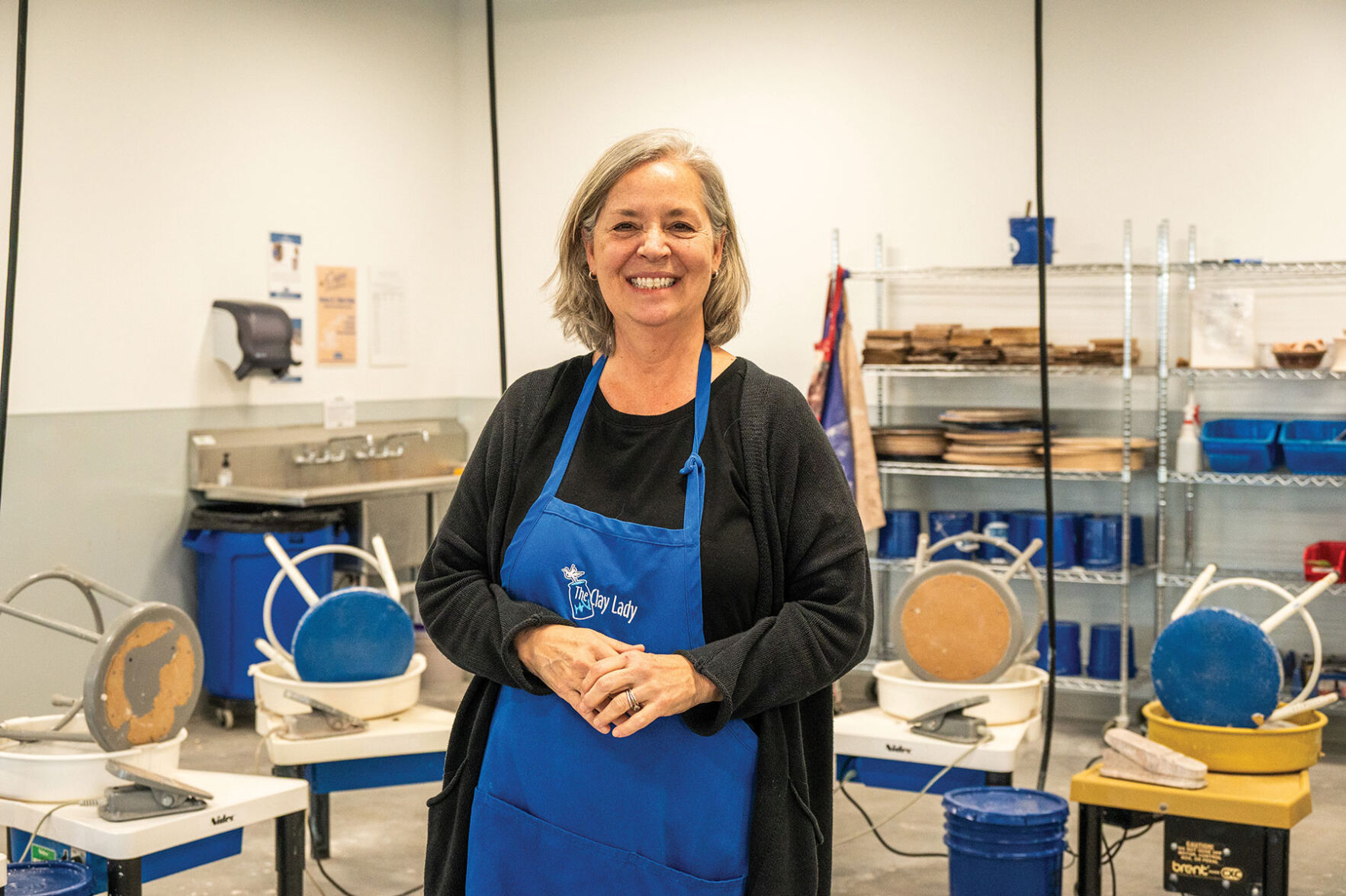
Nashville’s own Clay Lady continues to grow her Lebanon Pike campus
The turn toward ceramics isn’t unique to Nashville, but it has taken hold here in a way that feels distinctly Southern — rooted in a sensibility of authenticity and craftsmanship. Griswold believes it’s something the city should embrace more fully.
“That’s the perennial problem with our city — there’s a lack of support or understanding. Nashville brands itself as this sort of everyman city. You know: humble, Southern, country music. I think these are all the sort of things that align with craft and tradition.”
She wishes support from the government and art patrons would extend out of community appreciation, but laments that the connection isn’t quite there yet.
“But it could be,” Griswold says. “And pretty easily, I think.”

Ash Atterberry



