


By Michael Ray Taylor
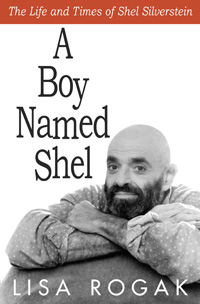
Long before the giving tree gave or the sidewalk ended, a discharged Army cartoonist named Shel Silverstein walked the streets of Chicago, hungry for work, entertainment and any possible means of avoiding the family bakery business. The year was 1955, and Silverstein carried a portfolio of cartoons that he had drawn for the Pacific edition of Stars and Stripes, depicting the lighter side of military life. As Lisa Rogak explains in A Boy Named Shel, the first biography of the prolific author, artist, songwriter and playwright who died in 1999, Silverstein made two discoveries during those rambles that profoundly changed his life, and ultimately touched the lives of countless Americans.
The first discovery was the modest offices of a startup magazine called Playboy, recently launched by fellow Chicago native and veteran Hugh Hefner. Silverstein and Hef hit it off. The result was a lifetime professional association with the magazine for Silverstein, first as a cartoonist and later as a travel writer and satirist. Silverstein’s freelance work for the magazine would open doors to his ever-expanding creative ambitions time and again over the next four decades. The personal friendship with Hefner also lasted a lifetime, leading Silverstein to live for part of every year in the Playboy mansion, fully embracing the “playboy lifestyle”: the beloved author of children’s books never married, but dated hundreds (perhaps thousands, Rogak suggests) of beautiful, mostly younger women.
Silverstein’s second discovery after his Army hitch would ultimately tie him to Nashville, leading him to spend about as much time here as in the Playboy mansion each year: the Gate of Horn, a Chicago folk club frequented by such struggling young artists as Judy Collins, Joan Baez, George Carlin and Bob Dylan. Silverstein was drawn to the energy of the folk music scene, and later to the beatnik movement that grew from it. Although even Silverstein’s close friends described his singing voice as “sounding like it was being squeezed through gravel and tin cans,” performers in the club appreciated Silverstein’s quick wit. He soon went from providing them with a line here and there to writing complete songs on the spot.
Silverstein, who traveled constantly, almost obsessively, followed music from Chicago to Greenwich Village to Nashville, his circle of musical friends eventually growing to include Johnny Cash, Kris Kristofferson, Waylon Jennings, Willie Nelson and many other country greats. Even as The Giving Tree, published in 1964, began to establish Silverstein’s reputation as a children’s book author, he was penning such hit songs as “The Unicorn,” “A Boy Named Sue,” “Hey Loretta,” “Sylvia’s Mother,” and “The Cover of the Rolling Stone.” Ultimately, he would copyright over 800 songs, often collaborating with other writers and singers in manic sessions that could last for days. At the same time, he never stopped cartooning, drawing for adults in Playboy and for children in a growing body of books. Amid the songs and cartoons, he also wrote dozens of plays, scored a movie for Dustin Hoffman and co-wrote another with David Mamet.
Rogak portrays a man who valued creativity above all else, who would simply walk out of a room (or a city or a relationship) the moment it ceased to excite him creatively. He never lived in one place, but owned cottages, houseboats and apartments in such far-flung places as New York, San Francisco, Key West, Martha’s Vineyard and Nashville. While many of his friends and collaborators eventually became household names, many others continued to toil in relative obscurity. Yet, as Rogak’s interviews prove, celebrities and unknowns alike craved time with Silverstein the way six-year-olds would eventually crave his irreverent poems: they uniformly describe a creative guru who energized everyone in his presence, who would flash with an explosion of brilliance and then vanish in a puff of smoke.
Lisa Rogak’s respect for Silverstein’s prodigious output is understandable: she is something of a book factory herself, with over 40 published titles including novels, cookbooks and books on living with cats. As a result of her bestselling unauthorized biography of Dan Brown, author of The DaVinci Code, Rogak is best known for biographies. Earlier this year she coauthored Barack Obama in His Own Words. While her prose seldom soars, her research is solid, and her subject in Shel is more than flamboyant enough to excite readers in those places where the writing fails to do so. Although he loved to be the center of attention within a small group, Silverstein hated publicity and would shun friends who talked to the press about him. Thus many close associates refused to speak with Rogak. But as much as Silverstein traveled and craved human interaction, he accumulated many friends, and some, like country music star Bobby Bare, were eager to share accounts of time they spent with the writer.
In the end, Silverstein’s life, like his books and songs, comes across as wickedly funny, joyously subversive, yet tinged with melancholy. Silverstein may have been his own model for the circle in his children’s book, The Missing Piece: “It was missing a piece. And it was not happy.”



